
Tell us about financial advice
Tell us whether you pay for financial advice, who provides it and how much you trust it. Your answers are combined with other people's and reported only as totals.
Start the financial advice surveyAbout 5 minutes. No account needed. You can stop at any time.
What financial advice covers
Financial advice ranges from a single conversation about a savings account to a long-term relationship covering every part of a household's money. Common areas include:
- investing for retirement and other goals;
- retirement planning, including when to retire and how to draw income;
- tax planning, such as which accounts to use;
- insurance, including life, disability and critical illness cover;
- debt management and budgeting;
- estate planning, often alongside a lawyer;
- major decisions, such as buying a home, separating or receiving an inheritance.
Some advisers focus on one area, especially investments. Others offer comprehensive financial planning.
Who gives financial advice
People get advice from a mix of professionals and informal sources:
- Bank advisers in branches, who usually recommend the bank's own products.
- Investment advisers at brokerage firms, who can offer a wider range of investments.
- Mutual fund representatives, licensed to sell mutual funds.
- Financial planners, some of whom hold designations such as Certified Financial Planner (CFP) or, in Quebec, are regulated financial planners (Pl. Fin.).
- Insurance advisers, licensed to sell insurance products.
- Accountants and tax professionals, for tax-related questions.
- Robo-advisers, online services that build portfolios using questionnaires and algorithms.
- Family, friends, online forums and social media, which many people use first.
The titles people see are not always clear. In several provinces, the titles "financial planner" and "financial advisor" are now restricted to people with recognized credentials, but rules differ between places.
Example
A new graduate searches online for help and finds people calling themselves advisers, planners, coaches and consultants. Unsure of the difference, they ask their parents' adviser for a referral and check the person's registration on the provincial securities regulator's website before booking a meeting.
How advisers are paid
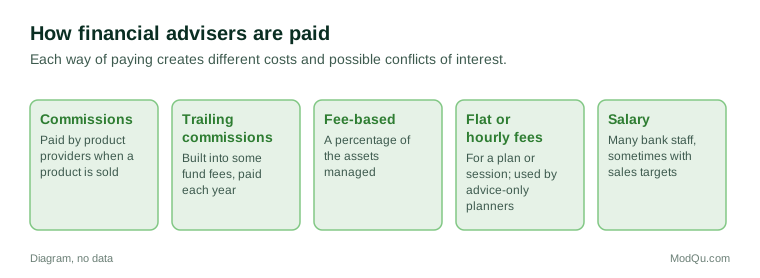
How an adviser is paid affects what advice may cost and where conflicts of interest can arise:
- Commissions paid by product providers when a product is sold.
- Trailing commissions built into some mutual fund fees and paid each year.
- Fee-based accounts, where clients pay a percentage of the assets managed.
- Flat or hourly fees for a financial plan or advice session, used by advice-only planners.
- Salaries, for many bank employees, sometimes with sales targets or bonuses.
Many clients do not know how their adviser is paid or how much they pay in total each year. Regulators have introduced rules requiring firms to report costs and to address conflicts of interest.
Example (hypothetical figures)
An investor has $200,000 in mutual funds with total annual fees of 2%, which is $4,000 a year. A fee-based account at 1.25% would cost $2,500 a year, and an advice-only planner would charge $2,000 for a one-time plan. The investor had never added up the yearly fees before the comparison.
Robo-advisers and online tools
Robo-advisers ask about goals, time horizon and risk tolerance, then invest in a portfolio, usually of exchange-traded funds, and rebalance it automatically. They usually charge lower fees than traditional advisers and have low minimum investments. Some offer access to human advisers by phone or video.
People who choose robo-advisers often value low cost and simplicity. People who avoid them often want a personal relationship, more complex planning, or reassurance during market falls.
What people want from an adviser
When asked what matters most, people commonly mention:
- honesty and acting in their best interests;
- clear explanations without jargon;
- reasonable and transparent costs;
- availability when they have questions;
- understanding their whole situation, not just their investments;
- staying calm and offering perspective when markets fall.
Trust and distrust
Trust in financial advice is mixed. Positive experiences often involve long relationships with one adviser. Negative experiences often involve high fees discovered later, products that were not suitable, pressure to buy, or advisers who changed often. Some people distrust advice in general because they believe advisers are mainly salespeople.
Example
A couple in their fifties have had the same adviser for 20 years. During a sharp market fall, the adviser calls them before they call her, explains what is happening and reminds them of their plan. They say that call is the reason they stayed invested and the reason they would recommend her.
Doing it yourself
Many people manage their own money using online brokerages, books, podcasts and calculators. Self-directed investors often cite cost and control as reasons. Some combine approaches: paying for a one-time plan, then managing investments themselves.
Checking an adviser's background
Regulators provide free tools to check whether someone is registered to sell investments and whether they have a disciplinary history. In Canada, these include the Canadian Securities Administrators' National Registration Search and the Canadian Investment Regulatory Organization's AdvisorReport. Few people know these tools exist, and fewer use them before choosing an adviser.
Questions people ask before choosing an adviser
Consumer groups and regulators suggest asking a few questions at a first meeting. The answers help people compare advisers on more than personality:
- What are you licensed or registered to do, and with which regulator?
- How are you paid, and what will I pay in total each year in dollars?
- Which products can you recommend, and are any of them your firm's own?
- What services are included: a written plan, tax advice, regular reviews?
- How often will we meet, and who do I contact if you are away?
- What happens if I want to move my accounts to another firm?
People who ask these questions say it changes the conversation. Some advisers welcome them; others become vague, which itself tells the client something.
Advice at life turning points
Many people seek advice only at turning points: a first job with a pension plan, a new baby, buying a home, an inheritance, a separation, a job loss or the approach of retirement. These moments involve large decisions that are hard to reverse, such as whether to take a pension as a lump sum or how to divide savings after a separation. Advisers say clients often wish they had asked for help a few years earlier.
Key terms
- Financial plannerA professional who helps clients plan across investing, tax, insurance and retirement.
- CommissionA payment to an adviser from a product provider when a product is sold.
- Trailing commissionAn ongoing yearly payment to an adviser built into some fund fees.
- Fee-based accountAn account where the client pays a percentage of assets each year.
- Advice-only plannerA planner paid directly by the client, not through product sales.
- Conflict of interestA situation where an adviser's pay may influence their recommendations.
- Management expense ratioThe yearly cost of running a fund, shown as a percentage.
- Fiduciary dutyA legal duty to act in the client's best interest.
Full glossary: wealth management terms on EditingTests.com.
Financial advice vocabulary test
How well do you know the language of this topic? Try 8 quick questions. Your score is shown straight away and is not saved.
What the financial advice survey asks
This survey is part of ModQu's Money and Banking survey. The financial advice part takes about five minutes and covers:
- Whether you pay for financial advice, and who provides it.
- How your adviser is paid, if you know, and roughly what you pay each year.
- Whether you have used a robo-adviser or manage your own investments.
- What you want most from financial advice.
- How much you trust financial advisers in general and your own adviser in particular.
- What would make you start, stop or change the advice you use.
After that you can choose to continue with other short parts of the Money and Banking survey, such as everyday banking or digital payments and wallets, or stop.
Ready to take part?
Your answers help show what people really think and do. Results are only ever reported as totals; no one can see your individual answers.
Start the surveyQuestions about this survey
Who can take part?
Adults with savings or investments.
Do I have to give my name?
No. You may be asked for your age group, region and similar details so results can be broken down, but not your name. ModQu never asks for passwords, card numbers or account numbers.
How are the results used?
Answers are combined into totals and percentages and published in ModQu reports. Individual answers are never shown.
Is the vocabulary test part of the survey?
No. It is optional and separate, and your score is not stored.