
The Generation of Knowledge · Trust, quality and the future
Trust in Knowledge: Expertise, Authority and Credibility
Why most of what anyone knows rests on trust in others, how non-experts can judge experts, what makes a source credible, why trust in expertise divides along group lines, and how producers of knowledge can earn trust that is deserved.
No one can check most of what they know. A person who accepts that smoking causes cancer, that the climate is warming or that a medicine is safe has, in almost every case, not examined the evidence personally. They rely on doctors, scientists, statisticians, journalists and institutions whose work they cannot repeat. The real question is not whether to trust, but whom to trust, how far and on what grounds. This article examines the philosophy and psychology of trust in knowledge, the nature of expertise and authority, and what makes a source of knowledge credible.
Knowledge depends on trust
Hardwig (1985) argued that in a modern society, rational belief very often rests on trust in experts. A layperson who believes a physicist's claim has good reason to do so, even without understanding the evidence, because the physicist is in a position to know. Hardwig went further and showed that even experts depend on each other. In a later paper, Hardwig (1991) described research papers with dozens of authors, none of whom could personally vouch for every part of the work. Each relied on colleagues for measurements, calculations and analyses outside their own speciality. Scientific knowledge, on this view, is produced and held by communities bound together by trust.
The historian Shapin (1994) reached a similar conclusion by studying the early Royal Society in seventeenth-century England. The new experimental science depended on reports of experiments that most members had not witnessed. Whose reports counted as reliable was settled by social conventions, at first strongly tied to the standing and reputation of gentlemen whose word was considered good.
Judging experts without being one
If laypeople must rely on experts, how can they choose between experts who disagree? Goldman (2001) considered this problem directly. A non-expert cannot assess the evidence the way an expert can, but they can still look for indirect signs. Goldman suggested several: the arguments each expert offers and how well they respond to objections; how many other experts agree; the expert's credentials and the evaluations of independent authorities; evidence of bias or conflicts of interest; and, most powerfully, the expert's past record of correct judgements.
Collins and Evans (2007) distinguished between kinds of expertise. Contributory expertise is the ability to do the work of a field: to run the experiments, carry out the analyses or design the studies. Interactional expertise is the ability to talk fluently about a field and understand its debates without practising it. They also warned against treating all opinions as equal. Expertise is real and varies in degree, and some people know far more about a question than others. At the same time, experts' authority is limited to their domain. A distinguished physicist has no special authority on economic policy.
What makes a source credible
Psychologists have studied credibility for more than seventy years. In a classic experiment, Hovland and Weiss (1951) gave people the same message attributed either to a highly credible source or to a less credible one. People initially changed their opinions more when the message came from the trusted source. Credibility was found to rest on two main qualities: expertise, whether the source knows the truth, and trustworthiness, whether the source will tell it.
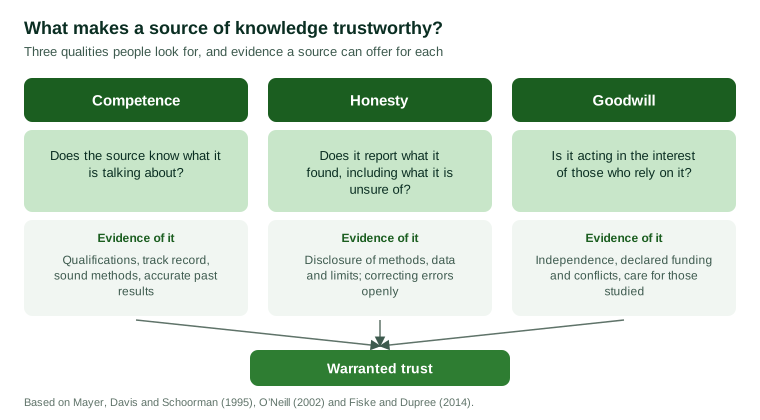
Research on trust in organisations added a third element. Mayer et al. (1995) proposed that trust depends on the perceived ability, benevolence and integrity of the one being trusted. Ability is competence in the relevant domain. Benevolence is a sense that the trusted party cares about the interests of the one who trusts. Integrity is adherence to principles that the truster finds acceptable, such as honesty and fairness. Fiske and Dupree (2014) applied a related framework to scientists. In surveys of the American public, scientists were seen as highly competent but only moderately warm, and that perceived lack of warmth limited how far people trusted them. Hendriks et al. (2015) developed a questionnaire to measure how laypeople judge the trustworthiness of experts they meet online, and found that their judgements fell into the same three dimensions: expertise, integrity and benevolence. Scientists who showed that they shared their audience's concerns, and who talked with people rather than at them, could earn greater trust.
Trusting well, not just trusting more
O'Neill (2002), in her Reith Lectures, argued that public debate often worried about a decline in trust when the real issue was whether trust was well placed. The aim should not be to maximise trust but to place it in those who are trustworthy and withhold it from those who are not. She was critical of attempts to rebuild trust through ever more audit, targets and formal accountability, which she argued could distort the work they were meant to measure. What people need, she suggested, is information they can assess: not just transparency, which can produce floods of material no one reads, but communication that is accessible, intelligible and open to checking.
Oreskes (2019) asked why science, in particular, deserves trust. Her answer was that the reliability of science comes not from any individual scientist or a single method but from its social processes: claims are subjected to critical scrutiny by a diverse community of experts, and conclusions that survive this scrutiny are more likely to be reliable than those of any individual. Trust in science is therefore warranted when that process is working, and it is weakened when the process is distorted, for example by conflicts of interest or a lack of diversity of views.
Why trust divides
Trust in expertise is not distributed evenly. Kahan et al. (2011) asked people whether a scientist with impressive credentials was a genuine expert on issues such as climate change, nuclear waste and gun control. People's judgements depended heavily on whether the scientist's stated view agreed with the position associated with their own cultural group. The same credentials were seen as more impressive when the conclusion was congenial. This pattern, sometimes called cultural cognition, suggests that disagreements about scientific questions often reflect group identity rather than lack of information.
Wynne (1992) studied the relationship between government scientists and sheep farmers in Cumbria after the Chernobyl accident of 1986. The scientists initially predicted that radioactive contamination of upland grazing would pass quickly, and the restrictions on selling sheep would be short. The prediction proved wrong, partly because the scientists had not taken account of local knowledge about soils and farming practices that the farmers possessed. The farmers' trust in official science fell, not because they rejected science in general, but because the experts had shown little respect for what the farmers knew and had expressed more certainty than the evidence supported.
Earning trust in research
Merton (1973) described the norms of science, including organised scepticism, the expectation that all claims be exposed to critical examination before they are accepted. For producers of knowledge, the lesson is that trust is earned by making work open to the kind of checking that could reveal its weaknesses.
For a survey and research organisation, several practices follow:
- Show competence through method. Describe how samples were drawn, how questions were worded and how results were weighted, so that knowledgeable readers can judge the quality of the work.
- Be honest about uncertainty. State margins of error and limitations plainly. Overstated certainty, as the Cumbrian case showed, destroys trust when results prove wrong.
- Separate findings from interests. Disclose who commissioned research and keep the reporting of findings independent of what any client hopes to hear.
- Respect local knowledge. Listen to the people being studied, and treat their understanding of their own circumstances as evidence.
- Build a track record. Compare past estimates with later outcomes and publish the results, since a record of accuracy is the strongest indirect evidence of expertise a non-expert can use (Goldman, 2001).
Conclusion
Trust is not the opposite of knowledge but one of its foundations. Most of what people know they know because they trust others, and even experts depend on the work of colleagues they cannot check. The task is to trust well: to place confidence in sources that are competent, honest and concerned for the interests of those who rely on them. Laypeople can judge experts indirectly through their arguments, agreement among peers, conflicts of interest and track records. Producers of knowledge, for their part, earn deserved trust by opening their methods to scrutiny, stating uncertainty honestly, keeping findings independent of interests and showing respect for the people their knowledge concerns.
References
Collins, H., & Evans, R. (2007). Rethinking expertise. University of Chicago Press.
Fiske, S. T., & Dupree, C. (2014). Gaining trust as well as respect in communicating to motivated audiences about science topics. Proceedings of the National Academy of Sciences, 111(Suppl. 4), 13593–13597. https://doi.org/10.1073/pnas.1317505111
Goldman, A. I. (2001). Experts: Which ones should you trust? Philosophy and Phenomenological Research, 63(1), 85–110. https://doi.org/10.1111/j.1933-1592.2001.tb00093.x
Hardwig, J. (1985). Epistemic dependence. The Journal of Philosophy, 82(7), 335–349. https://doi.org/10.2307/2026523
Hardwig, J. (1991). The role of trust in knowledge. The Journal of Philosophy, 88(12), 693–708. https://doi.org/10.2307/2027007
Hendriks, F., Kienhues, D., & Bromme, R. (2015). Measuring laypeople's trust in experts in a digital age: The Muenster Epistemic Trustworthiness Inventory (METI). PLoS ONE, 10(10), e0139309. https://doi.org/10.1371/journal.pone.0139309
Hovland, C. I., & Weiss, W. (1951). The influence of source credibility on communication effectiveness. Public Opinion Quarterly, 15(4), 635–650. https://doi.org/10.1086/266350
Kahan, D. M., Jenkins-Smith, H., & Braman, D. (2011). Cultural cognition of scientific consensus. Journal of Risk Research, 14(2), 147–174. https://doi.org/10.1080/13669877.2010.511246
Mayer, R. C., Davis, J. H., & Schoorman, F. D. (1995). An integrative model of organizational trust. Academy of Management Review, 20(3), 709–734. https://doi.org/10.5465/amr.1995.9508080335
Merton, R. K. (1973). The sociology of science: Theoretical and empirical investigations. University of Chicago Press.
O'Neill, O. (2002). A question of trust: The BBC Reith Lectures 2002. Cambridge University Press.
Oreskes, N. (2019). Why trust science? Princeton University Press.
Shapin, S. (1994). A social history of truth: Civility and science in seventeenth-century England. University of Chicago Press.
Wynne, B. (1992). Misunderstood misunderstanding: Social identities and public uptake of science. Public Understanding of Science, 1(3), 281–304. https://doi.org/10.1088/0963-6625/1/3/004