
The Generation of Knowledge · Trust, quality and the future
Information Literacy as a Foundation for Knowledge
What information literacy means, how the idea developed from library skills to a framework for critical thinking about sources, what research shows about how people actually evaluate information, the methods that work, and why information literacy matters for anyone who produces or uses research.
Knowledge does not begin with information alone. Between the vast amount of information available and the knowledge a person can rely on lies a set of skills: recognising what one needs to know, finding it, judging whether it can be trusted and using it well. These skills are known as information literacy. In a world where anyone can publish and where false and true claims circulate side by side, information literacy has become a basic condition for knowing anything at all. This article traces how the idea developed, examines what research shows about how people evaluate information in practice, and considers what information literacy means for the producers and users of research.
Origins of the idea
The term was introduced by Zurkowski (1974), the president of the Information Industry Association in the United States, in a paper for the National Commission on Libraries and Information Science. He described information-literate people as those who had learned techniques and skills for using a wide range of information tools and primary sources in solving their problems. He argued that most of the population was not yet information literate and proposed a national programme to achieve universal information literacy within a decade.
The idea was taken up by librarians. A committee of the American Library Association (1989) gave the definition that became standard for many years: to be information literate, a person must be able to recognise when information is needed and have the ability to locate, evaluate and use effectively the needed information. The committee argued that information literacy was a survival skill in the information age and that people who had it had learned how to learn.
Over time, definitions broadened. Bawden (2001) reviewed the many related terms then in use, including computer literacy, library literacy, media literacy, network literacy and digital literacy, and concluded that they overlapped heavily. He argued for an understanding of information literacy that went beyond technical skills to include the critical evaluation of information and an awareness of how information is produced. Webber and Johnston (2000) argued that information literacy should be treated as a discipline in its own right, not merely as a set of library skills, and that it should be taught in ways that helped people understand the information environment in which they lived.
Lloyd (2010) extended the concept beyond formal education. She studied how information literacy works in workplaces and everyday life, for example among firefighters and ambulance officers, and found that much of it is learned through practice and through interaction with colleagues, bodies and physical environments as well as through texts. Information literacy, she argued, is a social practice shaped by the setting in which it is used.
In the United Kingdom, the Chartered Institute of Library and Information Professionals (CILIP, 2018) defined information literacy as the ability to think critically and make balanced judgements about any information we find and use. Its definition emphasised that information literacy applies in everyday life, at work, in education, in health and in citizenship, and that it empowers people to reach and express informed views and to engage fully with society.
From standards to a framework
For many years, higher education in the United States used a set of standards that listed skills students should master, such as defining a research question, searching databases and citing sources. In 2015, the Association of College and Research Libraries replaced these standards with a Framework for Information Literacy for Higher Education (Association of College and Research Libraries, 2015). The framework defines information literacy as the set of integrated abilities encompassing the reflective discovery of information, the understanding of how information is produced and valued, and the use of information in creating new knowledge and participating ethically in communities of learning.
Rather than listing skills, the framework is organised around six frames, each a core idea about the nature of information that learners need to grasp. Together they shift the emphasis from finding information to understanding where it comes from, how it gains authority and how it fits into continuing conversations.
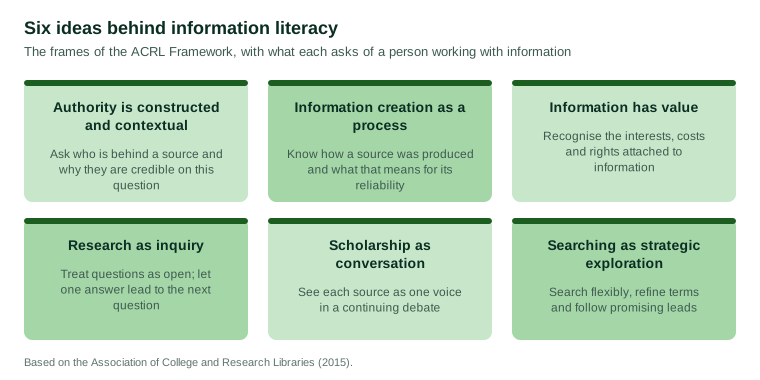
The first frame, authority is constructed and contextual, holds that the credibility of a source depends on the expertise of its author and on the context in which it is used. A medical researcher is an authority on clinical trials but not necessarily on economics. The second, information creation as a process, holds that the way information is produced, whether as a peer-reviewed article, a news report, a blog post or a survey release, affects how it should be used. The remaining frames emphasise that information has economic and social value, that research is a process of inquiry in which answers raise new questions, that scholarship is a continuing conversation among many voices, and that searching is a strategic, iterative activity rather than a single query.
The search process
Information seeking is not only a cognitive task. Kuhlthau (2004) studied students and other people engaged in research projects and identified a series of stages in the information search process: initiation, selection, exploration, formulation, collection and presentation. At each stage, people experienced characteristic feelings as well as thoughts. Uncertainty and anxiety typically increased during exploration, when people encountered information that was inconsistent or did not fit what they expected, and decreased once they had formulated a focused perspective on their topic. Kuhlthau argued that this uncertainty is a normal part of learning, and that people who are helped to understand it are better able to persist through it.
This finding has practical importance. People who expect searching to be quick and simple may stop at the first plausible answer. Those who understand that confusion is part of the process are more likely to keep looking until they have a clearer view of the question.
How people actually evaluate information
Research on how people judge the credibility of information shows a gap between what they are taught to do and what they actually do. Metzger (2007) reviewed studies of credibility evaluation on the web and found that people rarely carried out the thorough checks recommended by educators, such as verifying the author's credentials or checking whether information was current. They relied instead on quicker cues, such as the design of a website. Metzger et al. (2010) found from focus groups that people used a set of heuristics, or mental shortcuts, to judge credibility: whether a source was familiar or recommended by others, whether information was consistent across several sites, whether it violated their expectations, and whether it seemed to have a persuasive intent. Such shortcuts are efficient but can be misleading.
Studies of students have repeatedly found weak skills. Head and Eisenberg (2010) surveyed more than 8,000 college students in the United States and found that most relied heavily on a small set of familiar sources, such as course readings and search engines, and had difficulty beginning research and narrowing topics. Gross and Latham (2012) tested first-year college students and found that those with below-proficient information literacy skills tended to overestimate their abilities. This pattern mirrors the finding of Kruger and Dunning (1999) that people who perform poorly in a domain often lack the very skills needed to recognise their own mistakes.
McGrew et al. (2018) designed assessments of what they called civic online reasoning, the ability to judge the credibility of social and political information online. Students from middle school to university often failed to distinguish news stories from sponsored content, accepted claims from sources with obvious interests, and did not investigate who was behind a website. A later national study of more than 3,000 high school students in the United States reached similar conclusions (Breakstone et al., 2021). Large international assessments have found comparable gaps. The OECD (2021) reported that, across OECD countries taking part in the 2018 Programme for International Student Assessment, fewer than one in ten 15-year-olds reached the level of reading proficiency at which students can reliably distinguish between fact and opinion.
What the experts do
If many people evaluate information poorly, what do skilled evaluators do differently? Wineburg and McGrew (2019) compared three groups as they evaluated websites: professional fact-checkers, historians with doctoral degrees and undergraduate students at Stanford University. The fact-checkers were the fastest and most accurate. The key difference was in how they read. Historians and students tended to read vertically, examining a website carefully from top to bottom and judging it by its own appearance and content. Fact-checkers read laterally: they quickly left the site and opened new browser tabs to see what other sources said about the organisation or author behind it. By reading less of the site and more about it, they learned more about its reliability.
Caulfield (2017) turned these findings into a practical method for students, later summarised as four moves: stop before reacting or sharing; investigate the source; find better coverage from trusted sources; and trace claims, quotes and media to their original context. The method is deliberately simple, because the goal is to help people make quick but sound judgements in the few seconds they typically spend on a piece of information.
Does teaching information literacy help?
Evidence suggests that information literacy can be taught and that it makes a difference. Jones-Jang et al. (2021) surveyed adults in the United States and measured several kinds of literacy. Information literacy, the ability to find, evaluate and use information, significantly increased the likelihood that people correctly identified fake news stories. Media literacy, news literacy and digital literacy, measured separately, did not have the same effect. Guess et al. (2020) tested a short set of tips for spotting false news, modelled on guidance published by Facebook, among large samples in the United States and India. The tips improved people's ability to distinguish mainstream from false headlines, and in the United States the effect could still be detected several weeks later. The effects were modest, but the intervention was cheap and could be delivered at scale.
Statistical literacy
A particular form of information literacy concerns numbers. Gal (2002) defined statistical literacy as the ability to interpret and critically evaluate statistical information and data-based arguments, and to discuss or communicate one's reactions to them. He argued that it requires knowledge of basic statistical ideas, mathematical skills, knowledge of the context, the ability to ask critical questions, and a critical stance towards claims based on data.
Gigerenzer et al. (2007) showed that even doctors often misunderstand basic health statistics. Many could not correctly interpret the result of a screening test, because they confused the sensitivity of a test with the probability that a person who tested positive actually had the disease. The authors argued that much of this confusion could be removed by presenting statistics in clearer forms, such as natural frequencies (for example, "8 out of 1,000 women") rather than conditional probabilities. Statistical literacy, in other words, depends both on the skills of the audience and on how the producers of statistics present their findings.
Information literacy and survey research
For the producers and users of survey research, information literacy matters in two directions.
Users of research need to be able to evaluate survey findings. They should ask who conducted a survey and who paid for it, how the sample was drawn and how large it was, how questions were worded, how results were weighted, and what the margins of error are. A survey with a self-selected sample of website visitors, however large, does not support the same conclusions as a carefully designed probability or well-weighted panel sample. Information-literate users recognise these differences and adjust their confidence accordingly.
Producers of research, for their part, can make the evaluation of their work easier. Following the second frame of the ACRL framework, they can make the process by which their findings were created visible: publishing methods, questionnaires and weighting procedures alongside results. Following Gigerenzer et al. (2007), they can present numbers in forms that audiences understand. And following the findings on lateral reading, they can make it easy for readers to find independent information about who they are, how they are funded and how their past work has been judged.
Information literacy also matters inside research organisations. Analysts must judge the quality of the secondary sources, official statistics and earlier studies on which they build, and they face the same temptations as anyone else: to accept a convenient figure without tracing it to its origin, or to rely on a familiar source without asking whether it fits the question. Lloyd (2010) showed that much information literacy in workplaces is learned from colleagues. Organisations can build it deliberately by expecting staff to trace key figures to their original sources, to record where each number in a report came from, and to review one another's use of evidence before findings are released.
Conclusion
Information literacy began as a set of library skills and has grown into a broader understanding of how information is produced, how it gains authority and how it should be judged. Research shows that many people, including well-educated students, evaluate information through quick and often misleading shortcuts, and tend to overestimate their skills. Skilled evaluators read laterally, checking what others say about a source rather than judging it by its appearance. Information literacy can be taught, and it improves people's ability to tell reliable from unreliable information. Because knowledge in a complex society depends on the ability of many people to find, judge and use information well, information literacy is not a specialist skill but a foundation for shared knowledge. Those who produce research share responsibility for it, by making their methods visible and their findings understandable.
References
American Library Association. (1989). Presidential Committee on Information Literacy: Final report. American Library Association.
Association of College and Research Libraries. (2015). Framework for information literacy for higher education. American Library Association.
Bawden, D. (2001). Information and digital literacies: A review of concepts. Journal of Documentation, 57(2), 218–259. https://doi.org/10.1108/EUM0000000007083
Breakstone, J., Smith, M., Wineburg, S., Rapaport, A., Carle, J., Garland, M., & Saavedra, A. (2021). Students' civic online reasoning: A national portrait. Educational Researcher, 50(8), 505–515. https://doi.org/10.3102/0013189X211017495
Caulfield, M. (2017). Web literacy for student fact-checkers. Pressbooks.
CILIP. (2018). CILIP definition of information literacy 2018. Chartered Institute of Library and Information Professionals.
Gal, I. (2002). Adults' statistical literacy: Meanings, components, responsibilities. International Statistical Review, 70(1), 1–25. https://doi.org/10.1111/j.1751-5823.2002.tb00336.x
Gigerenzer, G., Gaissmaier, W., Kurz-Milcke, E., Schwartz, L. M., & Woloshin, S. (2007). Helping doctors and patients make sense of health statistics. Psychological Science in the Public Interest, 8(2), 53–96. https://doi.org/10.1111/j.1539-6053.2008.00033.x
Gross, M., & Latham, D. (2012). What's skill got to do with it?: Information literacy skills and self-views of ability among first-year college students. Journal of the American Society for Information Science and Technology, 63(3), 574–583. https://doi.org/10.1002/asi.21681
Guess, A. M., Lerner, M., Lyons, B., Montgomery, J. M., Nyhan, B., Reifler, J., & Sircar, N. (2020). A digital media literacy intervention increases discernment between mainstream and false news in the United States and India. Proceedings of the National Academy of Sciences, 117(27), 15536–15545. https://doi.org/10.1073/pnas.1920498117
Head, A. J., & Eisenberg, M. B. (2010). Truth be told: How college students evaluate and use information in the digital age (Project Information Literacy Progress Report). University of Washington Information School.
Jones-Jang, S. M., Mortensen, T., & Liu, J. (2021). Does media literacy help identification of fake news? Information literacy helps, but other literacies don't. American Behavioral Scientist, 65(2), 371–388. https://doi.org/10.1177/0002764219869406
Kruger, J., & Dunning, D. (1999). Unskilled and unaware of it: How difficulties in recognizing one's own incompetence lead to inflated self-assessments. Journal of Personality and Social Psychology, 77(6), 1121–1134. https://doi.org/10.1037/0022-3514.77.6.1121
Kuhlthau, C. C. (2004). Seeking meaning: A process approach to library and information services (2nd ed.). Libraries Unlimited.
Lloyd, A. (2010). Information literacy landscapes: Information literacy in education, workplace and everyday contexts. Chandos Publishing.
McGrew, S., Breakstone, J., Ortega, T., Smith, M., & Wineburg, S. (2018). Can students evaluate online sources? Learning from assessments of civic online reasoning. Theory & Research in Social Education, 46(2), 165–193. https://doi.org/10.1080/00933104.2017.1416320
Metzger, M. J. (2007). Making sense of credibility on the Web: Models for evaluating online information and recommendations for future research. Journal of the American Society for Information Science and Technology, 58(13), 2078–2091. https://doi.org/10.1002/asi.20672
Metzger, M. J., Flanagin, A. J., & Medders, R. B. (2010). Social and heuristic approaches to credibility evaluation online. Journal of Communication, 60(3), 413–439. https://doi.org/10.1111/j.1460-2466.2010.01488.x
OECD. (2021). 21st-century readers: Developing literacy skills in a digital world. OECD Publishing. https://doi.org/10.1787/a83d84cb-en
Webber, S., & Johnston, B. (2000). Conceptions of information literacy: New perspectives and implications. Journal of Information Science, 26(6), 381–397. https://doi.org/10.1177/016555150002600602
Wineburg, S., & McGrew, S. (2019). Lateral reading and the nature of expertise: Reading less and learning more when evaluating digital information. Teachers College Record, 121(11), 1–40. https://doi.org/10.1177/016146811912101102
Zurkowski, P. G. (1974). The information service environment relationships and priorities (Related Paper No. 5). National Commission on Libraries and Information Science.