
Share your experience of bank fees
Tell us what you pay your bank, whether you have switched, and what would make you move. Your answers are combined with other people's and reported only as totals.
Start the bank fees and switching banks surveyAbout 5 minutes. No account needed. You can stop at any time.
The fees banks charge
Banks earn money in two main ways: the gap between the interest they pay on deposits and the interest they charge on loans, and the fees they charge for services. For everyday accounts, the fees people most often meet include:
- Monthly account fees, sometimes waived if a minimum balance is kept or pay is deposited.
- Transaction fees when a monthly limit on payments or withdrawals is passed.
- ATM fees for using another bank's machine, sometimes charged by both banks.
- Overdraft and returned-payment fees when there is not enough money in the account.
- Foreign transaction fees on card purchases in another currency.
- Transfer fees, especially for international and same-day transfers.
- Paper statement and cheque fees in some countries.
- Card replacement and account closing fees, less common but still found.
Fee levels and the range of fees vary widely between countries. In some places, free basic accounts are common or required by law; in others, monthly fees are normal.
Working out what an account really costs
Many people do not know how much they pay their bank each year. Fees are taken in small amounts on different dates, and some, such as the margin built into an exchange rate, do not appear as a separate line at all.
Example (hypothetical figures)
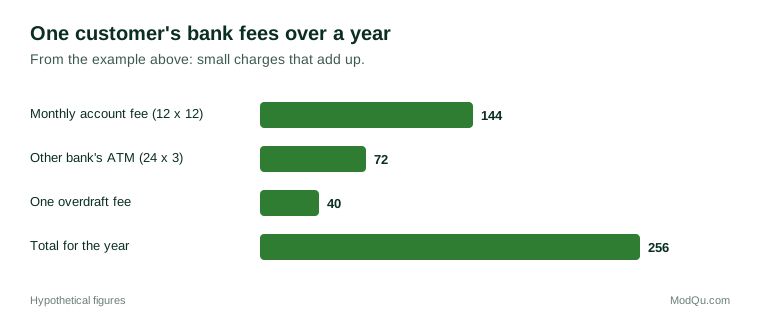
A customer pays a monthly account fee of 12, uses another bank's ATM twice a month at 3 each, and is charged one overdraft fee of 40 during the year. Over twelve months that comes to 144 in account fees, 72 in ATM fees and 40 in overdraft fees: 256 in total.
The figure below shows how the yearly total in that example builds up.
A simple way to see the real cost is to add up every fee on twelve months of statements. Some countries require banks to send a yearly fee summary or to show fees in a standard format so that accounts can be compared.
Why most people stay with their bank
Switching a main bank account is less common than switching phone or energy providers. People give several reasons:
- Hassle: pay, benefits, bills and automatic payments all need to be moved.
- Fear of mistakes: a missed rent or mortgage payment during the move.
- Other products: a mortgage, loan or credit card at the same bank.
- Habit and trust: the feeling that all banks are much the same.
- Low awareness: not knowing how much is being paid in fees.
This means a bank can raise fees or offer weaker service without losing many customers, which is one reason governments in some countries have tried to make switching easier.
Example
A family has banked with the same bank for twenty years. They know their account fee has gone up, but their mortgage, two children's accounts and about a dozen automatic payments are all there. They decide the fee is not worth the effort of moving, but they ask the bank to put them on a cheaper package, and it agrees.
How switching works
The process differs by country. In some, a formal switching service moves payments and transfers the balance for the customer within a set number of days and redirects any payments sent to the old account. In others, the customer must do each step themselves.
A do-it-yourself switch usually involves:
- opening the new account and getting the new account details;
- giving the new details to the employer or benefits office;
- moving each automatic payment and standing order;
- updating cards saved with online shops and subscriptions;
- leaving some money in the old account until all payments have moved;
- closing the old account once nothing more goes through it.
What attracts people to a new bank
When people do switch, the reasons tend to be:
- a lower or zero monthly fee;
- a cash bonus or other reward for switching;
- a better mobile app, or a bank that is fully online;
- better customer service after a bad experience;
- a better mortgage or savings rate;
- moving house or country, which makes a nearby branch matter.
Some people do not switch fully but open a second account, for example an online account for savings or travel, while keeping the old account for bills.
Example
A young worker opens an app-only account to get a fee-free card for travel and better notifications. Over a year, they find they use it for almost everything. They move their pay to it and keep their old account open only for one direct debit.
Fair fees and the rules around them
In several countries, regulators have looked at overdraft and returned-payment fees in particular, because they fall most heavily on people with little money. Measures have included caps on fees, rules that a customer must agree to overdraft cover, warnings before a fee is charged, and grace periods to add money.
Some countries also require banks to offer a basic or low-cost account to anyone who needs one, so that people with low incomes or poor credit can still receive pay and pay bills.
Fees for small businesses and older customers
Two groups often face different fee patterns. Small business accounts usually carry higher fees than personal accounts, including charges for cash deposits, card terminals and each payment made. Older customers, meanwhile, may still write cheques, ask for paper statements and visit branches, which can bring fees that app users never see. Some banks offer reduced-fee packages for seniors, students or people on benefits, but customers often need to ask for them.
What people disagree about
Some people see bank fees as a fair price for a service that costs money to run, and point out that branches, fraud protection and payment systems are expensive. Others argue that fees punish people who can least afford them and that profitable banks should offer free basic banking. Opinion also differs on whether bonuses for switching are good for customers or simply encourage short-term moves.
Questions that businesses want answered include which fees people pay and notice, how much they think they pay, how satisfied they are, whether they have switched or opened a second account, and what offer would make them move.
Key terms
- Monthly account feeA regular charge for having an account.
- Minimum balance waiverNo monthly fee in months when the balance stays above a set amount.
- Overdraft feeA charge for spending past a zero balance.
- Returned-payment feeA charge when a payment fails because there is not enough money.
- Foreign transaction feeA charge on card payments made in another currency.
- Account switching serviceA process that moves payments and balances from one bank to another.
- Standing orderA regular fixed payment the customer sets up from their account.
- Basic bank accountA simple low-cost account designed so that everyone can bank.
Full glossary: retail banking terms on EditingTests.com.
Bank fees and switching banks vocabulary test
How well do you know the language of this topic? Try 8 quick questions. Your score is shown straight away and is not saved.
What the bank fees and switching banks survey asks
This survey is part of ModQu's Money and Banking survey. The bank fees and switching banks part takes about five minutes and covers:
- Which fees you paid your bank in the last year, and roughly how much.
- How much you think your main account costs each year.
- How satisfied you are with what you get for your fees.
- Whether you have switched your main bank or opened a second account, and why.
- What made switching easy or hard.
- Which offer or change would make you move.
After that you can choose to continue with other short parts of the Money and Banking survey, such as everyday banking or digital payments and wallets, or stop.
Ready to take part?
Your answers help show what people really think and do. Results are only ever reported as totals; no one can see your individual answers.
Start the surveyQuestions about this survey
Who can take part?
Adults with a bank account.
Do I have to give my name?
No. You may be asked for your age group, region and similar details so results can be broken down, but not your name. ModQu never asks for passwords, card numbers or account numbers.
How are the results used?
Answers are combined into totals and percentages and published in ModQu reports. Individual answers are never shown.
Is the vocabulary test part of the survey?
No. It is optional and separate, and your score is not stored.