
Share your views on pensions
Tell us what you know about your pension, what you expect to receive, and how confident you feel. Your answers are combined with other people's and reported only as totals.
Start the pensions and state retirement benefits surveyAbout 5 minutes. No account needed. You can stop at any time.
The three main sources of retirement income
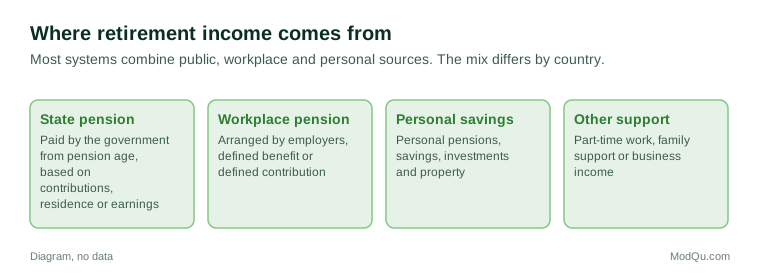
Retirement income systems differ a great deal from country to country, but many are built on three layers, often called pillars:
- State or public pensions paid by the government, usually funded by taxes or social insurance contributions taken from pay.
- Workplace or occupational pensions arranged by employers, often with contributions from both employer and employee.
- Personal savings and investments, including personal pension plans, savings accounts, property and other assets.
In some countries the state pension is the main source of income for most retirees. In others it provides a basic floor, and workplace pensions or compulsory savings accounts do most of the work. Many people also rely on family support, continued part-time work or income from a business.
The figure below shows these layers.
How state pensions usually work
State pensions usually depend on one or more of the following:
- Age: payments begin at a set pension age, which many countries have been raising.
- Contribution record: the number of years a person paid in, or was credited for, through work, caring or unemployment.
- Earnings: in some systems, higher past earnings lead to a higher pension, up to a limit.
- Residence: some pensions are based on years lived in the country rather than contributions.
- Means testing: some extra payments depend on income or savings being below a threshold.
Many countries let people check a statement or forecast of their state pension online. Surveys often find that a large share of people have never checked theirs.
Example
A shop worker in their fifties assumes they will get a full state pension. When they check their record, they find several years missing from a period when they worked abroad. They learn they can apply to have some years counted under an agreement between the two countries, and fill some gaps with voluntary contributions.
Workplace pensions
Workplace pensions come in two main forms:
- Defined benefit (often called final salary or career average): the pension is a set amount based on salary and years of service, and the employer carries the investment risk.
- Defined contribution: money is paid into an individual pot and invested. What the person receives depends on how much is paid in, investment returns and fees. The member carries the risk.
Over recent decades many private employers have moved from defined benefit to defined contribution. Public sector workers in many countries are still more likely to have defined benefit pensions. Some countries automatically enrol employees into a workplace scheme, with the option to opt out.
Example (hypothetical figures)
Two colleagues earn the same salary. One contributes 5% of pay and the employer adds 5%. The other opts out to have more money now. After 30 years, the first has built up a pension pot from contributions and investment growth; the second has none from that job and must rely on the state pension and their own savings.
What affects how much people receive
Several factors explain why people with similar careers can end up with very different retirement incomes:
- the age they started saving and any long breaks;
- contribution rates, including whether they took up employer matching;
- investment returns and fees over many years;
- whether they took money out early, where this is allowed;
- how they turn a pot into income, for example a lifetime annuity or drawing down gradually;
- inflation, which reduces what a fixed income can buy.
Gaps in pension income are common for people who spent years caring for children or relatives, worked part time, were self-employed, or moved between countries.
Common worries about pensions
When asked, people often say they are worried about:
- not having enough to live on;
- the state pension age rising before they reach it;
- the future of public pensions as populations age;
- running out of money if they live a long time;
- scams that target pension savings;
- not understanding their options.
Example
A self-employed designer has paid into a personal pension only when work was good. At 48 they realize they have far less than friends who were employed. They read about the rules, talk to a free government-backed guidance service, and set up a fixed monthly contribution.
Retiring in another country
More people now spend part of their working life abroad or retire to a different country. This raises questions about whether pension rights earned in one country can be paid in another, how payments are taxed, whether pensions rise with inflation when paid abroad, and how health care is covered. Agreements between some countries allow years worked in each to be added together; in other cases they are not.
Pensions and the gender gap
In many countries, women retire with noticeably lower pension income than men. The main reasons are lower average pay, more part-time work, and more time out of paid work to care for children or relatives, all of which reduce contributions. Women also live longer on average, so their savings must last more years. Some pension systems give credits for years spent caring, and some split pension rights between partners on divorce, but rules differ widely. Surveys on retirement often ask about time out of work and caring responsibilities for this reason.
What people disagree about
Pension policy is often debated. Questions include how high the state pension should be, whether the pension age should keep rising, whether workplace saving should be compulsory, how much risk individuals should carry, and how to make sure pension funds are invested responsibly. People also disagree about fairness between generations: who should pay for the pensions of a growing older population.
Questions that businesses want answered include whether people know how much state pension they will get, whether they have workplace or personal pensions, how confident they are about retirement income, when they expect to retire, and where they go for information.
Key terms
- State pensionA pension paid by the government, usually from a set age.
- Pension ageThe age at which a state pension can start.
- Contribution recordThe years a person paid in, or was credited for, toward a state pension.
- Defined benefit pensionA workplace pension that pays a set amount based on salary and service.
- Defined contribution pensionA pension pot whose value depends on contributions, returns and fees.
- Auto-enrolmentAutomatically placing employees in a workplace pension, with the right to opt out.
- AnnuityA product that turns a lump sum into a regular income, often for life.
- DrawdownTaking income gradually from a pension pot that stays invested.
Full glossary: retirement planning terms on EditingTests.com.
Pensions and state retirement benefits vocabulary test
How well do you know the language of this topic? Try 8 quick questions. Your score is shown straight away and is not saved.
What the pensions and state retirement benefits survey asks
This survey is part of ModQu's Money and Banking survey. The pensions and state retirement benefits part takes about five minutes and covers:
- Whether you know roughly how much state pension you will receive.
- Whether you have a workplace pension or personal pension, and what type.
- How much you contribute and whether your employer adds to it.
- When you expect to retire and how confident you are about your income.
- Where you go for information about pensions.
- Your views on pension age and the future of public pensions.
After that you can choose to continue with other short parts of the Money and Banking survey, such as everyday banking or digital payments and wallets, or stop.
Ready to take part?
Your answers help show what people really think and do. Results are only ever reported as totals; no one can see your individual answers.
Start the surveyQuestions about this survey
Who can take part?
Adults aged 40 and over.
Do I have to give my name?
No. You may be asked for your age group, region and similar details so results can be broken down, but not your name. ModQu never asks for passwords, card numbers or account numbers.
How are the results used?
Answers are combined into totals and percentages and published in ModQu reports. Individual answers are never shown.
Is the vocabulary test part of the survey?
No. It is optional and separate, and your score is not stored.
Can I get a state pension from more than one country?
Sometimes. Some countries have agreements that let years worked in each count, and some pay pensions abroad. Check with the pension authority in each country.
Should I join my workplace pension?
This page describes how pensions work and does not give advice. Free, impartial guidance services exist in many countries.