
Share your experience of scams
Tell us whether you have been targeted by a scam, what happened, and who helped. Your answers are combined with other people's and reported only as totals.
Start the financial fraud and scams surveyAbout 5 minutes. No account needed. You can stop at any time.
Fraud and scams: the difference
People often use the words fraud and scam to mean the same thing, but there is a useful difference:
- Unauthorized fraud is when someone uses a person's account or card without permission, for example after stealing card details.
- Authorized fraud, often called a scam, is when the person is tricked into making the payment themselves, believing it is genuine.
The difference matters because banks and card schemes often treat them differently when it comes to refunds. Many countries require banks to refund unauthorized fraud quickly; refunds for scams where the customer sent the money themselves are less certain and depend on local rules.
Common types of scam
Scams change often, but most fit into a few familiar types:
- Impersonation: someone pretends to be from a bank, the police, a tax office or a delivery company and says there is a problem that needs urgent payment or details.
- Safe account scams: the caller says the person's account is at risk and asks them to move money to a "safe" account the fraudster controls.
- Investment scams: promises of high, fast returns, often in cryptocurrency or foreign exchange, sometimes with fake trading websites.
- Romance scams: a relationship built online over weeks or months, followed by requests for money for an emergency or travel.
- Purchase scams: goods advertised online, often below normal prices, that never arrive.
- Invoice and payment redirection: an email that looks like it comes from a builder, lawyer or supplier, giving new bank details.
- Family emergency scams: a message claiming to be from a child or grandchild who has lost their phone and needs money.
- Phishing: texts or emails with links to fake websites that collect login details.
Why scams work
Scams succeed because they use normal human reactions, not because victims are foolish. Fraudsters rely on:
- Urgency: a short deadline stops people from thinking or checking.
- Authority: claiming to be a bank, a government body or the police.
- Fear: warnings that money will be lost or that the person is in trouble.
- Trust and affection: in romance and family scams.
- Greed and hope: in investment and prize scams.
- Isolation: instructions not to tell anyone, including bank staff.
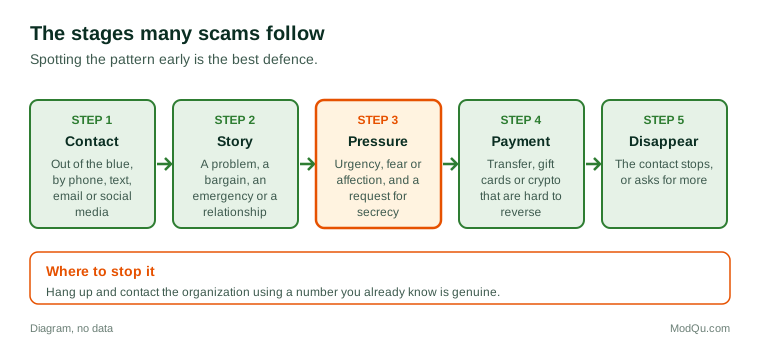
The figure below shows the stages that many scams follow.
Example
A man receives a call from someone who knows his name and the last digits of his card. The caller says they are from the bank's fraud team and that someone is trying to take money from his account. To protect it, he must move his savings to a new account opened in his name. The caller stays on the line for an hour. He moves the money. The "new account" belongs to the fraudster.
Warning signs
Many scams share warning signs:
- being contacted out of the blue, especially by phone, text or social media;
- pressure to act immediately;
- requests to keep the matter secret;
- requests for passwords, one-time codes or card PINs, which genuine banks never ask for;
- payment by bank transfer, gift cards or cryptocurrency, which are hard to reverse;
- returns or prices that seem too good to be true;
- a change of bank details sent by email.
A simple rule many advice services repeat is to stop, hang up, and contact the organization using a number or website you already know is genuine.
What to do after a scam
Speed matters. People who think they have been scammed are usually advised to:
- contact their bank straight away using the number on the back of their card;
- report the scam to the police or national fraud reporting service;
- change passwords and turn on extra login checks if accounts may be exposed;
- keep records of messages, calls and payments;
- watch for follow-up "recovery" scams, where someone offers to get the money back for a fee.
Example (hypothetical figures)
A shopper pays 600 by bank transfer for a used bike listed on a selling site. The seller stops replying. The shopper reports it to their bank within an hour. The bank contacts the receiving bank, which freezes 450 still left in the fraudster's account. The shopper gets that back, but loses the remaining 150.
Banks, refunds and prevention
Banks use automated systems to spot unusual payments and may hold a payment and contact the customer. Some countries have introduced checks that warn if the name on a receiving account does not match the name the sender typed. Others have made banks share the cost of refunding scam victims, with exceptions where the customer was very careless.
Telecom companies, social media platforms and selling sites also play a part, by blocking spoofed numbers, removing fake adverts and taking down scam profiles. How much responsibility each should carry is still debated.
The effects on victims
Losing money is only part of the harm. People who have been scammed often report shame, anxiety, loss of trust and reluctance to use online services. Some do not report it at all because they feel embarrassed, which means official figures are thought to understate how common scams are.
Example
A widow loses part of her savings to someone she met online who said he worked abroad. She does not tell her family for months. When she does, her daughter helps her report it and find a support service for scam victims. She says talking to others who had the same experience helped most.
What people disagree about
Opinions differ on who should pay when a customer is tricked into sending money: the customer, the sending bank, the receiving bank, or the platform where the scam began. Some argue that full refunds make people careless; others say that scams are now so convincing that customers cannot be expected to spot them.
Questions that businesses want answered include how often people are targeted, which channels scams arrive through, how many people lose money, whether they report it, how banks responded, and how confident people feel about spotting a scam.
Key terms
- ScamA trick that persuades a person to hand over money or details.
- Authorized payment fraudA scam in which the victim makes the payment themselves.
- Unauthorized fraudUse of a person's account or card without their permission.
- PhishingFake messages or websites that collect login or card details.
- Impersonation scamA scam in which the fraudster pretends to be a trusted organization.
- Safe account scamA scam that persuades a person to move money to an account the fraudster controls.
- Money muleA person whose account is used to receive and pass on stolen money.
- Confirmation of payeeA check that the name on a receiving account matches the name entered.
Full glossary: financial fraud detection terms on EditingTests.com.
Financial fraud and scams vocabulary test
How well do you know the language of this topic? Try 8 quick questions. Your score is shown straight away and is not saved.
What the financial fraud and scams survey asks
This survey is part of ModQu's Money and Banking survey. The financial fraud and scams part takes about five minutes and covers:
- Whether you have been contacted by a scam in the last 12 months, and how.
- Whether you lost money, and roughly how much.
- Who you reported it to, and how they responded.
- Whether your bank refunded any of the money.
- How confident you feel about spotting a scam.
- Who you think should be responsible for refunding scam victims.
After that you can choose to continue with other short parts of the Money and Banking survey, such as everyday banking or digital payments and wallets, or stop.
Ready to take part?
Your answers help show what people really think and do. Results are only ever reported as totals; no one can see your individual answers.
Start the surveyQuestions about this survey
Who can take part?
Adults.
Do I have to give my name?
No. You may be asked for your age group, region and similar details so results can be broken down, but not your name. ModQu never asks for passwords, card numbers or account numbers.
How are the results used?
Answers are combined into totals and percentages and published in ModQu reports. Individual answers are never shown.
Is the vocabulary test part of the survey?
No. It is optional and separate, and your score is not stored.