
Investigation · Business and corporate investigation
The Fraud Triangle: Pressure, Opportunity and Rationalisation
Where the fraud triangle came from, what its three elements mean, how investigators and auditors use it, and where research says it falls short.
Most people who commit occupational fraud have no criminal record. They are trusted employees, managers and owners who, at some point, decide to misuse the trust placed in them. Explaining how that happens is the purpose of the fraud triangle, the most widely taught model in fraud examination. It holds that fraud becomes likely when three conditions are present at once: a pressure or motive, an opportunity, and a rationalisation that lets the person justify the act. This article explains the model's origins, how it is used in practice, and what its critics have added.
Origins: Cressey's study of embezzlers
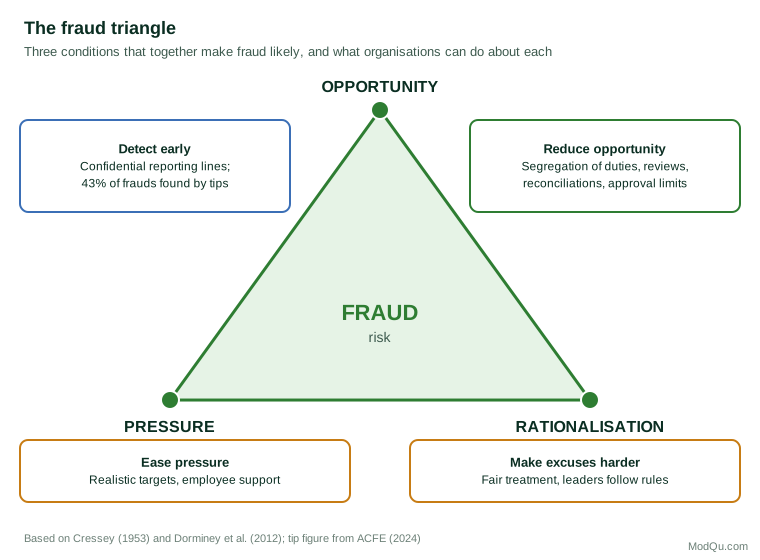
The model grew out of the work of the American criminologist Donald Cressey, a student of Edwin Sutherland, who had introduced the idea of white-collar criminality (Sutherland, 1940). In the late 1940s and early 1950s he interviewed people imprisoned for embezzlement to find out what their cases had in common. In Other People's Money, Cressey (1953) concluded that trusted persons became trust violators when three things came together. First, they saw themselves as having a financial problem they could not share with others. Second, they realised the problem could be solved secretly by violating the trust of their position. Third, they could describe the act to themselves in words that preserved their view of themselves as honest people, for example as "borrowing" rather than stealing.
Cressey did not draw a triangle. The diagram, and the labels pressure, opportunity and rationalisation, were developed later by practitioners and educators, and the model spread widely through fraud examination training and auditing guidance (Dorminey et al., 2012; Morales et al., 2014). Morales et al. (2014) trace how the model shifted the focus of fraud prevention towards the individual employee and the vigilance of the organisation.
The three elements
Pressure
Pressure, sometimes called incentive or motive, is the need that pushes a person towards fraud. In Cressey's account it was a financial problem the person felt unable to share, such as debts, business losses or a gambling problem. Modern accounts widen the term to include pressure to meet sales or earnings targets, fear of losing a job, and the desire to maintain a lifestyle. Pressure is often invisible to employers, which is why investigators look for behavioural warning signs such as unexplained changes in spending or reluctance to take holidays.
Opportunity
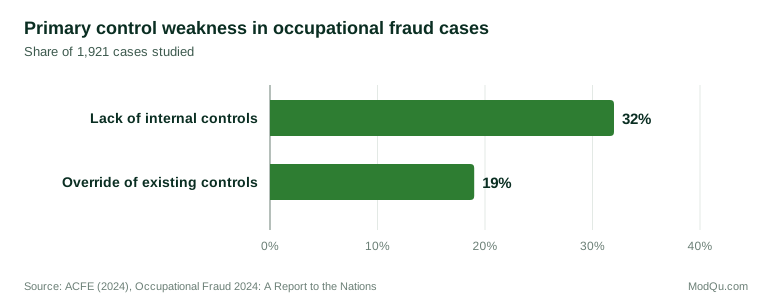
Opportunity is the perceived chance to commit fraud and conceal it. It arises from weak internal controls, poor separation of duties, lack of oversight, and the trust and access that come with senior or long-serving roles. Of the three elements, opportunity is the one an organisation can most directly change. The Association of Certified Fraud Examiners' (ACFE, 2024) global study of 1,921 cases found that a lack of internal controls was the primary weakness in 32% of cases and the override of existing controls in a further 19%.
Rationalisation
Rationalisation is the reasoning that allows a person to commit fraud while still seeing themselves as basically honest. Common examples include "I'm only borrowing it", "the company owes me", "everyone does it" and "nobody is really hurt". Cressey (1953) argued that these verbal justifications were formed before the act, not merely invented afterwards as excuses. Sykes and Matza (1957) described similar "techniques of neutralization" among delinquents, such as denying injury, and Anand et al. (2004) show how such justifications become shared and normalised within organisations. Murphy and Dacin (2011) argue that people can also reach fraud without deliberate reasoning, for example through lack of awareness. Rationalisation is closely tied to organisational culture: when employees believe that their employer treats them unfairly or that senior staff break the rules, justifications become easier to find.
How the model is used
The fraud triangle gives investigators, auditors and managers a shared vocabulary for thinking about risk. Auditing standards ask auditors to consider fraud risk factors grouped in a very similar way, as incentives or pressures, opportunities, and attitudes or rationalisations (Dorminey et al., 2012). Skousen et al. (2009) found that measures of pressure and opportunity helped predict financial statement fraud, and Hogan et al. (2008) and Trompeter et al. (2013) review the wider research. In practice the model supports three tasks:
- Risk assessment. Mapping where pressures are high (for example, aggressive targets), where controls are weak, and where the culture tolerates rule-bending helps an organisation focus its prevention work.
- Investigation. When an anomaly is found, the triangle prompts questions about who had access, who was under pressure, and how the person might have justified the act. These are leads to test, not proof.
- Prevention. Because opportunity is the element most under management control, prevention programmes concentrate on segregation of duties, reconciliations, approval limits, mandatory holidays and job rotation, as well as confidential reporting lines. The ACFE (2024) found that 43% of frauds were detected through tips, more than by any other method, which underlines the value of hotlines and a culture in which employees feel safe to speak up.
A worked illustration
Consider a hypothetical accounts payable clerk at a mid-sized company. The clerk has run up debts after a family illness and feels unable to tell anyone (pressure). The company has grown quickly, and the same person now sets up new suppliers, enters invoices and prepares payment runs, with a manager who approves batches without reviewing the details (opportunity). The clerk has recently been passed over for a promotion and believes the company has treated them unfairly, and tells themselves that a few small payments to a supplier account they control are a temporary loan that will be repaid (rationalisation).
Each corner of the triangle points to a different response. The organisation cannot easily see the clerk's debts, but it can offer confidential employee assistance and make clear that people in difficulty can ask for help. It can directly remove the opportunity by separating supplier set-up from payment, requiring independent review of new supplier accounts, and reconciling payments to purchase orders. And it can address the conditions for rationalisation by handling promotion decisions transparently and making sure employees know how to raise grievances. An investigator who later finds unusual payments to a newly created supplier would use the same structure to plan lines of inquiry: who could create suppliers, who could approve payments, and whether access and behaviour fit the pattern. None of these factors would prove that the clerk was responsible; they would show where to look for evidence.
Criticisms and extensions
The fraud triangle has been criticised on several grounds, and researchers have proposed additions.
Capability. Wolfe and Hermanson (2004) argued that many frauds, particularly large ones, also require the right personal traits and position: the authority to override controls, the knowledge to exploit weaknesses, the confidence to avoid detection and the ability to handle stress. They added capability as a fourth element, turning the triangle into a "fraud diamond".
Limited practical use of two corners. Schuchter and Levi (2016) interviewed convicted fraudsters and fraud experts and argued that pressure and rationalisation are hard for organisations to observe or influence, which limits the model's value for prevention. Their work supports the practical emphasis on reducing opportunity and on strengthening deterrence.
Individual focus. Free (2015) reviewed the research literature and called for new directions, including more attention to collusion between several people, to the organisational and social settings in which fraud happens, and to the experiences of fraudsters themselves. Morales et al. (2014) similarly argue that the model's focus on the "risky individual" can draw attention away from wider organisational pressures, such as incentive systems that reward short-term results at any cost. Lokanan (2015) questions the model's value as a detection tool, and Ramamoorti (2008) argues that fraud education should draw more on psychology and sociology.
Other motives. Dorminey et al. (2012) review alternative frameworks, including models that recognise motives beyond money, such as ideology, coercion and ego, and models that distinguish between people who stumble into fraud and predators who seek out opportunities from the start. A model built on Cressey's accidental, trust-violating embezzler may fit the predator less well.
Taken together, these critiques do not overturn Cressey's insight that fraud usually requires a motive, a means and a justification. They show instead that the triangle describes some frauds better than others, and that it should be used alongside attention to capability, collusion, organisational culture and the incentive systems that shape behaviour across a whole organisation.
Using the triangle well
Despite these criticisms, the triangle remains useful as long as it is treated as a structured set of questions rather than a test of guilt. Its main lessons for organisations are practical:
- Reduce opportunity through sound internal controls, and check that controls are actually followed, since override by senior people is a major weakness.
- Reduce pressure where possible, for example by setting realistic targets and offering confidential support to employees in financial difficulty.
- Make rationalisation harder through a culture in which leaders follow the rules they set, unfair treatment is addressed, and concerns can be raised safely.
- Investigate evidence, not profiles. The presence of pressure or opportunity is a reason to look more closely, never a conclusion in itself.
For research and survey organisations, the same logic applies to data integrity. Fabricated interviews, manipulated responses and falsified results follow the same pattern: pressure to meet quotas or deadlines, an opportunity created by weak verification, and a rationalisation that "the results would have been the same anyway". Independent checks on data collection address the opportunity, and a culture that values accurate results over convenient ones addresses the rest.
References
Anand, V., Ashforth, B. E., & Joshi, M. (2004). Business as usual: The acceptance and perpetuation of corruption in organizations. Academy of Management Executive, 18(2), 39–53. https://doi.org/10.5465/ame.2004.13837437
Association of Certified Fraud Examiners. (2024). Occupational fraud 2024: A report to the nations. https://www.acfe.com/RTTN
Cressey, D. R. (1953). Other people's money: A study in the social psychology of embezzlement. Free Press.
Dorminey, J., Fleming, A. S., Kranacher, M.-J., & Riley, R. A., Jr. (2012). The evolution of fraud theory. Issues in Accounting Education, 27(2), 555–579. https://doi.org/10.2308/iace-50131
Free, C. (2015). Looking through the fraud triangle: A review and call for new directions. Meditari Accountancy Research, 23(2), 175–196. https://doi.org/10.1108/MEDAR-02-2015-0009
Hogan, C. E., Rezaee, Z., Riley, R. A., Jr., & Velury, U. K. (2008). Financial statement fraud: Insights from the academic literature. Auditing: A Journal of Practice & Theory, 27(2), 231–252. https://doi.org/10.2308/aud.2008.27.2.231
Lokanan, M. E. (2015). Challenges to the fraud triangle: Questions on its usefulness. Accounting Forum, 39(3), 201–224. https://doi.org/10.1016/j.accfor.2015.05.002
Morales, J., Gendron, Y., & Guénin-Paracini, H. (2014). The construction of the risky individual and vigilant organization: A genealogy of the fraud triangle. Accounting, Organizations and Society, 39(3), 170–194. https://doi.org/10.1016/j.aos.2014.01.006
Murphy, P. R., & Dacin, M. T. (2011). Psychological pathways to fraud: Understanding and preventing fraud in organizations. Journal of Business Ethics, 101(4), 601–618. https://doi.org/10.1007/s10551-011-0741-0
Ramamoorti, S. (2008). The psychology and sociology of fraud: Integrating the behavioral sciences component into fraud and forensic accounting curricula. Issues in Accounting Education, 23(4), 521–533. https://doi.org/10.2308/iace.2008.23.4.521
Schuchter, A., & Levi, M. (2016). The fraud triangle revisited. Security Journal, 29(2), 107–121. https://doi.org/10.1057/sj.2013.1
Skousen, C. J., Smith, K. R., & Wright, C. J. (2009). Detecting and predicting financial statement fraud: The effectiveness of the fraud triangle and SAS No. 99. In M. Hirschey, K. John, & A. K. Makhija (Eds.), Corporate governance and firm performance (Advances in Financial Economics, Vol. 13, pp. 53–81). Emerald. https://doi.org/10.1108/S1569-3732(2009)0000013005
Sutherland, E. H. (1940). White-collar criminality. American Sociological Review, 5(1), 1–12. https://doi.org/10.2307/2083937
Sykes, G. M., & Matza, D. (1957). Techniques of neutralization: A theory of delinquency. American Sociological Review, 22(6), 664–670. https://doi.org/10.2307/2089195
Trompeter, G. M., Carpenter, T. D., Desai, N., Jones, K. L., & Riley, R. A., Jr. (2013). A synthesis of fraud-related research. Auditing: A Journal of Practice & Theory, 32(Suppl. 1), 287–321. https://doi.org/10.2308/ajpt-50360
Wolfe, D. T., & Hermanson, D. R. (2004). The fraud diamond: Considering the four elements of fraud. The CPA Journal, 74(12), 38–42.