
Investigation · Business and corporate investigation
Forensic Accounting and Financial Investigation
Forensic accountants apply accounting, auditing and investigative skills to questions that may end up in court. This article explains what the discipline covers, how forensic accountants work, and the duties they owe when they give evidence.
When a company suspects that its finance director has been diverting funds, when two former business partners dispute what their company was worth, or when a court must decide how much a breach of contract cost the claimant, the people asked to answer are often forensic accountants. The word "forensic" means suitable for use in a court of law, and forensic accounting is the application of accounting, auditing and investigative skills to questions that may be decided in legal proceedings. It sits between accounting and investigation, and it draws on both.
This article describes what forensic accountants do, how their work differs from ordinary auditing, the methods they use and the professional and legal duties that shape their evidence.
What forensic accountants do
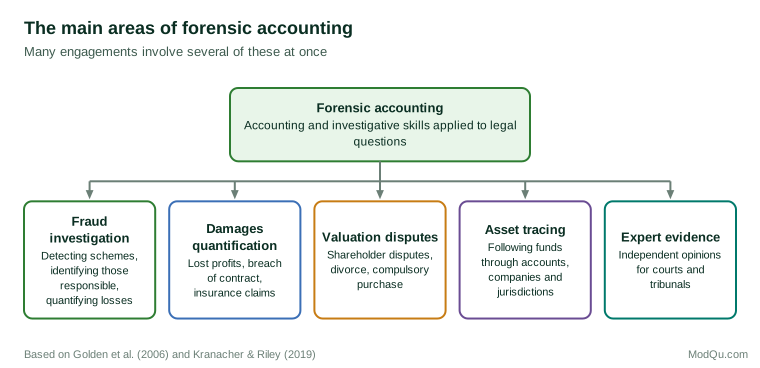
Forensic accounting covers two broad kinds of work. Investigation looks backwards at what happened: whether fraud or misconduct occurred, how it was carried out, who was involved and how much was lost. Litigation support helps courts and parties resolve financial disputes: calculating damages, valuing businesses and interests, tracing assets and explaining complex transactions (Golden et al., 2006; Kranacher & Riley, 2019).
The discipline has a long history. Accountants have given evidence in courts for well over a century, and one of the best-known early examples of financial investigation was the case built against the gangster Al Capone in the United States, who was convicted in 1931 not for violence but for tax evasion, on the basis of evidence of income he could not explain. Modern forensic accounting grew rapidly after the corporate scandals of the early 2000s, and specialist qualifications and standards have followed.
How forensic accounting differs from auditing
Forensic accountants and auditors use many of the same skills, but their purposes differ. An external audit is designed to give reasonable assurance that financial statements as a whole are free from material misstatement. It relies on sampling and on assessments of risk, and it does not aim to detect every irregularity. A forensic investigation, by contrast, is targeted at a specific question, such as whether a particular set of payments was fraudulent, and may examine every relevant transaction. It assumes that records may have been falsified, looks for intent and concealment, and is conducted with the expectation that its findings may be challenged in court.
The skills required reflect this difference. DiGabriele (2008), surveying practitioners, academics and users of forensic accounting services, found that deductive analysis, critical thinking, unstructured problem solving, investigative flexibility, analytical proficiency, oral and written communication and knowledge of the law were among the skills considered most relevant. Many of these are investigative rather than technical accounting skills.
Methods
Forensic accountants use a range of methods, adapted to the question at hand.
Document examination and reconstruction. Investigators gather accounting records, bank statements, contracts, invoices and correspondence, and reconstruct what happened from them. Where records are missing or falsified, they may rebuild the accounts from third-party sources such as bank and supplier records.
Tracing. Funds are followed from source to destination through bank accounts, companies and jurisdictions, with each step documented. Tracing is central both to fraud investigation and to recovering assets.
Data analytics. Large volumes of transactions are tested for anomalies: duplicate payments, round amounts, entries posted at unusual times, and suppliers who share details with employees. Tests based on Benford's law compare the distribution of leading digits in financial data with the expected distribution and can indicate invented figures, though deviations have many innocent explanations and the tests must be used with care (Durtschi et al., 2004; Nigrini, 2012).
Financial statement analysis. Ratio analysis and models developed in accounting research can identify companies whose reported results look inconsistent with their underlying activity. Beneish (1999) and Dechow et al. (2011) developed models that distinguish firms later found to have manipulated their accounts from others. Rezaee (2005) reviews the causes and consequences of financial statement fraud and the warning signs that analysts and investigators look for.
Quantification. Whether the question is the size of a fraud loss or the profits lost because of a breach of contract, the forensic accountant must produce a figure and show how it was calculated, with each assumption stated and justified.
A simple hypothetical example shows how quantification works. A distributor claims that a supplier's breach of an exclusive supply contract cost it two years of profits. The forensic accountant first establishes what the distributor would have earned had the contract been honoured, using its sales history, the market trend and any evidence of customers lost. From this, the accountant deducts what the distributor actually earned, including profits from replacement products, and the costs it saved by not handling the supplier's goods. The result is then tested against alternative explanations for the decline, such as a general market downturn, and adjusted for any failure by the distributor to reduce its losses. Each assumption is stated in the report, so that the court can see how sensitive the figure is to it. An expert appointed by the supplier will usually prepare a competing calculation, and the court will often order the two experts to meet and list the points on which they agree and disagree.
Interviews. Forensic accountants often take part in interviews, particularly to understand accounting processes and to put specific transactions to the people involved.
Duties as an expert witness
Much forensic accounting work ends with a report for a court or tribunal, and the accountant may be called to give evidence and be cross-examined. Courts have developed clear rules about the role of experts.
In England and Wales, the classic statement of an expert's duties comes from National Justice Compania Naviera SA v Prudential Assurance Co Ltd (1993), known as The Ikarian Reefer, in which the court said that expert evidence should be, and should be seen to be, the independent product of the expert, uninfluenced by the pressures of litigation; that the expert should state the facts and assumptions on which the opinion is based and not omit facts that detract from it; and that the expert should make clear when a question falls outside their expertise. These principles are now reflected in the Civil Procedure Rules, which state that an expert's overriding duty is to the court, and that this duty overrides any obligation to the person who instructs or pays them (Civil Procedure Rules 1998, Part 35).
In the United States, federal courts apply Rule 702 of the Federal Rules of Evidence and the standard set out in Daubert v. Merrell Dow Pharmaceuticals, Inc. (1993), which requires judges to assess whether expert testimony rests on a reliable foundation and is relevant to the case. In Kumho Tire Co. v. Carmichael (1999), the Supreme Court held that this gatekeeping duty applies to all expert testimony, including technical and specialised evidence such as that given by accountants, not only to scientific evidence.
Professional standards add further requirements. In the United States, the American Institute of Certified Public Accountants issued a standard for forensic services that requires members to be objective, to avoid acting as advocates when giving opinions, and not to provide opinions on the ultimate question of whether a person committed fraud, which is for the court to decide (American Institute of Certified Public Accountants [AICPA], 2019).
Independence and its pressures
The forensic accountant's value depends on independence, but the structure of the work puts pressure on it. The accountant is usually appointed and paid by one party, receives instructions from that party's lawyers and works closely with them. The risk is that the expert, consciously or not, adopts the client's view. The rules described above are designed to counter this, and courts are critical of experts who appear partisan. A forensic accountant who reports what the evidence shows, including points that do not help the client, is more useful to the client in the long run, because the evidence is more likely to be believed.
Why it matters
Fraud imposes large costs on organisations; in the cases reported to the Association of Certified Fraud Examiners (2024), the median loss per case ran to well over one hundred thousand dollars, and many frauds continue for more than a year before detection. Financial disputes, from shareholder conflicts to insurance claims, turn on figures that the parties cannot agree. Forensic accounting brings structured, evidence-based methods to these questions. Its contribution is not only to establish what happened, but to explain it in a form that judges, juries, boards and regulators can understand and test.
References
American Institute of Certified Public Accountants. (2019). Statement on standards for forensic services No. 1.
Association of Certified Fraud Examiners. (2024). Occupational fraud 2024: A report to the nations.
Beneish, M. D. (1999). The detection of earnings manipulation. Financial Analysts Journal, 55(5), 24–36. https://doi.org/10.2469/faj.v55.n5.2296
Civil Procedure Rules 1998, SI 1998/3132, Part 35 (UK).
Daubert v. Merrell Dow Pharmaceuticals, Inc., 509 U.S. 579 (1993).
Dechow, P. M., Ge, W., Larson, C. R., & Sloan, R. G. (2011). Predicting material accounting misstatements. Contemporary Accounting Research, 28(1), 17–82. https://doi.org/10.1111/j.1911-3846.2010.01041.x
DiGabriele, J. A. (2008). An empirical investigation of the relevant skills of forensic accountants. Journal of Education for Business, 83(6), 331–338. https://doi.org/10.3200/JOEB.83.6.331-338
Durtschi, C., Hillison, W., & Pacini, C. (2004). The effective use of Benford's law to assist in detecting fraud in accounting data. Journal of Forensic Accounting, 5(1), 17–34.
Golden, T. W., Skalak, S. L., & Clayton, M. M. (2006). A guide to forensic accounting investigation. Wiley.
Kranacher, M.-J., & Riley, R. A., Jr. (2019). Forensic accounting and fraud examination (2nd ed.). Wiley.
Kumho Tire Co. v. Carmichael, 526 U.S. 137 (1999).
National Justice Compania Naviera SA v Prudential Assurance Co Ltd (The Ikarian Reefer) [1993] 2 Lloyd's Rep 68 (QB).
Nigrini, M. J. (2012). Benford's law: Applications for forensic accounting, auditing, and fraud detection. Wiley.
Rezaee, Z. (2005). Causes, consequences, and deterence of financial statement fraud. Critical Perspectives on Accounting, 16(3), 277–298. https://doi.org/10.1016/S1045-2354(03)00072-8