
Investigation · Business and corporate investigation
Workplace Investigations: Fairness, Process and Outcomes
When an employee is accused of misconduct or raises a grievance, the employer usually has to investigate. This article explains what a fair workplace investigation involves, why fair process matters as much as the outcome, and the steps that make the findings defensible.
A complaint of bullying, an allegation of theft, a report that a manager has been falsifying timesheets: most organisations face matters like these regularly, and most of them must be investigated before anyone can decide what to do. Workplace investigations are usually carried out by managers or human resources staff rather than professional investigators, and they are often done under pressure. Yet their results can end careers, lead to legal claims and shape how safe employees feel raising concerns. Getting the process right matters as much as getting the answer right.
What the law expects
The legal standard for a workplace investigation is not proof beyond reasonable doubt. In the United Kingdom, the long-standing test from British Home Stores Ltd v Burchell (1980) asks whether the employer genuinely believed the employee was guilty of misconduct, whether it had reasonable grounds for that belief, and whether it had carried out as much investigation as was reasonable in the circumstances. A statutory code of practice adds that employers should investigate without unreasonable delay, tell the employee of the case against them and allow them to respond at a meeting, where they may be accompanied (Acas, 2015). In California, the state supreme court similarly held that an employer need not prove that misconduct actually occurred, provided it acted in good faith on a reasonable belief reached after an appropriate investigation that included notice of the allegations and a chance to respond (Cotran v. Rollins Hudig Hall International, Inc., 1998).
In both systems, the quality of the investigation is what makes a decision defensible. A thin or one-sided investigation can make a dismissal unfair even if the employee was in fact guilty.
The steps of a fair investigation
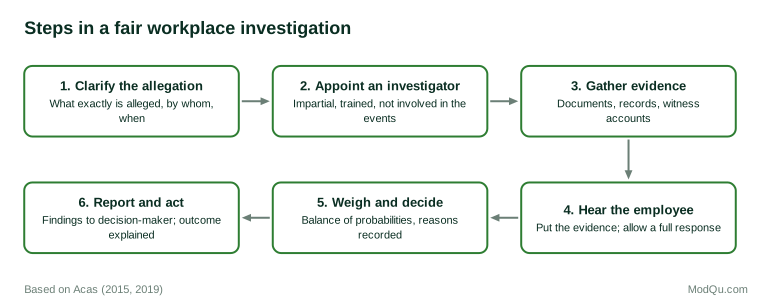
Guidance for employers sets out a sequence of practical steps (Acas, 2019). The allegation should first be stated precisely, because a vague complaint cannot be fairly answered. An investigator who is impartial and was not involved in the events should be appointed, and in most cases the person who investigates should not be the one who decides on discipline. The investigator then gathers documents and records and interviews the complainant and witnesses, keeping notes that the witnesses can check.
Interim steps may be needed while the investigation runs. Where there is a risk to other people or to evidence, the employer may separate the parties, change working arrangements or, in serious cases, suspend the employee on full pay. Suspension should not be automatic and should be kept under review, because it can be read by colleagues as a sign of guilt (Acas, 2019). Everyone involved should be asked to keep the matter confidential, and records should be stored securely and kept only as long as they are needed.
The employee under investigation must be told what is alleged, shown the evidence that matters and given a real opportunity to respond, including to suggest witnesses or documents that support their account. The investigator then weighs the evidence on the balance of probabilities and explains, in a written report, which facts were found and why. Evidence that points away from the allegation belongs in the report as much as evidence that supports it.
Why fair process matters
Fair process is not only a legal requirement. Research on organisational justice shows that people judge decisions both by their outcomes and by how they were made. Thibaut and Walker (1975) found that people accept unfavourable outcomes more readily when they have had a voice in the process. Leventhal (1980) proposed criteria for a fair procedure: consistency, freedom from bias, accuracy, the ability to correct errors, representation of all parties' concerns and conformity with ethical standards. Lind and Tyler (1988) argued that fair treatment signals to people that they are respected members of the group.
A meta-analysis by Colquitt et al. (2001) confirmed that perceived procedural justice is strongly related to employees' trust, commitment and acceptance of decisions. For workplace investigations, this means that a fair process benefits not only the employee under investigation but also the complainant, the witnesses and everyone who watches how the organisation handles a problem.
Common failures
Workplace investigations most often go wrong in predictable ways:
- the investigator decides early what happened and seeks only confirming evidence;
- the employee is not told the full allegations or shown key evidence;
- witnesses suggested by the employee are not interviewed;
- the investigation takes so long that memories fade and trust erodes;
- the report states conclusions without explaining how the evidence supports them.
Each of these can be avoided with clear allegations, an impartial investigator, a timetable and a report that shows its reasoning.
Outcomes
An investigation can find an allegation upheld, not upheld or unproven. Each outcome needs to be explained to the people involved, with care for confidentiality. Even when an allegation is not upheld, the investigation may reveal problems in management, training or working practices that should be addressed. Treated this way, a workplace investigation is not only a means of deciding an individual case but a source of knowledge about how the organisation works.
References
Acas. (2015). Code of practice on disciplinary and grievance procedures. Advisory, Conciliation and Arbitration Service.
Acas. (2019). Conducting workplace investigations. Advisory, Conciliation and Arbitration Service.
British Home Stores Ltd v Burchell [1980] ICR 303 (EAT).
Colquitt, J. A., Conlon, D. E., Wesson, M. J., Porter, C. O. L. H., & Ng, K. Y. (2001). Justice at the millennium: A meta-analytic review of 25 years of organizational justice research. Journal of Applied Psychology, 86(3), 425–445. https://doi.org/10.1037/0021-9010.86.3.425
Cotran v. Rollins Hudig Hall International, Inc., 17 Cal. 4th 93 (1998).
Leventhal, G. S. (1980). What should be done with equity theory? New approaches to the study of fairness in social relationships. In K. J. Gergen, M. S. Greenberg, & R. H. Willis (Eds.), Social exchange: Advances in theory and research (pp. 27–55). Plenum.
Lind, E. A., & Tyler, T. R. (1988). The social psychology of procedural justice. Plenum.
Thibaut, J., & Walker, L. (1975). Procedural justice: A psychological analysis. Erlbaum.