
Investigation · Business and corporate investigation
Due Diligence Investigations in Mergers and Acquisitions
Before buying a company, the acquirer has a short window to find out what it is really buying. This article explains the purpose, workstreams and limits of due diligence in mergers and acquisitions, and the investigative habits that make it effective.
When one company buys another, it pays for assets, earnings and prospects that it can only partly see. The seller knows far more about the business than the buyer does, and has every reason to present it in the best light. Due diligence is the investigation that the buyer carries out to close that gap before the deal is signed. Done well, it confirms what the buyer is paying for, uncovers liabilities that should change the price or the terms, and identifies problems that would make the deal a mistake. Done badly, it becomes a box-ticking exercise that lends false comfort to a decision already made.
This article explains why due diligence matters, what it covers, how it is carried out, and why it so often fails to prevent costly acquisitions.
The problem due diligence addresses
Akerlof (1970) showed that when sellers know more about quality than buyers, markets can break down, because buyers cannot tell good offers from bad and discount them all. Acquisitions are a sharp example of this information asymmetry. The buyer sees what the seller chooses to disclose, often in a data room assembled for the purpose, and must decide within weeks whether to commit very large sums.
The stakes are high. Research on acquisitions consistently finds that many fail to create value for the acquiring company's shareholders. Andrade et al. (2001) found that, on average, target shareholders gain substantially while acquirer shareholders gain little or nothing. Moeller et al. (2005) documented very large losses for acquirers in the merger wave of the late 1990s, and a meta-analysis of post-acquisition performance by King et al. (2004) found that acquisitions on average did not improve the acquirer's financial performance. Roll (1986) proposed that managers' overconfidence leads them to overpay, and Lovallo and Kahneman (2003) describe how optimistic forecasts and neglect of base rates distort major business decisions. Due diligence is one of the few points at which these tendencies can be checked against evidence.
What due diligence covers
Due diligence is usually organised into workstreams, each led by specialists. Bruner (2004) and Howson (2003) describe the main areas, and the balance between them depends on the target's industry, size and risks.
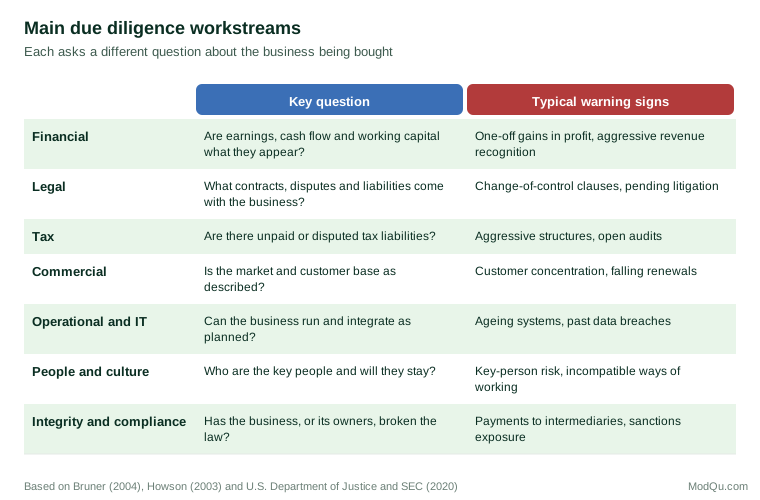
Financial due diligence tests the quality of earnings: whether reported profits reflect sustainable trading or have been flattered by one-off items, changes in accounting policy or timing. Wangerin (2019) found that the time and effort acquirers devote to due diligence is associated with fewer later write-downs and accounting problems, suggesting that careful financial investigation pays off.
Legal due diligence reviews contracts, licences, intellectual property, employment terms, litigation and regulatory status. Clauses allowing customers or suppliers to terminate on a change of control can remove much of the value being bought.
Integrity due diligence examines the target's owners, managers and business practices for corruption, fraud, sanctions breaches and links to organised crime. Under anti-corruption law, a buyer can inherit liability for the target's past conduct, and enforcement authorities expect acquirers to investigate before closing and to remedy problems promptly afterwards (U.S. Department of Justice & U.S. Securities and Exchange Commission, 2020). In practice, integrity due diligence combines searches of corporate registries, court records, sanctions and politically exposed person lists and media archives with discreet inquiries among people who know the target's market. It asks who really owns and controls the business, how it wins its contracts, which agents and intermediaries it pays and on what terms, and whether its owners or managers have been linked to past misconduct. Where the target operates in sectors or countries with a high risk of corruption, the review usually extends to a sample of payments to third parties, since these are the most common channel for bribes. Findings are graded by how well they are supported, because allegations in the press or from competitors are leads to be tested rather than established facts.
Data and cyber due diligence has grown in importance. After Yahoo disclosed two large data breaches during its sale to Verizon, the purchase price was reduced by 350 million dollars, and the regulator later fined Yahoo's successor for failing to disclose the breach to investors (U.S. Securities and Exchange Commission, 2018). When Marriott acquired Starwood, a compromise of Starwood's reservation system had already begun and went undetected; the United Kingdom regulator later fined Marriott and noted that the acquirer should have carried out more thorough checks of the systems it acquired (Information Commissioner's Office, 2020). Reviewing personal data during due diligence is itself regulated, and in Europe it must comply with the General Data Protection Regulation (Regulation (EU) 2016/679, 2016).
People and culture are often given the least attention, though they frequently determine whether an acquisition succeeds. Cartwright and Cooper (1993) argued that incompatible organisational cultures are a major cause of failed mergers, and Haspeslagh and Jemison (1991) showed that integration problems often stem from issues that could have been identified before the deal.
How the investigation is carried out
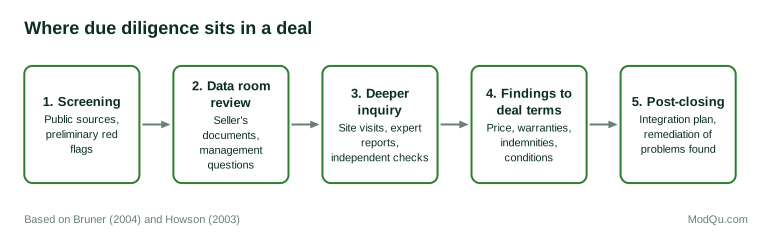
Due diligence usually begins with public sources: company filings, court records, media reports, sanctions lists and corporate registries. This early screening can reveal problems before the buyer has invested heavily in the deal. Once the parties have signed a confidentiality agreement, the seller opens a data room. Advisers review its contents and send written questions to management.
The data room is a curated source. It contains what the seller has chosen to provide, and the investigator's task is to test it rather than simply summarise it. Good practice includes reconciling management accounts to audited accounts and bank statements, speaking to customers and former employees where the seller allows it, visiting sites, and checking claims against independent sources. Questions that receive slow, vague or inconsistent answers deserve particular attention.
Findings are translated into the deal. A confirmed liability may reduce the price. An uncertain one may be covered by a warranty, in which the seller promises that a fact is true, or an indemnity, in which the seller agrees to bear a specific loss. Serious problems may lead to conditions that must be met before closing, or to the buyer walking away.
Why due diligence fails
Due diligence often fails for reasons that have little to do with the competence of the advisers.
- Time pressure. Competitive auctions give buyers only weeks, and sellers may restrict access to people and sites.
- Momentum. Once senior executives have committed publicly to a deal, findings that threaten it may be minimised. Roll's (1986) hubris hypothesis and the optimism described by Lovallo and Kahneman (2003) both predict this.
- Scope set too narrowly. Workstreams that do not talk to each other can miss problems that are only visible when financial, legal and operational findings are combined.
- Reliance on the seller. If the main sources are the seller's own documents and managers, deliberate misrepresentation can be hard to detect.
The purchase of Autonomy by Hewlett-Packard illustrates the last point. Hewlett-Packard wrote down most of the value of the acquisition a year later, alleging that Autonomy's accounts had been misstated. The High Court in London later found that Autonomy's former leaders had engaged in fraudulent accounting practices that inflated its revenue (ACL Netherlands BV v Lynch, 2022). The case shows that due diligence based mainly on the target's own records can be defeated by those who control those records.
Investigative habits that help
Due diligence works best when it is treated as an investigation rather than a checklist. That means stating the hypotheses that would make the deal unattractive and actively seeking evidence for them. It means testing management's account against independent sources, following up anomalies rather than noting them, and sharing findings across workstreams so that patterns become visible. It means reporting clearly to decision-makers what was not examined, what could not be verified and how much confidence they can place in the findings.
Above all, it means giving the people carrying out due diligence the independence to report bad news. The purpose of due diligence is not to justify a deal but to find out whether it should be done, and on what terms.
References
ACL Netherlands BV v Lynch [2022] EWHC 1178 (Ch).
Akerlof, G. A. (1970). The market for "lemons": Quality uncertainty and the market mechanism. Quarterly Journal of Economics, 84(3), 488–500. https://doi.org/10.2307/1879431
Andrade, G., Mitchell, M., & Stafford, E. (2001). New evidence and perspectives on mergers. Journal of Economic Perspectives, 15(2), 103–120. https://doi.org/10.1257/jep.15.2.103
Bruner, R. F. (2004). Applied mergers and acquisitions. Wiley.
Cartwright, S., & Cooper, C. L. (1993). The role of culture compatibility in successful organizational marriage. Academy of Management Executive, 7(2), 57–70. https://doi.org/10.5465/ame.1993.9411302324
Haspeslagh, P. C., & Jemison, D. B. (1991). Managing acquisitions: Creating value through corporate renewal. Free Press.
Howson, P. (2003). Due diligence: The critical stage in mergers and acquisitions. Gower.
Information Commissioner's Office. (2020). Penalty notice: Marriott International Inc.
King, D. R., Dalton, D. R., Daily, C. M., & Covin, J. G. (2004). Meta-analyses of post-acquisition performance: Indications of unidentified moderators. Strategic Management Journal, 25(2), 187–200. https://doi.org/10.1002/smj.371
Lovallo, D., & Kahneman, D. (2003). Delusions of success: How optimism undermines executives' decisions. Harvard Business Review, 81(7), 56–63.
Moeller, S. B., Schlingemann, F. P., & Stulz, R. M. (2005). Wealth destruction on a massive scale? A study of acquiring-firm returns in the recent merger wave. Journal of Finance, 60(2), 757–782. https://doi.org/10.1111/j.1540-6261.2005.00745.x
Regulation (EU) 2016/679 of the European Parliament and of the Council of 27 April 2016 on the protection of natural persons with regard to the processing of personal data and on the free movement of such data (General Data Protection Regulation). (2016). Official Journal of the European Union, L 119, 1–88.
Roll, R. (1986). The hubris hypothesis of corporate takeovers. Journal of Business, 59(2), 197–216. https://doi.org/10.1086/296325
U.S. Department of Justice, & U.S. Securities and Exchange Commission. (2020). A resource guide to the U.S. Foreign Corrupt Practices Act (2nd ed.).
U.S. Securities and Exchange Commission. (2018, April 24). Altaba, formerly known as Yahoo, charged with failing to disclose massive cybersecurity breach; agrees to pay $35 million [Press release 2018-71].
Wangerin, D. (2019). M&A due diligence, post-acquisition performance, and financial reporting for business combinations. Contemporary Accounting Research, 36(4), 2344–2378. https://doi.org/10.1111/1911-3846.12520