
Investigation · Business and corporate investigation
Background Checks and Pre-Employment Screening
Background checks are the most common investigation most people will ever be the subject of. This article explains what employers check, what the evidence says about how well checks predict behaviour at work, the legal limits on screening, and how to make it fair and proportionate.
For most people, the only formal investigation they will ever be the subject of is a background check. Before starting a new job, they are asked to prove their identity and right to work, to name referees, to consent to a criminal record search and sometimes to a credit check or drug test. Employers screen candidates to protect customers, colleagues and assets, to meet legal and regulatory duties, and to avoid liability for harm caused by people they should not have hired. Screening is now a large industry, and much of it is automated.
Background checks raise the same questions as any other investigation. What exactly is being established, and why? How reliable are the sources? Does the information actually predict what the employer cares about? And is the inquiry fair and proportionate to the person being examined? This article sets out what screening involves, what research shows about its value and its costs, the main legal constraints, and the practices that distinguish good screening from bad.
Why employers screen
To verify what candidates say
The most basic purpose of screening is to check that the candidate is who they claim to be and has the history they describe. Application forms and curricula vitae are written by the candidate to make a good impression, and some candidates go further than favourable emphasis. Henle et al. (2019) developed a measure of intentional résumé deception and found that fabrication, embellishment and omission were all reported by a meaningful share of job seekers. In interviews, too, candidates use a range of impression management tactics, some of which shade into deception (Levashina & Campion, 2007). Verification of identity, qualifications and employment history tests these claims against independent records.
To reduce the risk of harm
Employers also screen to reduce the risk that a new employee will harm others or the organisation. In occupational fraud cases reported to the Association of Certified Fraud Examiners (2024), most perpetrators had no prior fraud conviction, which shows that screening cannot catch everyone; but where a candidate's past does reveal relevant dishonesty or violence, employers are expected to take it into account. For roles involving children, vulnerable adults, money, sensitive data or national security, screening is often a legal requirement. In England and Wales, for example, the Safeguarding Vulnerable Groups Act 2006 created lists of people barred from working with children and vulnerable adults, and employers in regulated activity must check them.
To manage liability
In the United States, an employer can be held liable for negligent hiring if it knew or should have known that an employee posed a risk and that risk caused harm. In Ponticas v. K.M.S. Investments (1983), the Minnesota Supreme Court upheld liability against the owner of an apartment complex that had hired a resident manager, given him keys to tenants' apartments and failed to make reasonable inquiries into his background, which included violent offences. The case is widely cited as establishing that the extent of the inquiry required depends on the risks of the job.
What is checked
A background check is not a single inquiry but a bundle of separate ones, each drawing on different sources with different strengths and weaknesses.
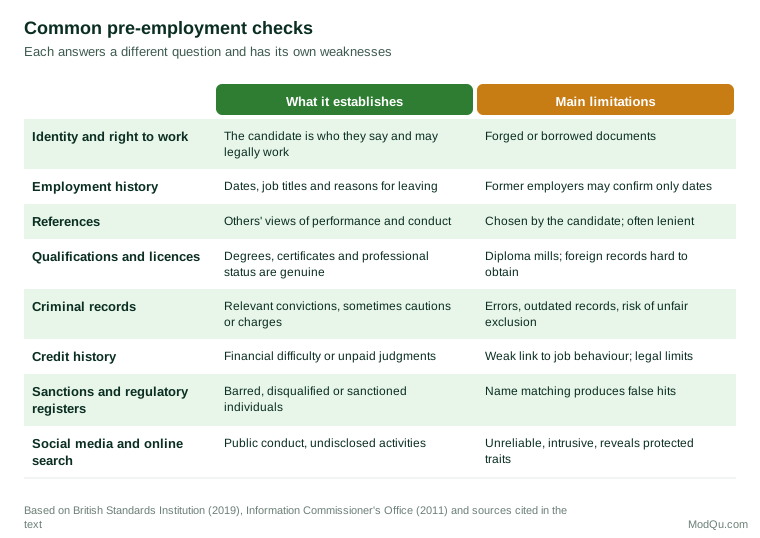
Identity and right to work. Employers check identity documents and, in many countries, are legally required to confirm that the person is entitled to work. Forged and borrowed documents are the main risk, and specialist checks of document security features or online government services reduce it.
Employment history and references. Investigators confirm previous employers, dates and job titles. Gaps and inconsistencies are followed up, since an unexplained gap may conceal a period of employment that ended badly or a period in custody. References are weaker evidence than they appear. Candidates choose their referees, and many employers, fearing defamation claims, will confirm only dates of employment. Taylor et al. (2004) found that a structured reference check, in which referees rated specific job-relevant behaviours, had useful predictive validity, but unstructured references add little.
Qualifications and licences. Claims about degrees and professional qualifications are checked with the issuing institution or a verification service. Fake degrees from unaccredited institutions, sometimes called diploma mills, are a persistent problem, and qualifications from abroad can be slow to verify.
Criminal records. Criminal record checks are the most consequential and the most contested element of screening, and are discussed in detail below.
Credit history. Some employers, particularly in financial services, check credit records on the theory that people in financial difficulty are more likely to steal. The evidence for this is weak. Bernerth et al. (2012) found that credit scores were related to conscientiousness and to some aspects of job performance, but not to deviant behaviour at work, which is what credit checks are usually meant to predict.
Sanctions and regulatory registers. Checks against sanctions lists, registers of disqualified directors and lists of people barred by financial or health regulators are essential for certain roles. Their main weakness is name matching: common names produce false hits that must be resolved with dates of birth and other identifiers before anyone is treated as a match.
Social media and online searches. Searching a candidate's online presence is cheap and increasingly common, but it is also the least reliable and most intrusive form of screening. Kluemper et al. (2012) found that ratings of personality from social networking profiles had some relationship with job performance, but Van Iddekinge et al. (2016) found that recruiters' ratings of Facebook profiles did not predict job performance or turnover and tended to favour some demographic groups over others. Online searches also expose information about religion, health, sexuality and family status that employers are not permitted to use, which creates a risk of discrimination claims even if the information is not consciously relied upon.
How well do background checks predict behaviour at work?
Background checks are usually justified by their power to predict. The research on selection methods suggests that this power varies a great deal. In their influential review, Schmidt and Hunter (1998) reported that reference checks had a modest correlation with later job performance, much lower than structured interviews or tests of cognitive ability. Sackett et al. (2022) later argued that many earlier validity estimates had been overcorrected and revised several of them downwards, but the broad conclusion that background information is a weaker predictor than well-designed assessments still holds.
Integrity tests, which ask candidates about their attitudes to honesty and rule-breaking, have been studied more closely than most background checks. Ones et al. (1993) found substantial validity for predicting counterproductive behaviour at work. A later meta-analysis by Van Iddekinge et al. (2012) using stricter criteria found much smaller relationships, particularly for objective measures of misconduct, and the debate between the two groups of researchers has not been fully resolved. The disagreement is a useful reminder that claims about what screening can predict should be examined as carefully as the candidates themselves.
The weakest predictive evidence is for credit checks and social media screening. The strongest case for screening rests not on prediction but on verification: confirming identity, legal status, qualifications and the absence of specific disqualifications that the law or the role requires.
Criminal records: relevance, accuracy and fairness
The scale of the issue
Criminal records are widespread. In the United States, large numbers of adults have an arrest or conviction record, and the growth of commercial databases means that these records are easier to find than ever. Jacobs (2015) describes how criminal records have become permanent, publicly accessible and widely used for purposes far beyond the criminal justice system. Lageson (2020) shows how private companies collect records from courts and police, repackage them and sell them, often with errors: records attributed to the wrong person, charges that were dropped shown as convictions, and records that had been sealed or expunged still in circulation.
The effect on candidates
Field experiments show that criminal records have large effects on hiring. Pager (2003) sent matched pairs of testers to apply for entry-level jobs in Milwaukee, with one member of each pair reporting a drug conviction. Testers with a record received far fewer callbacks, and the penalty was greater for Black testers. Uggen et al. (2014) found that even a low-level arrest that did not lead to conviction reduced callbacks in a similar experiment.
Because criminal records are unevenly distributed across racial and ethnic groups, blanket exclusions can have a disproportionate effect on some groups. Guidance from the U.S. Equal Employment Opportunity Commission (2012) advises employers that excluding everyone with a criminal record may amount to discrimination under civil rights law, and recommends an individualised assessment that considers the nature of the offence, the time that has passed since it occurred and the nature of the job.
Policies that try to address it
Many jurisdictions have adopted "ban the box" policies, which remove questions about criminal history from initial application forms and delay record checks until later in the hiring process. The effects have been mixed. Agan and Starr (2018) found that when employers could no longer ask about criminal records, the gap in callbacks between Black and white applicants grew, apparently because some employers assumed that young Black men were more likely to have a record. Doleac and Hansen (2020) reported similar effects on employment outcomes. These studies show that hiding information does not necessarily remove the bias it was intended to address; employers may substitute guesses based on race for the information they can no longer see.
Other approaches focus on how old and how relevant a record is. Blumstein and Nakamura (2009) examined how long it takes for the risk of reoffending among people with a past arrest to fall to the level of the general population of the same age. They found that after several years without a further arrest, the risk was close to that of people with no record, which suggests that old records have limited predictive value. Laws on spent convictions reflect this idea. In the United Kingdom, the Rehabilitation of Offenders Act 1974 allows many convictions to become "spent" after a period, after which they need not be disclosed for most jobs, although exceptions apply to roles such as teaching, health care and law.
Legal limits on screening
Background checks involve collecting and using personal data, and they are regulated accordingly.
In the United States, the Fair Credit Reporting Act (1970) governs background reports obtained from commercial screening companies. Employers must tell candidates that a report will be obtained and get their written consent. If the employer intends to reject a candidate because of the report, it must first give the candidate a copy and a summary of their rights, so that errors can be corrected, and must then send a final notice. Screening companies must follow reasonable procedures to ensure accuracy.
In the European Union and the United Kingdom, the General Data Protection Regulation (Regulation (EU) 2016/679, 2016) requires that personal data be processed lawfully, fairly and transparently, for specified purposes, and that it be adequate, relevant and limited to what is necessary. Criminal conviction data receives special protection and can be processed only where national law authorises it. Guidance from the United Kingdom regulator on employment practices advises that vetting should be limited to cases where there are particular and significant risks, that candidates should be told what checks will be made, and that information should be obtained from reliable sources (Information Commissioner's Office, 2011).
Industry standards add further detail. The British Standard for screening people who work in secure environments sets out how far back employment history should be verified, how gaps should be investigated and how the process should be documented (British Standards Institution, 2019).
Matching screening to risk
A recurring principle in law and guidance is proportionality: the depth of the check should match the risks of the role. A junior retail assistant and a treasury manager should not face the same inquiry, and neither should a contractor with no access to customers and a care worker who visits elderly people at home.
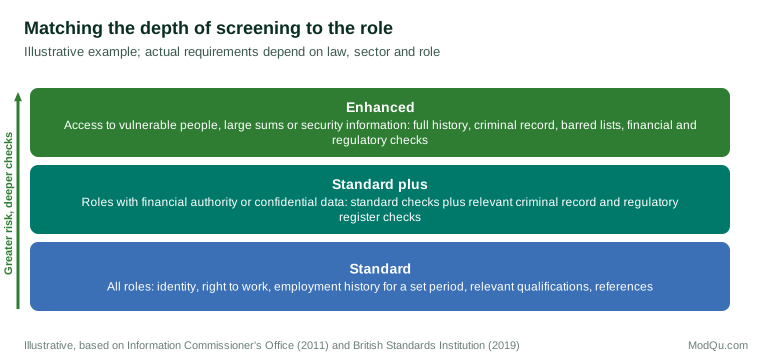
A risk-based approach starts by asking what harm a person in the role could cause, then identifying which checks provide relevant evidence about that risk. A criminal record check for a driver should focus on driving and violence offences; for a payroll clerk, on dishonesty. Information that is unrelated to the risks of the role should not be collected, and if it is found, it should not be used.
Screening across borders and over time
Two developments have made screening more complicated. The first is international mobility. Many candidates have lived, studied or worked in several countries, and the records available differ greatly between them. Some countries do not release criminal records to employers at all, some issue certificates only to the individual, and some have no central register. Education records may be held by institutions that no longer exist or that respond slowly to foreign requests. A check that is routine for a domestic candidate can therefore take weeks for someone with an international history, and the result may be less complete. Employers should record what could not be checked rather than treating an absence of records as a clean result.
The second is continuous screening. Rather than checking people only at the point of hiring, some employers, particularly in finance, transport and government, now re-check employees at intervals or subscribe to services that report new arrests, court judgments or regulatory actions as they occur. This can identify risks that arise after hiring, but it also extends the investigation into the whole of a person's employment. The same principles of relevance, transparency and accuracy apply, and employees should know that ongoing checks take place and what they cover. An alert from an automated service is a lead, not a finding: it should be confirmed, matched to the right person and discussed with the employee before any action is taken.
Doing screening well
Screening is an investigation into a person who usually cannot see the evidence being gathered. Good practice therefore rests on the same principles as other fair investigations.
- Define the purpose. Decide what each check is meant to establish and how the results will be used before collecting anything.
- Be transparent. Tell candidates what will be checked, why and by whom, and obtain consent where it is required.
- Use reliable sources. Prefer primary sources, such as issuing institutions and official registers, to aggregated databases, and confirm identity before attributing a record to a candidate.
- Assess relevance. Consider the nature of any adverse information, how long ago it occurred, whether it relates to the job and what the candidate has done since.
- Give the candidate a chance to respond. Before rejecting someone on the basis of a check, show them the information and let them explain or correct it. This protects against errors as well as treating candidates fairly.
- Keep it consistent. Apply the same checks to all candidates for the same role, and document decisions so that they can be reviewed.
- Retain and dispose of data properly. Keep screening results only as long as necessary, store them securely and limit access.
The step most often skipped is the fifth. A candidate's explanation can show that a record belongs to someone else, that a gap in employment was spent caring for a relative, or that a qualification was awarded under a former name. Without it, screening is a one-sided inquiry that can reach the wrong conclusion and leave the candidate without remedy.
Conclusion
Background checks are a form of investigation applied on a very large scale. At their best, they verify facts that matter to the job, protect vulnerable people and give employers reasonable confidence in their hiring decisions. At their worst, they rely on inaccurate data, exclude people for reasons unrelated to the role and reproduce existing inequalities. The research reviewed here suggests that screening is most valuable when it verifies specific claims and requirements, and least valuable when it is used as a general predictor of character. Employers who define what they need to know, collect only relevant information, check it carefully and give candidates the chance to respond will hire more safely and more fairly.
References
Agan, A., & Starr, S. (2018). Ban the box, criminal records, and racial discrimination: A field experiment. Quarterly Journal of Economics, 133(1), 191–235. https://doi.org/10.1093/qje/qjx028
Association of Certified Fraud Examiners. (2024). Occupational fraud 2024: A report to the nations.
Bernerth, J. B., Taylor, S. G., Walker, H. J., & Whitman, D. S. (2012). An empirical investigation of dispositional antecedents and performance-related outcomes of credit scores. Journal of Applied Psychology, 97(2), 469–478. https://doi.org/10.1037/a0026055
Blumstein, A., & Nakamura, K. (2009). Redemption in the presence of widespread criminal background checks. Criminology, 47(2), 327–359. https://doi.org/10.1111/j.1745-9125.2009.00155.x
British Standards Institution. (2019). Screening of individuals working in a secure environment: Code of practice (BS 7858:2019).
Doleac, J. L., & Hansen, B. (2020). The unintended consequences of "ban the box": Statistical discrimination and employment outcomes when criminal histories are hidden. Journal of Labor Economics, 38(2), 321–374. https://doi.org/10.1086/705880
Fair Credit Reporting Act, 15 U.S.C. § 1681 et seq. (1970).
Henle, C. A., Dineen, B. R., & Duffy, M. K. (2019). Assessing intentional resume deception: Development and nomological network of a resume fraud measure. Journal of Business and Psychology, 34(1), 87–106. https://doi.org/10.1007/s10869-017-9527-4
Information Commissioner's Office. (2011). The employment practices code.
Jacobs, J. B. (2015). The eternal criminal record. Harvard University Press.
Kluemper, D. H., Rosen, P. A., & Mossholder, K. W. (2012). Social networking websites, personality ratings, and the organizational context: More than meets the eye? Journal of Applied Social Psychology, 42(5), 1143–1172. https://doi.org/10.1111/j.1559-1816.2011.00881.x
Lageson, S. E. (2020). Digital punishment: Privacy, stigma, and the harms of data-driven criminal justice. Oxford University Press.
Levashina, J., & Campion, M. A. (2007). Measuring faking in the employment interview: Development and validation of an interview faking behavior scale. Journal of Applied Psychology, 92(6), 1638–1656. https://doi.org/10.1037/0021-9010.92.6.1638
Ones, D. S., Viswesvaran, C., & Schmidt, F. L. (1993). Comprehensive meta-analysis of integrity test validities: Findings and implications for personnel selection and theories of job performance. Journal of Applied Psychology, 78(4), 679–703. https://doi.org/10.1037/0021-9010.78.4.679
Pager, D. (2003). The mark of a criminal record. American Journal of Sociology, 108(5), 937–975. https://doi.org/10.1086/374403
Ponticas v. K.M.S. Investments, 331 N.W.2d 907 (Minn. 1983).
Regulation (EU) 2016/679 of the European Parliament and of the Council of 27 April 2016 on the protection of natural persons with regard to the processing of personal data and on the free movement of such data (General Data Protection Regulation). (2016). Official Journal of the European Union, L 119, 1–88.
Rehabilitation of Offenders Act 1974, c. 53 (UK).
Sackett, P. R., Zhang, C., Berry, C. M., & Lievens, F. (2022). Revisiting meta-analytic estimates of validity in personnel selection: Addressing systematic overcorrection for restriction of range. Journal of Applied Psychology, 107(11), 2040–2068. https://doi.org/10.1037/apl0000994
Safeguarding Vulnerable Groups Act 2006, c. 47 (UK).
Schmidt, F. L., & Hunter, J. E. (1998). The validity and utility of selection methods in personnel psychology: Practical and theoretical implications of 85 years of research findings. Psychological Bulletin, 124(2), 262–274. https://doi.org/10.1037/0033-2909.124.2.262
Taylor, P. J., Pajo, K., Cheung, G. W., & Stringfield, P. (2004). Dimensionality and validity of a structured telephone reference check procedure. Personnel Psychology, 57(3), 745–772. https://doi.org/10.1111/j.1744-6570.2004.00006.x
Uggen, C., Vuolo, M., Lageson, S., Ruhland, E., & Whitham, H. K. (2014). The edge of stigma: An experimental audit of the effects of low-level criminal records on employment. Criminology, 52(4), 627–654. https://doi.org/10.1111/1745-9125.12051
U.S. Equal Employment Opportunity Commission. (2012). Enforcement guidance on the consideration of arrest and conviction records in employment decisions under Title VII of the Civil Rights Act of 1964.
Van Iddekinge, C. H., Lanivich, S. E., Roth, P. L., & Junco, E. (2016). Social media for selection? Validity and adverse impact potential of a Facebook-based assessment. Journal of Management, 42(7), 1811–1835. https://doi.org/10.1177/0149206313515524
Van Iddekinge, C. H., Roth, P. L., Raymark, P. H., & Odle-Dusseau, H. N. (2012). The criterion-related validity of integrity tests: An updated meta-analysis. Journal of Applied Psychology, 97(3), 499–530. https://doi.org/10.1037/a0021196