
Share your experience of credit scores
Tell us whether you know your score, how often you check it, and how it has affected you. Your answers are combined with other people's and reported only as totals.
Start the credit scores and credit reports surveyAbout 5 minutes. No account needed. You can stop at any time.
What credit reports and credit scores are
In many countries, organizations called credit bureaus or credit reference agencies collect information about how people use credit. Banks, card issuers, phone companies and other lenders send them details of accounts and payments. The bureau keeps this as a credit report (also called a credit file).
A credit score is a number calculated from the report. It is meant to predict how likely a person is to repay. Lenders use it, together with other information, to decide whether to lend, how much, and at what interest rate.
Not every country works the same way. Some have several private bureaus that each hold their own file on a person, so the scores can differ. Some have a single public credit registry run by the central bank. Some use scores widely; others rely more on the full report or on income checks. In places where formal credit is less common, lenders may use other data, such as mobile phone payments.
What a credit report usually contains
The contents vary by country, but most reports include:
- Personal details: name, date of birth, current and past addresses.
- Accounts: credit cards, loans, mortgages, overdrafts, and sometimes phone and utility contracts.
- Payment history: whether payments were made on time, late or missed.
- Balances and limits: how much is owed and how much credit is available.
- Public records: bankruptcies, court judgments or insolvency arrangements, where these are reported.
- Searches: a list of organizations that have looked at the report, and when.
Reports usually do not include income, savings, religion, ethnicity or health. Negative items stay on the file for a set number of years, which differs by country.
How scores are worked out
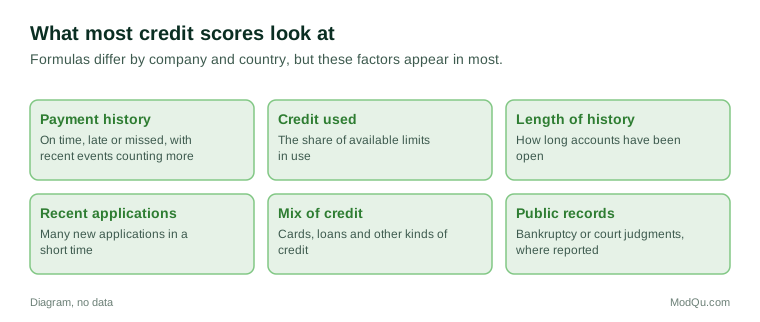
Each scoring company uses its own formula, and the exact formulas are not public. In general, scores tend to reflect a small number of factors:
- Payment history: paying on time helps; late and missed payments hurt, and recent ones count more.
- How much credit is used: using a small share of available limits is usually seen as lower risk than using most of it.
- Length of history: a longer record gives lenders more to go on.
- Recent applications: many applications in a short time can lower a score.
- Mix of credit: some scores consider whether a person has handled different kinds of credit.
Example (hypothetical figures)
A person has two credit cards with a combined limit of 5,000 and a combined balance of 4,000, so they are using 80% of their available credit. They pay the balances down to 1,000 over three months, bringing use to 20%. Their next score is higher, even though nothing else has changed.
The figure below shows the factors most scoring systems look at.
Where scores are used
Credit scores are used for more than loans. Depending on the country, they may be checked when someone:
- applies for a credit card, car loan or mortgage;
- signs a phone contract or opens a utility account;
- rents a flat, where landlords check applicants;
- buys some kinds of insurance;
- applies for certain jobs, where this is allowed.
A higher score can mean a better interest rate, a larger limit, or approval where someone with a lower score would be declined. A thin file, meaning very little credit history, can cause problems too, because the lender has little to go on.
People with little or no credit history
Young adults, newcomers to a country, and people who have always paid with cash may have no credit file or a very thin one. This can make it hard to get a first card, rent a home or sign a phone contract.
Common ways people build a history include a secured credit card, where a deposit acts as the limit; a small loan designed to build credit; being added as an additional cardholder on someone else's account; and, in some countries, having rent or utility payments reported.
Example
A nurse moves to a new country for work. Despite a good salary and a clean history at home, they have no local credit file. Their first rental application is turned down. They open a secured card with a small deposit, pay it in full every month, and after a year are approved for a standard card and a phone contract.
Checking and correcting a report
In many countries people have a legal right to see their own credit report, often free of charge, at least once a year. Many lenders and apps also show a score for free. Checking one's own report usually does not affect the score.
Errors are not rare. Common problems include accounts that belong to someone else with a similar name, payments recorded as late when they were on time, debts that were paid but still show as outstanding, and accounts opened by fraudsters. Most countries have a process for disputing errors with the bureau, which must investigate and correct the file if the information is wrong.
Example
A shopper is declined for a store card and checks their report for the first time. It shows a phone contract they never opened, with three missed payments. They report it to the bureau and the phone company as fraud. The account is removed, and they add a fraud alert to their file.
Myths and misunderstandings
Credit scores are widely misunderstood. Common beliefs that are usually wrong include:
- that checking your own score lowers it;
- that your income is part of your credit score;
- that closing old cards always improves a score (it can reduce available credit and shorten history);
- that there is only one score (there are often several, from different companies and models);
- that living with someone with poor credit automatically affects your own file (in many places, only joint accounts link people).
What people disagree about
Supporters say credit scores make lending faster, fairer and less dependent on personal judgment. Critics say scores can shut out people with thin files, can be hard to understand, and can reflect past disadvantages. There is also debate about using new kinds of data, such as rent or phone payments, which can help some people build a history but raises privacy questions.
Questions that businesses want answered include how many people know their score, how often they check it, where they check it, whether they have found errors, and how scores have affected their borrowing and renting.
Key terms
- Credit bureauAn organization that collects and keeps information about how people use credit.
- Credit reportThe record a bureau holds about a person's credit accounts and payments.
- Credit scoreA number calculated from a credit report to predict the chance of repayment.
- Credit utilizationThe share of available credit limits that is being used.
- Thin fileA credit report with little or no history.
- Hard inquiryA search by a lender after an application, which may affect a score.
- Soft inquiryA search that does not affect a score, such as checking your own report.
- Secured credit cardA card backed by a cash deposit, often used to build credit.
Full glossary: consumer credit terms on EditingTests.com.
Credit scores and credit reports vocabulary test
How well do you know the language of this topic? Try 8 quick questions. Your score is shown straight away and is not saved.
What the credit scores and credit reports survey asks
This survey is part of ModQu's Money and Banking survey. The credit scores and credit reports part takes about five minutes and covers:
- Whether you know your credit score and where you last checked it.
- How often you look at your credit report.
- Whether you have ever found an error, and what you did about it.
- How your credit score has affected borrowing, renting or other applications.
- What you believe raises or lowers a score.
- How you feel about new kinds of data being used in credit decisions.
After that you can choose to continue with other short parts of the Money and Banking survey, such as everyday banking or digital payments and wallets, or stop.
Ready to take part?
Your answers help show what people really think and do. Results are only ever reported as totals; no one can see your individual answers.
Start the surveyQuestions about this survey
Who can take part?
Adults with any credit product.
Do I have to give my name?
No. You may be asked for your age group, region and similar details so results can be broken down, but not your name. ModQu never asks for passwords, card numbers or account numbers.
How are the results used?
Answers are combined into totals and percentages and published in ModQu reports. Individual answers are never shown.
Is the vocabulary test part of the survey?
No. It is optional and separate, and your score is not stored.