
Share your experience of building a home
Tell us whether you have built a home or plan to, whether you hired a builder or managed it yourself and whether it went over budget. Your answers are combined with other people's and reported only as totals.
Start the building a new home surveyAbout 5 minutes. No account needed. You can stop at any time.
What this topic covers
Building a new home means having a house built for you, rather than buying one that already exists. This topic covers:
- the main routes: custom builders, package or volume builders, self-managed builds and self-build;
- the main steps, from land to moving in;
- budgets, financing and cost overruns;
- delays and their causes;
- choosing and working with builders;
- satisfaction and common problems.
It does not cover buying a newly built home from a developer in a finished development, except for comparison, though many of the same questions apply.
Routes to building a home
People build homes in several ways:
- Custom builder: an architect or designer creates a home for the owner's land, and a builder constructs it under contract.
- Package or volume builder: the owner chooses from a range of standard designs, often with options, built on their land or on a lot in a new estate. This is common in Australia, North America and elsewhere.
- Owner-managed build: the owner acts as project manager, hiring separate trades and buying materials.
- Self-build: the owner does much of the work themselves, often with help from family and friends. In many parts of the world, especially in rural areas and in Africa, Asia and Latin America, homes are commonly built step by step over years, as money allows.
- Kit and modular homes: parts or whole sections are made in a factory and assembled on site.
Example
A family in a growing town buys a plot and builds their house in stages over six years. They build the ground floor first and move in, then add a second floor when they have saved more money. They hire local builders for each stage and buy materials themselves. They say building in stages meant no large loan, but living on a building site was tiring.
The main steps
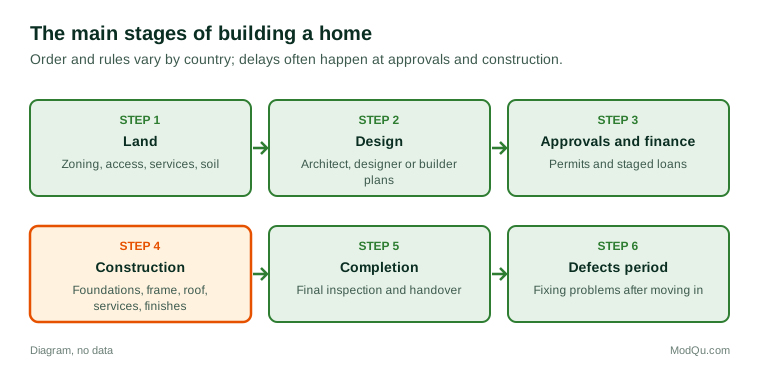
Most new home projects go through similar steps, though the order and rules vary by country:
- Finding land, checking zoning, access, services and soil;
- Design, with an architect, designer or builder's plans;
- Approvals: planning or building permits from local authorities;
- Financing: savings, a construction loan or mortgage released in stages;
- Choosing a builder and signing a contract;
- Construction: foundations, frame, roof, services, interior and finishes;
- Inspections at stages during building;
- Completion: final inspection, certificate of occupancy where required, and handover;
- Defects period: fixing problems that appear after moving in.
Figure 1 shows these stages.
Budgets and why they are exceeded
Going over budget is one of the most common experiences in building a home. Common reasons include:
- Changes by the owner after construction starts, called variations or change orders;
- Allowances in contracts that turn out too low for the finishes chosen;
- Site problems, such as poor soil, rock or drainage;
- Price rises for materials and labour during the build;
- Permit and connection costs for water, power and sewers;
- Landscaping, driveways and fences not included in the build price;
- Delays that increase rent or loan costs.
Many advisers suggest keeping a contingency fund for unexpected costs.
Example (hypothetical figures)
A couple's build contract is 320,000 dollars. Changes to the kitchen and windows add 18,000 dollars, extra foundation work on poor soil adds 12,000 dollars, and driveway and landscaping not in the contract cost 15,000 dollars. The final cost is 365,000 dollars, 45,000 dollars or about 14% over the contract price. They had set aside a 10% contingency of 32,000 dollars, so they had to find 13,000 dollars more.
Delays
Delays are also very common. Causes include:
- waiting for permits and approvals;
- bad weather;
- shortages of materials or skilled trades;
- builders running several projects at once;
- inspections that require rework;
- changes by the owner;
- financial problems at the building company, which in rare cases lead to insolvency and unfinished homes.
Delays matter because many owners are paying rent or a mortgage on another home while they wait.
Choosing and working with a builder
People choose builders through:
- recommendations from friends and neighbours;
- display homes and show homes;
- reviews and past projects;
- licensing and membership of industry bodies;
- comparing quotes and contracts.
Things owners often wish they had checked more include what is included in the price, how changes are priced, payment schedules, warranties, insurance and how disputes will be handled. In many countries, builders must be licensed and new homes come with a statutory or industry warranty for structural defects, though protections vary.
Example
An owner chooses the cheapest of three quotes for a custom build. During construction they discover the quote included only basic fixtures and very low allowances for flooring and lighting. They pay much more than planned for the finishes they wanted. Next time, they say, they would compare what each quote included, not just the total.
Satisfaction and common problems
Owners who are satisfied often mention good communication, a builder who kept to the timetable, clear pricing and a home that matched their plans. Common problems include:
- poor workmanship and defects;
- slow responses to problems after handover;
- poor communication during construction;
- disputes over extra charges;
- stress on relationships and family life;
- living in a home that is not quite finished.
Many owners say they would build again but would plan differently.
Trends and debates
Trends include energy-efficient and low-carbon building standards, modular and factory-built homes, smaller homes and accessory dwellings, and building in places affected by fire, flood and heat. Debates include the cost and time of planning approvals, the quality of volume-built homes, protection for owners when builders fail, and whether self-build should be supported more as a route to affordable housing.
Questions that businesses want answered here include how many people have built or plan to build, which route they chose, whether projects went over budget or time and how satisfied owners were.
Key terms
- Custom builderA builder who constructs a home designed specifically for the owner.
- Volume builderA builder who offers a range of standard home designs built in large numbers.
- Building permitOfficial approval to build, issued by a local authority.
- Construction loanA loan released in stages as building progresses.
- VariationA change to the building contract after it is signed, often with extra cost.
- ContingencyMoney set aside for unexpected costs.
- Defects periodA time after completion during which the builder must fix defects.
- Certificate of occupancyOfficial approval that a building is fit to live in, required in some places.
Full glossary: homebuilding operations terms on EditingTests.com.
Building a new home vocabulary test
How well do you know the language of this topic? Try 8 quick questions. Your score is shown straight away and is not saved.
What the building a new home survey asks
This survey is part of ModQu's Home and Property survey. The building a new home part takes about five minutes and covers:
- Whether you have built a home or plan to, and where.
- Which route you chose: custom builder, standard design, managing trades yourself or self-build.
- How you chose your builder, and what you checked.
- Whether the project went over budget, by how much and why.
- Whether the project was delayed, and why.
- How satisfied you are with the finished home and the builder.
After that you can choose to continue with other short parts of the Home and Property survey, such as buying a home or renting, or stop.
Ready to take part?
Your answers help show what people really think and do. Results are only ever reported as totals; no one can see your individual answers.
Start the surveyQuestions about this survey
Who can take part?
Adults who built or plan to build a home.
Do I have to give my name?
No. You may be asked for your age group, region and similar details so results can be broken down, but not your name. ModQu never asks for passwords, card numbers or account numbers.
How are the results used?
Answers are combined into totals and percentages and published in ModQu reports. Individual answers are never shown.
Is the vocabulary test part of the survey?
No. It is optional and separate, and your score is not stored.
Is building cheaper than buying an existing home?
It depends on land prices, building costs, the design and local market conditions. Building can cost more or less than buying, and costs are less certain until the project is finished.
What does a builder's warranty cover?
It depends on the country and the contract. Many cover structural defects for a number of years and workmanship for a shorter time. Owners are usually advised to read the warranty terms before signing.