
Share your experience of shared housing
Tell us whether you share your home with people who are not family, how you found them and what causes the most disagreements. Your answers are combined with other people's and reported only as totals.
Start the shared housing and roommates surveyAbout 5 minutes. No account needed. You can stop at any time.
What this topic covers
Shared housing means living in a home with one or more people who are not family members or partners. They may be called roommates, flatmates or housemates depending on the country. This topic covers:
- why people share and who shares;
- the different kinds of shared housing;
- how people find housemates or rooms;
- how rent, bills and chores are divided;
- common causes of disagreement and how they are handled;
- tenancy arrangements and rights.
Why people share
The main reasons people give include:
- Cost: sharing makes rent and bills more affordable, especially in expensive cities.
- Location: sharing lets people live closer to work, study or city centres.
- Company: some people prefer living with others to living alone.
- Flexibility: rooms can often be rented for shorter periods.
- Life stage: students, people moving to a new city, people after a separation and people saving for a home.
Sharing is most common among students and young adults, but older adults also share, sometimes because of rising housing costs, divorce, or a wish for company.
Kinds of shared housing
Shared housing takes several forms:
- Friends renting together, often on a joint lease.
- Renting a room in a home where other tenants already live.
- Lodging in a home where the owner also lives.
- Student housing, including halls of residence and shared student flats.
- Co-living spaces: purpose-built buildings with private bedrooms and shared kitchens, lounges and services, often with flexible contracts.
- Houses in multiple occupation, a legal term in some countries for homes rented to several unrelated tenants, often with extra safety rules and licences.
- Intergenerational home-sharing, where an older homeowner offers a room to a younger person, sometimes at low rent in exchange for help or company.
Finding housemates and rooms
People find housemates or rooms through:
- friends, classmates and colleagues;
- room-share websites and apps;
- social media groups and noticeboards;
- universities and employers;
- letting agents and co-living operators.
Many people meet potential housemates before agreeing, asking about schedules, cleanliness, guests, noise, smoking, pets and how bills will be paid. Scams are a known risk: fake listings that ask for a deposit before a viewing, or rooms that do not exist.
Example
A graduate moving to a new city for a job searches room-share apps from their home town. A room looks perfect, but the person advertising it asks for a deposit before any video call or viewing. The graduate refuses and instead books two weeks in a hostel, viewing rooms in person until they find a shared flat with three other young workers.
Splitting rent and bills
How costs are divided is a frequent source of discussion. Common approaches include:
- Equal shares of rent and bills;
- Rent by room size, so a larger bedroom or one with its own bathroom pays more;
- Bills split equally, or by use for things like heating;
- One person paying and others repaying, often through a bill-splitting app;
- All-inclusive rent, where the landlord includes bills.
Example (hypothetical figures)
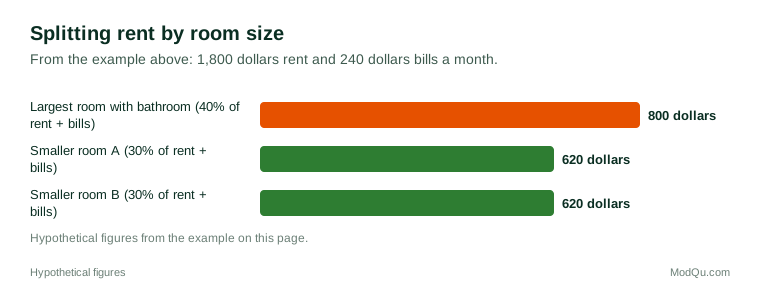
Three housemates share a flat with rent of 1,800 dollars a month. They agree to pay by room size: the largest room, with its own bathroom, pays 720 dollars (40%), and the two smaller rooms pay 540 dollars each (30%). Bills of 240 dollars a month are split equally, 80 dollars each. Monthly costs are 800 dollars for the largest room and 620 dollars for each smaller room.
Figure 1 shows the split from that example.
What causes disagreements
Housemates report many sources of tension:
- Cleanliness and chores: dirty dishes, bathrooms and shared spaces;
- Noise, especially at night;
- Guests and partners staying often;
- Bills and money: late payments, heating use and shared groceries;
- Food taken without asking;
- Different schedules: shift workers, students and early risers;
- Temperature: how warm or cool to keep the home;
- Moving out: finding a replacement and returning deposits.
Example
In a shared house of four, one housemate works night shifts and sleeps during the day. Others play music and cook loudly in the afternoon. After several arguments, they agree quiet hours from 9 a.m. to 3 p.m. on weekdays and buy a shared calendar for cleaning. They say putting rules in writing made it easier to raise problems without arguing.
What helps shared homes work
Housemates who get on well often mention:
- agreeing rules early, about chores, guests, noise and bills;
- a written house agreement, even an informal one;
- a cleaning rota or paying for a cleaner;
- using a bill-splitting app or a shared account;
- regular short house meetings;
- respecting privacy and personal space;
- dealing with small problems before they grow.
Tenancies and rights
The legal arrangements behind shared housing vary by country and region. Housemates may be on one joint tenancy agreement, where they may all be responsible for the whole rent; on separate agreements for each room; or living as lodgers with fewer rights. Rules on deposits, notice periods, rent increases and the number of people allowed in a home also differ. Many tenants are unsure which arrangement they have.
Trends and debates
Trends include more adults sharing into their thirties and beyond in expensive cities, the growth of co-living buildings, and intergenerational home-sharing schemes. Debates include whether co-living offers good value, the standards and safety of shared homes, landlords dividing homes into many small rooms, and how sharing affects people's wellbeing and plans to buy a home.
Questions that businesses want answered here include why people share, how they find housemates, how they split costs and what causes the most disagreements.
Key terms
- Roommate or housemateA person you share a home with who is not family or a partner.
- Joint tenancyOne rental agreement signed by all tenants, who may all be responsible for the whole rent.
- LodgerA person who rents a room in a home where the owner also lives.
- Co-livingPurpose-built shared housing with private rooms and shared spaces and services.
- House rulesAgreements among housemates about chores, guests, noise and bills.
- Bill-splitting appAn app that tracks shared costs and who owes what.
- DepositMoney paid at the start of a tenancy to cover damage or unpaid rent.
- Cleaning rotaA schedule that shares cleaning tasks among housemates.
Full glossary: residential property management terms on EditingTests.com.
Shared housing and roommates vocabulary test
How well do you know the language of this topic? Try 8 quick questions. Your score is shown straight away and is not saved.
What the shared housing and roommates survey asks
This survey is part of ModQu's Home and Property survey. The shared housing and roommates part takes about five minutes and covers:
- Whether you share your home with people who are not family, and how many.
- Why you share, and what kind of shared housing you live in.
- How you found your housemates or room.
- How you split rent, bills and chores.
- What causes the most disagreements, and how you resolve them.
- What kind of tenancy or agreement you have.
After that you can choose to continue with other short parts of the Home and Property survey, such as buying a home or renting, or stop.
Ready to take part?
Your answers help show what people really think and do. Results are only ever reported as totals; no one can see your individual answers.
Start the surveyQuestions about this survey
Who can take part?
Adults who share a home with non-family members.
Do I have to give my name?
No. You may be asked for your age group, region and similar details so results can be broken down, but not your name. ModQu never asks for passwords, card numbers or account numbers.
How are the results used?
Answers are combined into totals and percentages and published in ModQu reports. Individual answers are never shown.
Is the vocabulary test part of the survey?
No. It is optional and separate, and your score is not stored.
What should housemates agree before moving in?
Common topics are how rent and bills will be split, cleaning, guests and partners staying over, quiet hours, shared food, and what happens when someone wants to move out.
What happens if a housemate stops paying rent?
It depends on the tenancy. On a joint tenancy, the other tenants may be responsible for the whole rent. On separate room agreements, each tenant is usually responsible only for their own rent.