
Share your plans for moving out
Tell us whether you live with your parents, when you plan to move out and what is stopping you. Your answers are combined with other people's and reported only as totals.
Start the moving out of the family home surveyAbout 5 minutes. No account needed. You can stop at any time.
When young people leave home
The age at which young adults leave home differs greatly between countries and cultures. In parts of Northern Europe many young people move out around 18 to 21, often for study. In Southern Europe, parts of Asia, Latin America and the Middle East, many live with parents into their late twenties or until marriage. Statistical agencies in many countries have reported that young adults are staying at home longer than previous generations did.
The reasons people move out include:
- going to university or college;
- starting a job in another town or city;
- moving in with a partner or marrying;
- wanting independence and privacy;
- conflict at home;
- having a child.
Why many young adults stay longer
Common reasons young adults give for living with parents include:
- housing costs: rents and house prices that are high compared with starting wages;
- saving: living at home to save for a deposit or pay off debts;
- study: attending a local college while living at home;
- unstable work: short contracts, part-time hours or gig work;
- family and culture: expectations to stay until marriage, or to help care for parents or siblings;
- comfort and company: some simply prefer living with family.
Many young people move out and later return, sometimes called boomerang moves, after study, a break-up or a job loss.
Example
A 26-year-old graphic designer earns enough to rent a room in a shared flat but lives with parents to save for a deposit. They pay their parents 300 dollars a month towards bills and food and save most of the rest. They say living at home is comfortable but that they feel behind friends who moved out years ago.
Housing options when moving out
Young adults use several kinds of housing:
- student accommodation, such as university halls or private student housing;
- shared housing, renting a room with housemates or flatmates;
- renting alone, usually a studio or one-bedroom flat;
- living with a partner;
- lodging with a homeowner;
- buying, often with help from family, government schemes or a partner;
- employer housing, in some jobs and countries.
Each option involves trade-offs between cost, privacy, location and independence.
What moving out costs
Moving out brings one-off costs and ongoing costs. One-off costs often include a deposit or bond, the first month's rent in advance, agency fees where they are allowed, furniture and kitchen items, and moving costs. Ongoing costs include rent, utilities, internet, food, transport, insurance and, in some countries, local taxes.
Example (hypothetical figures)
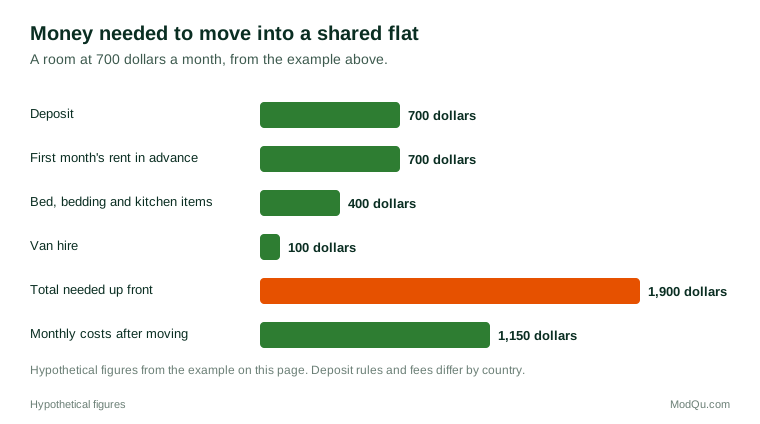
A young adult plans to rent a room in a shared flat for 700 dollars a month. Before moving, they need a deposit of one month's rent, 700 dollars, and the first month in advance, another 700 dollars. They budget 400 dollars for a bed, bedding and kitchen items and 100 dollars for a van. The total needed up front is 1,900 dollars. Their monthly costs, including 120 dollars for bills, 250 dollars for food and 80 dollars for transport, come to 1,150 dollars.
Many young people underestimate the cost of food, bills and household items in the first months.
Moving out for study
Study is one of the most common reasons young people leave home for the first time. Many universities offer student halls for first-year students, which give a bridge between living at home and renting privately: bills are often included, rooms are furnished and support staff are on site. Students then often move to shared houses with friends. In countries where students usually attend a local university, many live at home throughout their studies to save money, and move out only once they start work.
Skills for living independently
Moving out often means learning new skills: budgeting, cooking, cleaning, dealing with landlords and repairs, paying bills on time, registering with a doctor and handling paperwork. Some young people learn these at home; others learn by trial and error. Many say budgeting and cooking were the biggest surprises.
Example
A student moving into university halls has never cooked a full meal. In the first term they spend much of their budget on takeaway food. By the second term they cook in batches with flatmates on Sundays and say they now spend half as much on food.
Living with parents as an adult
For families where young adults stay at home, the arrangement works in different ways. Some parents ask for rent or a contribution to bills; others do not. Some households share chores and meals; others live more separately. Common sources of friction include privacy, chores, guests, noise and money. Many families say clear agreements about these help.
What helps young people move out
Young adults and housing experts mention several things that make moving out easier:
- more affordable rental housing;
- government schemes for first-time buyers or renters;
- help from family with deposits or guarantees;
- stable work with steady pay;
- shared housing with friends;
- housing linked to study or work.
What people disagree about
Moving out raises several debates:
- whether staying at home longer is a problem or a sensible choice;
- whether parents should charge adult children rent;
- what governments should do about housing costs for young people;
- whether family help with deposits makes housing less fair;
- how cultural expectations should shape when young people leave.
Questions housing providers, banks, furniture brands and policymakers want answered include when young adults plan to move out, what stops them, how much they can afford and what kinds of housing they want.
Key terms
- DepositMoney paid to a landlord at the start of a tenancy, returned at the end if there is no damage.
- Rent in advancePaying a rental period before living there.
- Shared housingRenting a room in a home with other tenants.
- LodgerA person who rents a room in a home where the owner also lives.
- GuarantorA person who agrees to pay rent if the tenant cannot.
- UtilitiesServices such as electricity, gas and water.
- Boomerang moveMoving back to the family home after living away.
- First-time buyerA person buying their first home.
Full glossary: rent collection services terms on EditingTests.com.
Moving out of the family home vocabulary test
How well do you know the language of this topic? Try 8 quick questions. Your score is shown straight away and is not saved.
What the moving out of the family home survey asks
This survey is part of ModQu's Life Stages and Family survey. The moving out of the family home part takes about five minutes and covers:
- Whether you live with your parents now, and whether you have moved out before.
- When you plan to move out, if you live at home.
- What is stopping you, or what made you move.
- Which kind of housing you plan to live in.
- How much you could afford for housing each month.
- Whether you contribute money at home.
After that you can choose to continue with other short parts of the Life Stages and Family survey, such as ageing and senior living or weddings and celebrations, or stop.
Ready to take part?
Your answers help show what people really think and do. Results are only ever reported as totals; no one can see your individual answers.
Start the surveyQuestions about this survey
Who can take part?
Young adults aged 18 to 34.
Do I have to give my name?
No. You may be asked for your age group, region and similar details so results can be broken down, but not your name. ModQu never asks for passwords, card numbers or account numbers.
How are the results used?
Answers are combined into totals and percentages and published in ModQu reports. Individual answers are never shown.
Is the vocabulary test part of the survey?
No. It is optional and separate, and your score is not stored.
Who can take part?
Adults aged 18 to 34, whether they live with parents or have moved out.
Does the survey ask about my parents' income?
No. It asks about your own situation and plans.
Does the survey cover students in halls?
Yes. Living in student accommodation counts as having moved out, and the survey asks about it.