
Share your experience of separation or a blended family
Tell us whether you live in a blended family, how you share parenting and what was hardest after separating. Your answers are combined with other people's and reported only as totals.
Start the divorce and blended families surveyAbout 5 minutes. No account needed. You can stop at any time.
Separation and divorce
When a couple separates, they face practical decisions about:
- where each person will live;
- how children will be cared for and how time with each parent is arranged;
- how money, property and debts are divided;
- whether one partner will pay support to the other or for the children;
- how to tell children, family and friends.
Divorce is the legal end of a marriage, while separation may be formal or informal. Unmarried couples who separate face many of the same practical issues, though legal rights often differ. Laws on divorce, property and children vary widely between countries and, in some countries, between states, provinces or religious systems.
This page describes common experiences. People going through separation usually seek advice from lawyers, mediators or advice services in their own country.
Ways of reaching agreement
Couples reach agreements in different ways:
- Between themselves, sometimes with help from family.
- Mediation, where a neutral mediator helps both people reach agreement. Some countries require people to consider mediation before going to court.
- Collaborative law, where each person has a lawyer and all agree to settle without court.
- Negotiation through lawyers.
- Court, where a judge decides if the couple cannot agree.
Many people say a less adversarial process helped them stay on workable terms, which matters when they will co-parent for years.
Living arrangements and co-parenting
When there are children, parents decide how the children will divide their time. Common patterns include:
- children living mainly with one parent and visiting the other on set days;
- shared care, with children spending roughly equal time in two homes;
- nesting, where children stay in the family home and parents take turns living there, usually for a limited time;
- arrangements that change as children grow or circumstances change.
Co-parenting means parents continuing to share decisions and care after separating. It ranges from close cooperation to parallel parenting, where parents have little direct contact and follow a clear plan to reduce conflict. Shared calendars and co-parenting apps are often used to arrange handovers and expenses.
Example
Two parents agree a week-on, week-off arrangement for their two children after separating. They live ten minutes apart so the children can stay at the same school. They use a shared calendar for activities and appointments and meet every few months to review how things are going. When the elder child starts secondary school, they change to a pattern that gives the child more say.
Money after separation
Separation usually makes families poorer, at least for a time, because one household's income now supports two homes. Common money issues include:
- dividing savings, pensions, property and debts;
- child support payments, which many countries calculate with a formula;
- spousal support in some cases;
- legal and mediation costs;
- setting up a second home.
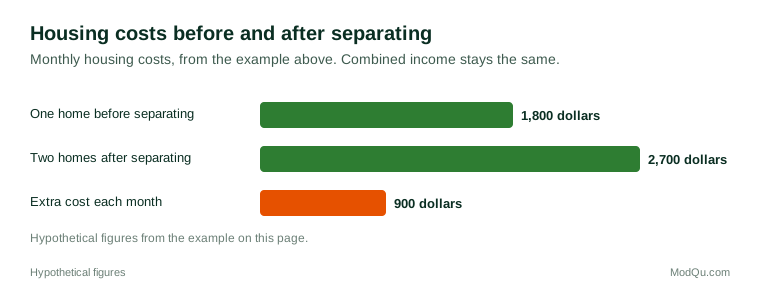
Example (hypothetical figures)
Before separating, a couple pays 1,800 dollars a month for one home. Afterwards, one parent rents a flat for 1,200 dollars and the other stays in the family home at 1,500 dollars. Their combined housing cost rises from 1,800 to 2,700 dollars a month, an increase of 900 dollars, or 10,800 dollars a year, while their combined income stays the same.
Telling children and others
How parents tell children about a separation often shapes how children cope. Many professionals suggest telling children together if possible, in words suited to their age, explaining what will change and what will stay the same, and making clear that the separation is not their fault. Parents also decide how and when to tell schools, wider family and friends. Some find that relatives take sides, which can add strain.
How children experience separation
Children's reactions depend on their age, personality and how the separation is handled. Researchers have found that conflict between parents tends to affect children more than separation itself, and that children usually cope better when they keep good relationships with both parents and are protected from adult disputes. Many parents look for support from schools, counsellors, books and groups for children of separated parents.
Blended families
A blended family, or step-family, forms when a parent with children has a new partner, and sometimes when both partners bring children. Blended families may include step-parents, step-siblings, half-siblings and children who live in two homes.
Common challenges include:
- defining the step-parent's role in discipline and decisions;
- children's loyalty to the parent who is not in the home;
- different household rules and routines;
- sharing space and possessions;
- relationships between step-siblings;
- money, inheritance and how costs are shared.
Many blended families say it took years, not months, to settle, and that patience, clear roles and time alone with each child helped.
Example
A woman with a nine-year-old moves in with a partner who has two teenagers every other week. At first the teenagers resent sharing their home and the younger child feels left out. The adults agree that each parent handles discipline for their own children, they keep some one-to-one time with each child, and they set a few shared house rules together. After two years, the children describe each other as "sort of siblings".
Support and services
People going through separation use many kinds of support: lawyers, mediators, financial advisers, counsellors, family support charities, online communities and friends. Some employers offer leave or flexible work during this time. Children's services, schools and parenting programmes for separated parents are available in some countries.
What people disagree about
This topic raises strong views:
- whether shared care should be the starting point in law;
- how child support should be calculated;
- whether divorce should be quicker and easier or involve more steps;
- how much say children should have in arrangements;
- the role of step-parents in decisions.
Questions family services, insurers and family product brands want answered include how families arrange care after separation, what costs they face, what support they use and what helps blended families settle.
Key terms
- DivorceThe legal end of a marriage.
- MediationA process in which a neutral person helps a couple reach agreement.
- Co-parentingParents sharing care and decisions for children after separating.
- Parallel parentingCo-parenting with little direct contact, following a clear plan.
- Shared careChildren spending roughly equal time with each parent.
- Child supportMoney paid by one parent towards a child's costs.
- Blended familyA family with a step-parent and possibly step-siblings or half-siblings.
- NestingChildren stay in the family home while parents take turns living there.
Full glossary: family law practice terms on EditingTests.com.
Divorce and blended families vocabulary test
How well do you know the language of this topic? Try 8 quick questions. Your score is shown straight away and is not saved.
What the divorce and blended families survey asks
This survey is part of ModQu's Life Stages and Family survey. The divorce and blended families part takes about five minutes and covers:
- Whether you have separated or divorced, or live in a blended family.
- How parenting is shared, and how arrangements were agreed.
- What support you used, such as mediation, lawyers or counselling.
- How separation affected your finances.
- What was hardest after separating.
- What has helped your blended family, if you have one.
After that you can choose to continue with other short parts of the Life Stages and Family survey, such as ageing and senior living or weddings and celebrations, or stop.
Ready to take part?
Your answers help show what people really think and do. Results are only ever reported as totals; no one can see your individual answers.
Start the surveyQuestions about this survey
Who can take part?
Adults who separated or live in a blended family.
Do I have to give my name?
No. You may be asked for your age group, region and similar details so results can be broken down, but not your name. ModQu never asks for passwords, card numbers or account numbers.
How are the results used?
Answers are combined into totals and percentages and published in ModQu reports. Individual answers are never shown.
Is the vocabulary test part of the survey?
No. It is optional and separate, and your score is not stored.
Does this page give legal advice?
No. Laws differ by country. People usually seek advice from a lawyer or advice service where they live.
Will the survey ask for details about my former partner?
No. It asks about your own experience, and every question can be skipped.