
Share your views on planning ahead
Tell us whether you have a will or a funeral plan, and what makes planning easier or harder. Your answers are combined with other people's and reported only as totals.
Start the end-of-life planning surveyAbout 5 minutes. No account needed. You can stop at any time.
What end-of-life planning covers
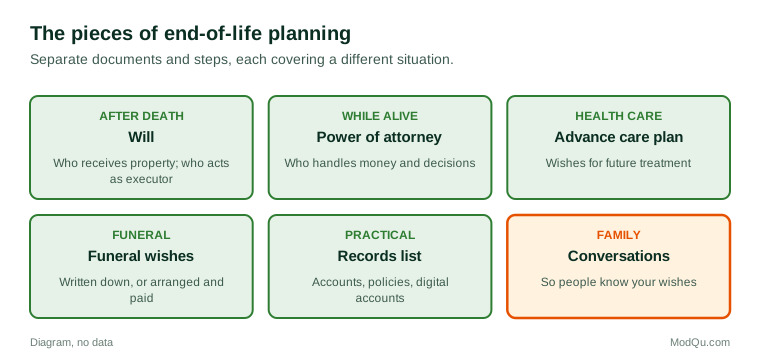
End-of-life planning means making decisions in advance about what should happen if a person becomes seriously ill, can no longer make decisions, or dies. It usually includes several separate pieces:
- A will, which says who receives a person's property and who will manage the estate.
- Powers of attorney or similar documents naming someone to handle money and property, and someone to make personal and health care decisions, if the person cannot.
- Advance care planning: thinking about and sharing values and wishes for future health care.
- Funeral and burial or cremation wishes, which may be written down or arranged and paid for ahead of time.
- Practical records: a list of accounts, passwords, insurance policies, digital accounts, and where documents are kept.
- Conversations with family so that wishes are known.
Laws on wills, substitute decision-makers and health care consent are set by each province and territory in Canada and by each state in the United States, and the names of documents differ from place to place.
Wills
A will names an executor (also called an estate trustee or liquidator in some provinces) to carry out its instructions and says who receives what. It may name a guardian for young children. When a person dies without a will, they are said to die intestate, and provincial law decides who inherits and who may manage the estate, which may not match what the person would have wanted.
People make wills in different ways: with a lawyer, with a notary in Quebec and British Columbia, using a will kit or online service, or by writing a holograph will in their own handwriting where that is allowed. Each way has different formal rules, such as the number and type of witnesses.
Example
A couple in their thirties buy a house and have their first child. A friend asks who would care for the baby if something happened to them both, and they realize they have never discussed it. They make wills naming a guardian and an executor, and say the hardest part was agreeing on the guardian.
Advance care planning and substitute decision-makers
Advance care planning is the process of thinking about one's values and wishes for health care and sharing them with family and health care providers. It may lead to a written document, sometimes called an advance directive or living will, though its legal status and name vary by province. It also usually involves naming, or knowing, who would make decisions on the person's behalf, called a substitute decision-maker.
Conversations often cover what matters most to the person, which treatments they would or would not want in different situations, and where they would like to be cared for near the end of life. Health care organizations and hospice groups in Canada promote advance care planning and publish plain-language guides.
Funeral pre-planning
Funeral pre-planning means recording or arranging funeral, burial or cremation wishes before death. There are two broad approaches:
- Pre-planning, where wishes are written down and shared but nothing is paid for.
- Pre-arranging and pre-paying, where a contract is signed with a funeral home or cemetery and paid in full or in instalments.
In many provinces, pre-paid funeral contracts are regulated, with rules on how the money is held and what happens if plans change. People choose to pre-plan to spare family from decisions at a difficult time, to fix prices, or to make their own choices about the service.
Example (hypothetical figures)
A widow aged 74 pre-arranges a cremation and a small memorial service costing $6,600. She pays $1,200 up front and the rest over 36 monthly instalments of $150. The instalments total $5,400, so with the first payment the total is $6,600. Her son says it made the week after her death much easier.
Why people put it off
Many adults delay making a will or written plans. Reasons people commonly give include:
- feeling too young or healthy to need one;
- not wanting to think about death;
- thinking they do not own enough to need a will;
- not knowing where to start, or expecting it to be expensive;
- difficulty choosing an executor or guardian;
- family conflict, or worry about upsetting someone;
- simply not getting around to it.
Life events often prompt people to act: marriage or separation, the birth of a child, buying a home, a diagnosis, the death of a parent, or retirement.
Example
After settling their mother's estate, two siblings find that she had a will but no list of accounts, and her phone password was unknown. It takes months to track down a pension, two bank accounts and several online subscriptions. Both siblings make wills and write a list of their own accounts within the year.
Digital accounts and records
More of people's lives are now held online: email, photos, social media, banking, subscriptions and cloud storage. When someone dies, family members may not know these accounts exist or be able to get into them. Some services let users name a legacy contact or choose whether the account is deleted or kept as a memorial. Planning guides commonly suggest keeping an up-to-date list of accounts and where important documents are stored, and telling the executor where to find it, while keeping passwords secure.
Talking with family
Even a well-prepared plan can fail if no one knows about it or where the documents are. Families vary in how openly they talk about death. In some families these talks are common; in others they are avoided, sometimes for cultural or religious reasons. Some people find it easier to start with practical topics, such as where documents are kept, before moving to wishes for care and funerals.
Trends and debates
Several changes are affecting end-of-life planning: online will services, digital estates (photos, email and social media accounts), more cremations and celebrations of life in place of traditional funerals, green burial, and public discussion of medical assistance in dying, which is legal in Canada under federal law with set eligibility rules. People disagree about how much planning should be done by professionals, how to handle digital accounts, and whether pre-paying a funeral is a good use of money. Questions businesses want answered include how many people have a will, what stops them, and how they would prefer to plan.
Key terms
- WillA legal document saying who receives a person's property after death.
- ExecutorThe person named to carry out a will and manage the estate.
- IntestateDying without a valid will.
- EstateEverything a person owns, and owes, at death.
- Power of attorneyA document naming someone to act for a person while they are alive.
- Advance care planningThinking about and sharing wishes for future health care.
- Substitute decision-makerA person who makes health decisions for someone who cannot.
- Pre-need contractA funeral or cemetery arrangement signed and paid for in advance.
Full glossary: funeral homes terms on EditingTests.com.
End-of-life planning vocabulary test
How well do you know the language of this topic? Try 8 quick questions. Your score is shown straight away and is not saved.
What the end-of-life planning survey asks
This survey is part of ModQu's Life Stages and Family survey. The end-of-life planning part takes about five minutes and covers:
- Whether you have a will, and when you last updated it.
- Whether you have named a power of attorney or a substitute decision-maker.
- Whether you have talked with family about your wishes for care and funerals.
- Whether you have pre-planned or pre-paid a funeral.
- What stops people from making a will, in your view.
- Where you would go for help: a lawyer, a notary, an online service or someone else.
After that you can choose to continue with other short parts of the Life Stages and Family survey, such as ageing and senior living or weddings and celebrations, or stop.
Ready to take part?
Your answers help show what people really think and do. Results are only ever reported as totals; no one can see your individual answers.
Start the surveyQuestions about this survey
Who can take part?
Adults aged 40 and over.
Do I have to give my name?
No. You may be asked for your age group, region and similar details so results can be broken down, but not your name. ModQu never asks for passwords, card numbers or account numbers.
How are the results used?
Answers are combined into totals and percentages and published in ModQu reports. Individual answers are never shown.
Is the vocabulary test part of the survey?
No. It is optional and separate, and your score is not stored.