
Share your experience of dating
Tell us how you date, which apps you have used and how safe you feel meeting people. Your answers are combined with other people's and reported only as totals.
Start the dating and relationships surveyAbout 5 minutes. No account needed. You can stop at any time.
What this topic covers
This topic is about how single adults look for partners: casual dates, long-term relationships, and companionship later in life. It covers where people meet, how dating apps and sites work, what people look for, how first dates are arranged, what dating costs, and how people protect themselves from harm and from scams.
Single adults are a varied group. They include young adults dating for the first time, people in their thirties and forties who want to settle down, separated and divorced parents returning to dating, and widowed older adults looking for company. Their goals, and the places they look, differ.
How people meet
People meet partners in many ways:
- Through friends and family, long one of the most common routes.
- At school, college or university.
- At work, though many workplaces have rules about relationships between colleagues.
- Through activities: sports leagues, clubs, volunteering, places of worship, classes.
- In bars, restaurants and social events.
- Online: dating apps and sites, and social media.
Research in several countries, including the United States, has found that meeting online grew to become one of the most common ways couples meet, overtaking meeting through friends. Many people still prefer to meet in person but use apps because their social circles are small, they have moved, or they work long hours.
How dating apps work
Dating apps and sites let users build a profile with photos and a short description, set preferences such as age range, distance and gender, and then browse or swipe through other profiles. When two people both show interest, they "match" and can message each other.
Apps differ in several ways:
- Who they serve: general audiences, specific age groups, religions, cultures or LGBTQ+ users.
- How matches are shown: swiping, daily curated matches, or questionnaires that score compatibility.
- Who messages first: some apps let only one person start the conversation.
- Price: most are free to join, with paid subscriptions or one-off purchases for extra features such as seeing who liked you.
Example
A 34-year-old who moved to a new city for work joins two apps. On the first, they get many matches but few conversations go beyond a few messages. On the second, which asks users to answer questions about values and goals, they get fewer matches but more dates. They delete the first app after three months.
What dating costs
Dating can cost money in several ways: app subscriptions, drinks and meals, activities, transportation, new clothes and grooming. Who pays on a date is a common topic of discussion, and expectations vary by age, culture and the people involved. Many people now split costs or take turns.
Example (hypothetical figures)
A user pays $30 a month for a premium subscription and goes on three first dates a month, each costing them about $35 for drinks and transit. Their monthly dating cost is $30 plus $105, or $135. Over six months that is $810. They switch to the free version and suggest coffee or a walk for first dates at about $15 each, cutting the monthly cost to about $45.
Safety when meeting people
Meeting a stranger from an app carries risks, and safety is a frequent concern, especially for women and for LGBTQ+ people. Commonly shared safety practices include:
- meeting in a public place for the first date;
- telling a friend where you are going and who you are meeting;
- arranging your own transportation;
- not sharing a home address or financial details early;
- video calling before meeting in person;
- using the app's reporting and blocking tools.
Some apps offer photo verification, identity checks and in-app safety features. Police services and public safety agencies publish advice on dating safety, and on what to do if a date becomes threatening.
Dating later in life
A growing number of people date in their fifties, sixties and beyond, after divorce or the death of a partner. Their goals often differ from those of younger daters: many want companionship and shared activities rather than marriage or children, and some prefer to keep separate homes and finances. Adult children, grandchildren, health and questions about property and inheritance can all affect these relationships. Older daters may be less familiar with apps and, as the scam example below shows, can be targeted by fraudsters.
Romance scams
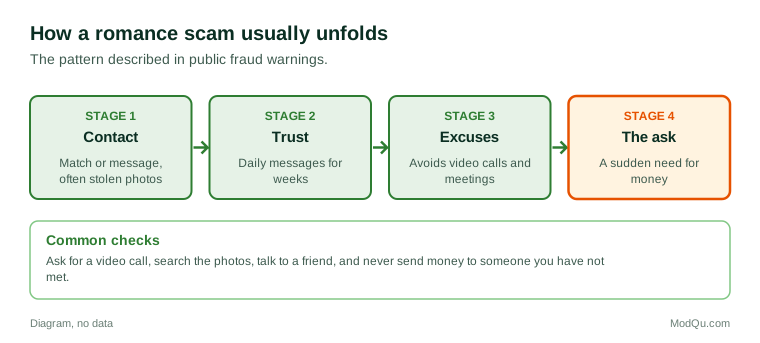
A romance scam is a type of fraud in which someone builds an online relationship to gain trust and then asks for money. Scammers often use stolen photos, claim to work overseas or in the military, avoid video calls, and invent emergencies such as medical bills, travel costs or frozen bank accounts. Some steer people toward fake investment platforms. The Canadian Anti-Fraud Centre has repeatedly identified romance scams as among the most costly frauds for victims.
Example
A widowed 67-year-old matches with someone who says they are an engineer working on an oil platform. They message daily for two months. Then the match asks for help paying a customs fee to ship equipment. A friend points out that the match has never agreed to a video call, and a reverse image search shows the photos belong to someone else.
Frustrations and changing attitudes
Many people describe dating apps as tiring. Common complaints include matches who stop replying without explanation (ghosting), conversations that go nowhere, profiles that do not match the person, and the feeling that endless choice makes commitment harder. Some people take breaks from apps or turn to in-person events, speed dating and activity-based meetups.
Attitudes to relationships are also changing. More people live together before marrying or instead of marrying, live apart while in a committed relationship, or date later in life after divorce or the death of a partner. Questions businesses want answered include which apps people use and pay for, how safe they feel, how couples met and what would improve the dating experience.
Example
Two friends in their late twenties, both tired of apps, sign up for a weekly running club and a board game night. One meets a partner there within a few months. The other says the events were enjoyable but no better for meeting someone, and goes back to an app with a clearer profile and fewer swipes.
Key terms
- MatchTwo users who have both shown interest in each other on an app.
- SwipingMoving through profiles by swiping to accept or reject each one.
- GhostingEnding contact suddenly without explanation.
- CatfishingUsing a fake identity or photos online to deceive someone.
- Romance scamFraud in which a scammer builds an online relationship and then asks for money.
- ProfileThe photos and text a user shares on a dating app.
- VerificationA check that a user's photos or identity are real.
- Premium subscriptionA paid tier of an app with extra features.
Full glossary: social media platforms terms on EditingTests.com.
Dating and relationships vocabulary test
How well do you know the language of this topic? Try 8 quick questions. Your score is shown straight away and is not saved.
What the dating and relationships survey asks
This survey is part of ModQu's Life Stages and Family survey. The dating and relationships part takes about five minutes and covers:
- Whether you are currently dating, and what kind of relationship you are looking for.
- Where and how you meet people.
- Which dating apps or sites you have used, and whether you pay for them.
- How safe you feel meeting people from apps, and what you do to stay safe.
- Whether you have met a scam or fake profile.
- What would make dating easier or better for you.
After that you can choose to continue with other short parts of the Life Stages and Family survey, such as ageing and senior living or weddings and celebrations, or stop.
Ready to take part?
Your answers help show what people really think and do. Results are only ever reported as totals; no one can see your individual answers.
Start the surveyQuestions about this survey
Who can take part?
Single adults.
Do I have to give my name?
No. You may be asked for your age group, region and similar details so results can be broken down, but not your name. ModQu never asks for passwords, card numbers or account numbers.
How are the results used?
Answers are combined into totals and percentages and published in ModQu reports. Individual answers are never shown.
Is the vocabulary test part of the survey?
No. It is optional and separate, and your score is not stored.