
Share your experience of raising children
Tell us about your family, where you get parenting advice and how you set rules such as screen time. Your answers are combined with other people's and reported only as totals.
Start the raising children surveyAbout 5 minutes. No account needed. You can stop at any time.
What this topic covers
This topic is about the everyday work of raising children from birth to age 18: paying for their needs, arranging care, finding information, setting rules, and supporting their schooling, health and activities. It covers families of every shape, including two-parent, single-parent, blended, adoptive, foster and same-sex parent families, and families where grandparents or other relatives share the work.
Parenting changes as children grow. Parents of babies worry about sleep, feeding and childcare; parents of school-age children about homework, friends and activities; parents of teenagers about phones, independence, mental health and the move to work or further study.
What raising children costs
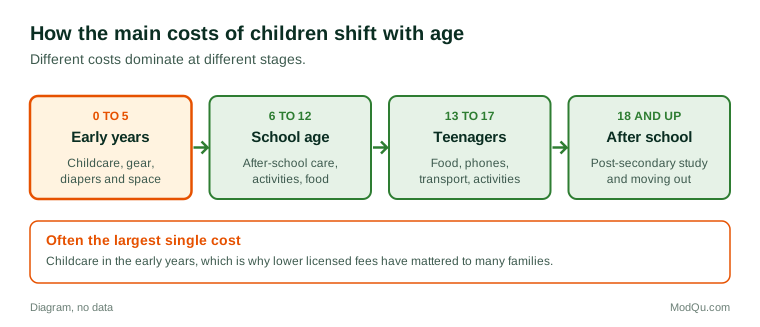
The costs of raising a child are spread over many years and many categories:
- Housing, often the largest, when a family needs more space.
- Food, clothing and personal care, which grow with the child.
- Childcare, often the largest cost in the early years.
- Transportation, from car seats to a second car or transit passes.
- Health costs not covered by public plans, such as dental care, glasses and some prescriptions.
- Education: school supplies, fees, trips, tutoring and saving for post-secondary study.
- Activities: sports, music, camps and lessons.
- Technology: phones, tablets, computers and data plans.
Governments offer some help. In Canada, the federal Canada Child Benefit is a tax-free monthly payment based on family income, and Registered Education Savings Plans receive federal grants. Provinces add their own programs. This page describes these programs in general and does not give financial advice.
Example (hypothetical figures)
A family with a seven-year-old adds up a typical month: $350 for food, $100 for clothing and shoes, $180 for after-school care, $90 for swimming and soccer, $50 for school costs and $100 into an education savings plan. The total is $870 a month, or $10,440 a year, before any extra housing cost.
Childcare
Families use a mix of childcare arrangements:
- Licensed child care centres, regulated by provinces and territories.
- Licensed home child care, where a provider cares for a small group in their home.
- Unlicensed home care, which is legal within limits set by each province.
- Nannies and babysitters, in the family's own home.
- Relatives, especially grandparents.
- Before- and after-school programs for school-age children.
- Parental leave, which in Canada is supported through Employment Insurance benefits for eligible parents, with separate rules in Quebec.
Canada's federal and provincial governments have agreed to lower fees for licensed child care, with an aim of an average of $10 a day, which has reduced costs for many families but has also increased demand and waiting lists in many communities.
Example
Two parents start looking for a licensed infant space while expecting their first child. By the time parental leave ends, they have been offered one space 30 minutes from home. They take it for three days a week, and a grandparent looks after the baby the other two days.
Where parents get advice
Parents gather information from many sources and often weigh them differently:
- doctors, nurses and public health units;
- family members and friends;
- books and parenting courses;
- websites, online forums, social media and video channels;
- teachers, early childhood educators and school counsellors;
- parenting groups and community centres.
Parents commonly say that advice is easy to find but hard to sort, since sources disagree. Public health agencies such as the Public Health Agency of Canada and the Canadian Paediatric Society publish guidance on topics such as safe sleep, vaccination, nutrition and car seats.
Screen time and technology
Screens are one of the most discussed parts of modern parenting. Questions include at what age children should have a tablet or phone, how many hours of use are reasonable, which apps and games are suitable, and how to handle social media. The Canadian Paediatric Society has published guidance on screen use for children of different ages, focusing on limiting screen time for young children and on the quality and context of use.
Families use a range of approaches: time limits, screen-free meals and bedrooms, parental control settings, shared family rules, and watching or playing together. Many parents say their own phone use makes rules harder to keep.
Example
A parent gives their 11-year-old a phone so they can walk home from school alone. The family agrees on rules: no phone at the dinner table, the phone charges in the kitchen overnight, and no social media apps until age 13. Within a month the child asks for a group chat with classmates, and the family has to decide whether a messaging app counts as social media.
School, activities and the parenting load
School brings its own decisions: public, Catholic, French immersion, private or home schooling depending on the province; homework routines; and how involved to be with teachers and school councils. Activities such as sports, music, arts and camps add schedules and costs. Some parents worry that children are over-scheduled; others worry about missing opportunities.
The work of parenting is often shared unevenly. Beyond time with the children, there is planning, booking appointments, tracking forms and remembering what each child needs. Couples who separate also need to arrange shared parenting across two homes.
Example
A single parent with a nine-year-old and a fourteen-year-old keeps a shared family calendar on their phone. Each week it holds two hockey practices, a piano lesson, a dentist appointment and a school trip form due Friday. The older child now takes the bus to practices alone, which the parent says saved more time than any app.
Teenagers and growing independence
The teenage years bring new questions: part-time jobs, driving, dating, money, mental health and plans after high school. Parents shift from making decisions for children to helping them make their own. Many parents of teens say their main sources of worry are online life, school pressure and mood, and that their teens are more likely to talk in the car or late at night than at a planned conversation.
What parents disagree about
Parents hold strong and varied views on many questions: discipline, sleep training, screen time, how much independence to give children, the right age for a phone, how much to protect children from risk, and whether to share photos of children online. Questions businesses want answered include what families spend, where parents get advice they trust, which childcare they use and how they set rules for screens.
Key terms
- Canada Child BenefitA federal tax-free monthly payment to eligible families with children under 18.
- RESPRegistered Education Savings Plan, an account for saving for a child's post-secondary education.
- Licensed child careCare that meets provincial standards and is inspected.
- Parental leaveTime off work after a birth or adoption, with benefits for eligible parents.
- Early childhood educatorA trained professional who works with young children in care settings.
- Screen timeTime spent using devices such as phones, tablets, computers and TVs.
- Parental controlsDevice or app settings that limit what children can see or do.
- Blended familyA family where one or both partners have children from earlier relationships.
Full glossary: childcare services terms on EditingTests.com.
Raising children vocabulary test
How well do you know the language of this topic? Try 8 quick questions. Your score is shown straight away and is not saved.
What the raising children survey asks
This survey is part of ModQu's Life Stages and Family survey. The raising children part takes about five minutes and covers:
- How many children you have, and their ages.
- Which childcare or after-school arrangements you use.
- Where you get parenting advice, and which sources you trust most.
- Whether you set screen time limits, and how.
- What you spend on activities, childcare and other costs for your children.
- What you find hardest about raising children today.
After that you can choose to continue with other short parts of the Life Stages and Family survey, such as ageing and senior living or weddings and celebrations, or stop.
Ready to take part?
Your answers help show what people really think and do. Results are only ever reported as totals; no one can see your individual answers.
Start the surveyQuestions about this survey
Who can take part?
Parents of children under 18.
Do I have to give my name?
No. You may be asked for your age group, region and similar details so results can be broken down, but not your name. ModQu never asks for passwords, card numbers or account numbers.
How are the results used?
Answers are combined into totals and percentages and published in ModQu reports. Individual answers are never shown.
Is the vocabulary test part of the survey?
No. It is optional and separate, and your score is not stored.