
Share your views on family planning
Tell us whether you plan to have children, whether you have used fertility treatment and what you think affects when people have children. Your answers are combined with other people's and reported only as totals.
Start the fertility and family planning surveyAbout 5 minutes. No account needed. You can stop at any time.
About this page
This page describes common experiences and choices. It is not medical advice. Questions about contraception, fertility and pregnancy are best discussed with a doctor, nurse or family planning service.
What family planning covers
Family planning means people deciding whether to have children, how many and when, and having the information and means to act on those decisions. It includes:
- contraception to prevent or delay pregnancy;
- planning a pregnancy, including health before conception;
- fertility services for people who have difficulty conceiving;
- other routes to parenthood, such as adoption, fostering, donor conception and surrogacy;
- choosing not to have children.
The World Health Organization and many national health services describe access to family planning as part of basic health care. Availability, cost and laws differ widely between countries.
Deciding whether and when to have children
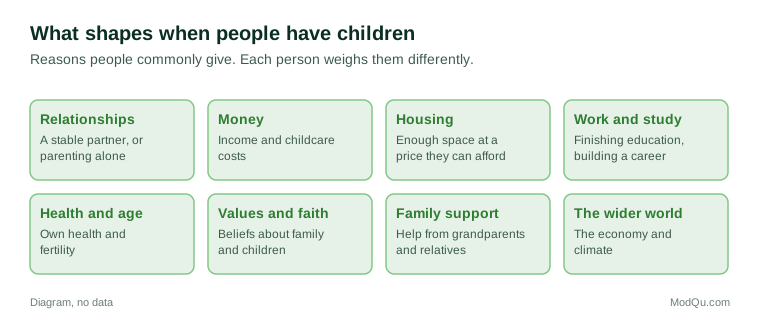
People give many reasons for their choices about children. Common factors include:
- relationships: having a stable partner, or deciding to parent alone;
- money: income, housing and the cost of childcare;
- work and education: finishing study, building a career and the effect of children on jobs;
- housing: having enough space;
- health and age;
- values, faith and culture;
- support from family, such as grandparents who can help;
- the state of the world, including worries about climate change and the economy.
In many countries the average age at which people have their first child has risen over recent decades, and families have become smaller. Researchers link this to more years in education, women's paid work, housing costs, access to contraception and changing values.
Example
A couple in their early thirties say they want two children but have delayed because they live in a one-bedroom flat in a city with high rents. They plan to move to a smaller town where they can afford a larger home, and to try for a first child after the move.
Contraception
Contraception lets people avoid or delay pregnancy. Common types include:
- barrier methods, such as condoms, which also reduce the risk of sexually transmitted infections;
- hormonal methods, such as pills, patches, injections and implants;
- intrauterine devices (IUDs), hormonal or copper;
- permanent methods, such as vasectomy and tubal ligation;
- fertility awareness methods, based on tracking the menstrual cycle;
- emergency contraception, used after unprotected sex.
People choose based on effectiveness, side effects, convenience, cost, health, religious beliefs and partner preferences. Access varies: in some countries contraception is free through health services, while in others it is expensive, hard to reach or restricted.
Difficulty conceiving
Many couples conceive within a year of trying, but some do not. Health services in many countries suggest seeking advice after a year of trying, or sooner for people over 35 or with known health issues. Causes can affect either partner, and in some cases no cause is found.
Fertility services range from tests and advice to treatment.
Fertility treatment
Common types of fertility treatment include:
- medicines to help ovulation;
- intrauterine insemination (IUI), placing sperm in the womb at the right time;
- in vitro fertilization (IVF), fertilizing eggs in a laboratory and transferring an embryo;
- ICSI, a form of IVF where a single sperm is injected into an egg;
- donor eggs, sperm or embryos;
- egg and embryo freezing for later use;
- surrogacy, where another person carries the pregnancy, legal in some countries and banned in others.
Treatment can be physically and emotionally demanding, and success is not guaranteed. Public funding differs widely: some countries fund several cycles of IVF, some fund few or none, and eligibility rules may depend on age, relationship status and other factors.
Example (hypothetical figures)
A couple in a country with no public funding for IVF is quoted 12,000 dollars per cycle including medicines. They budget for up to three cycles, 36,000 dollars, using savings and a loan from family. The first cycle is unsuccessful; the second leads to a pregnancy. Their total cost is 24,000 dollars, and they say the emotional cost was harder than the financial one.
Egg freezing and delaying parenthood
Egg freezing lets people store eggs to use later, often for medical reasons such as before cancer treatment, and increasingly for social reasons such as not yet having a partner. Success depends heavily on the age at which eggs are frozen. Some employers in some countries now include fertility benefits in their benefits packages, which has led to debate.
Example
A 34-year-old who wants children but has no partner looks into egg freezing. After an appointment, they learn the costs and that success rates fall with age. They decide to freeze eggs the following year, using savings, while continuing to hope to conceive naturally with a future partner.
Choosing not to have children
A growing number of people in many countries say they do not plan to have children. Reasons include not wanting children, focusing on career, relationships or other goals, cost, health, and concern about the future. Some people describe themselves as child-free (by choice), distinct from childless (wanting children but not having them). Both groups sometimes face pressure or questions from family and society.
What people disagree about
Family planning is one of the most debated public topics:
- whether governments should encourage people to have more children, and how;
- how fertility treatment should be funded and who should be eligible;
- laws on surrogacy, donor anonymity and egg freezing;
- access to contraception and how it should be paid for;
- how much employers should support fertility treatment and family planning.
Questions health services, insurers, employers and family brands want answered include how people plan families, what affects their timing, whether they have used fertility services and what support they want.
Key terms
- Family planningDeciding whether, when and how many children to have, and having the means to do so.
- ContraceptionMethods used to prevent pregnancy.
- IUDA small device placed in the womb to prevent pregnancy.
- IVFIn vitro fertilization: eggs are fertilized in a laboratory and an embryo is transferred.
- IUIIntrauterine insemination: sperm is placed in the womb at the right time.
- Egg freezingStoring eggs for possible use later.
- SurrogacyAnother person carrying a pregnancy for the intended parents.
- Child-freeChoosing not to have children.
Full glossary: reproductive medicine terms on EditingTests.com.
Fertility and family planning vocabulary test
How well do you know the language of this topic? Try 8 quick questions. Your score is shown straight away and is not saved.
What the fertility and family planning survey asks
This survey is part of ModQu's Life Stages and Family survey. The fertility and family planning part takes about five minutes and covers:
- Whether you have children, plan to, or do not plan to.
- What affects when you, or people you know, have children.
- Which kinds of contraception you have used, if you are willing to say.
- Whether you or a partner have used fertility services, and what kind.
- How fertility services were paid for.
- What support you think people need when planning a family.
After that you can choose to continue with other short parts of the Life Stages and Family survey, such as ageing and senior living or weddings and celebrations, or stop.
Ready to take part?
Your answers help show what people really think and do. Results are only ever reported as totals; no one can see your individual answers.
Start the surveyQuestions about this survey
Who can take part?
Adults aged 18 to 45.
Do I have to give my name?
No. You may be asked for your age group, region and similar details so results can be broken down, but not your name. ModQu never asks for passwords, card numbers or account numbers.
How are the results used?
Answers are combined into totals and percentages and published in ModQu reports. Individual answers are never shown.
Is the vocabulary test part of the survey?
No. It is optional and separate, and your score is not stored.
Are these questions sensitive?
Yes. Every question is optional, answers are anonymous, and you can stop at any time.
Who can take part?
Adults aged 18 to 45, whatever their plans or relationship status.
Where can I find reliable information?
Doctors, nurses, sexual health clinics and national health services in your country are the best sources for advice on contraception and fertility.