
Share your experience of becoming a parent
Tell us whether you are expecting or a new parent, what you bought before the birth and how much leave you took. Your answers are combined with other people's and reported only as totals.
Start the becoming a parent surveyAbout 5 minutes. No account needed. You can stop at any time.
What becoming a parent involves
The move to parenthood starts long before a baby arrives. Expecting parents usually deal with:
- health care in pregnancy, such as antenatal or prenatal appointments, scans and classes;
- planning the birth, including where it will happen and who will be there;
- preparing the home and buying equipment;
- arranging leave from work and thinking about childcare;
- money, including new costs and any loss of income during leave;
- paperwork, such as registering the birth, health cover and, in many countries, applying for child benefits;
- support, from partners, family, friends, health workers and other parents.
Parents become parents in many ways: through birth, adoption, fostering, surrogacy or as step-parents. Many of the practical questions are similar.
Preparing the home and buying for a baby
New parents face a long list of possible purchases. Common items include:
- a safe place for the baby to sleep, such as a cot, crib or bassinet;
- a car seat, required by law for car travel in many countries;
- a pram, pushchair or baby carrier;
- clothes, nappies or diapers, and changing supplies;
- feeding equipment, such as bottles, a breast pump or a high chair later on;
- a bath, towels and basic medical supplies;
- monitors, slings, play mats and toys.
Many parents say they bought items they never used and missed things they needed. Second-hand items, hand-me-downs from friends and family, and baby swaps are common, although health bodies often advise buying some items, such as car seats and mattresses, new or from a known source for safety reasons.
Example
An expecting couple makes a list of over 60 items from online guides. A friend with a one-year-old goes through it with them and crosses off half. They borrow a pram and cot, buy a new car seat and mattress, and wait to see what they actually need before buying more.
What a baby costs
The first year brings both one-off and ongoing costs. Ongoing costs include nappies, formula if used, clothes as the baby grows, and in some cases childcare. Many families also lose income while one or both parents take leave.
Example (hypothetical figures)
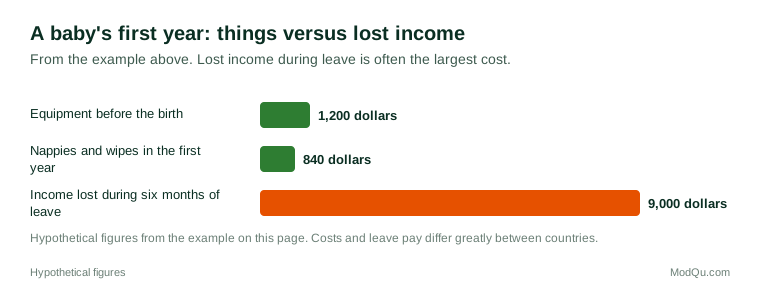
A couple spends 1,200 dollars on equipment before the birth: 300 for a pram, 250 for a car seat, 200 for a cot and mattress and 450 on clothes, bedding and supplies. In the first year they spend about 70 dollars a month on nappies and wipes, 840 dollars in total. One parent takes six months of leave at reduced pay, losing about 9,000 dollars of income. The income loss is far larger than the cost of things.
Costs vary greatly between countries and families. Where health care, childcare or parental leave is publicly funded, the private cost of having a baby is much lower.
Parental leave around the world
Rules on leave differ widely between countries:
- Maternity leave for the birth mother, usually paid at least in part, in most countries.
- Paternity leave for the other parent, often shorter.
- Shared or parental leave that either parent can take, in some countries.
- Adoption leave for adoptive parents.
- Unpaid leave where there is no paid scheme or after paid leave ends.
Some countries offer a year or more of paid leave that can be shared between parents, often with a part reserved for each parent. Others offer a few weeks, and a small number have no national paid leave, leaving it to employers. The International Labour Organization sets a minimum standard for maternity protection that many countries follow.
Going back to work
Returning to work is one of the biggest decisions for new parents. Options include returning full-time, part-time or with flexible hours, changing jobs, starting a business, or one parent staying at home. Decisions depend on income, childcare costs and availability, career plans, the baby's needs and personal values.
Example
A nurse returns to work after nine months on reduced shifts. Their partner, who works from home three days a week, takes the baby to a childminder on the other two days. They say the hardest part was not the work itself but arranging cover when the baby was ill.
Support and wellbeing
The early months are often tiring and emotional. Common sources of support include health visitors or community nurses, family doctors, parent groups, online forums, family and friends. Many parents say lack of sleep and isolation were harder than they expected.
Postnatal depression (also called postpartum depression) affects many new mothers and can affect fathers and partners too. Health services in many countries now screen for it. Signs include persistent low mood, anxiety and feeling unable to cope. Help is available through health services, and early support is encouraged.
Common questions from new parents
New parents often look for information on the same few subjects: feeding, sleep, crying, safe sleeping positions, vaccinations, returning to work and childcare. Many say they received conflicting advice from relatives, health workers and the internet. Public health bodies in many countries publish guidance on safe sleep and feeding, and health workers can explain local services. Parents also often say that trusting their own judgement, after checking reliable sources, became easier with time.
Changes in relationships
A baby changes relationships with partners, families and friends. Couples often renegotiate who does which tasks, including night feeds, housework and appointments. Grandparents may take on new roles, and some friendships change as routines shift. Many parents find new friends through baby groups and classes.
What people disagree about
Becoming a parent raises many debates:
- how long parental leave should be and who should pay for it;
- whether leave should be reserved for each parent to encourage sharing;
- how much new parents need to buy;
- whether employers do enough to support parents returning to work;
- how much advice new parents should get, and from whom.
Questions family product brands, employers, insurers and health services want answered include what parents buy, how they prepare, how much leave they take and where they find support.
Key terms
- Antenatal careHealth care during pregnancy, also called prenatal care.
- Maternity leaveTime off work for a birth mother around the birth.
- Paternity leaveTime off work for the other parent after a birth.
- Shared parental leaveLeave that either parent can take, in some countries.
- Postnatal depressionDepression after having a baby, also called postpartum depression.
- Health visitorA nurse who supports families with young children in some countries.
- Car seatA safety seat that holds a baby or child in a vehicle.
- Hand-me-downsUsed items passed on from other families.
Full glossary: maternity care terms on EditingTests.com.
Becoming a parent vocabulary test
How well do you know the language of this topic? Try 8 quick questions. Your score is shown straight away and is not saved.
What the becoming a parent survey asks
This survey is part of ModQu's Life Stages and Family survey. The becoming a parent part takes about five minutes and covers:
- Whether you are expecting, a new parent, or became a parent in the last few years.
- What you bought before the birth or arrival, and what you spent.
- How much leave you and your partner took, and whether it was paid.
- Who helped you most in the first months.
- How returning to work went, if you have returned.
- What you wish you had known before becoming a parent.
After that you can choose to continue with other short parts of the Life Stages and Family survey, such as ageing and senior living or weddings and celebrations, or stop.
Ready to take part?
Your answers help show what people really think and do. Results are only ever reported as totals; no one can see your individual answers.
Start the surveyQuestions about this survey
Who can take part?
Expecting and new parents.
Do I have to give my name?
No. You may be asked for your age group, region and similar details so results can be broken down, but not your name. ModQu never asks for passwords, card numbers or account numbers.
How are the results used?
Answers are combined into totals and percentages and published in ModQu reports. Individual answers are never shown.
Is the vocabulary test part of the survey?
No. It is optional and separate, and your score is not stored.
Can adoptive and foster parents take part?
Yes. The survey is for anyone who has recently become a parent, however that happened.
Does the survey ask about my health?
It may ask about support you used. Questions about wellbeing are optional and you can skip them.