
Share your experience as a parent of a teen or young adult
Tell us what worries you most, how much your teenager or young adult spends and how they earn money. Your answers are combined with other people's and reported only as totals.
Start the teenagers and young adults surveyAbout 5 minutes. No account needed. You can stop at any time.
A time of transition
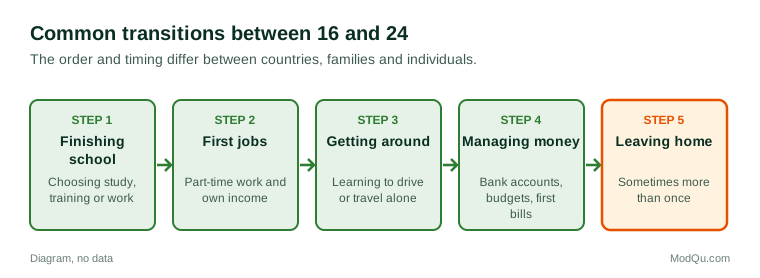
Between the ages of 16 and 24, most young people move through several transitions:
- finishing compulsory school and choosing further study, training or work;
- first part-time jobs and first full-time jobs;
- learning to drive or getting around on their own;
- first serious relationships;
- managing their own money;
- leaving home, sometimes more than once.
The timing differs greatly between countries and families. In some places young people commonly leave home at 18 for study or work; in others most live with parents until marriage or well into their late twenties. Economic conditions, housing costs and cultural expectations all play a part.
Money and spending
Money is one of the main areas where parents and young people negotiate independence. Common arrangements include:
- allowances or pocket money, sometimes linked to chores;
- paying specific costs, such as phone bills, transport or clothes;
- part-time work, such as shop, café or delivery jobs;
- gig and online work, such as tutoring, content creation or reselling items;
- contributions to the household once a young person earns, such as rent or food money;
- support during study, from help with fees to living costs.
Many parents use this period to teach budgeting. Some open bank accounts or prepaid cards for teenagers so they can manage spending with some oversight.
Example (hypothetical figures)
A 17-year-old works eight hours a week in a café at 12 dollars an hour, earning 96 dollars a week, about 416 dollars a month. Their parents pay for their phone and bus pass. The teenager spends about 200 dollars a month on food out, clothes and games, and saves the rest, about 216 dollars a month, towards driving lessons.
What parents worry about
Parents of older teens and young adults often mention worries such as:
- mental health, including stress, anxiety and low mood;
- education and career choices, and whether their child will find good work;
- money, including debt and the cost of housing;
- online life, from social media pressure to scams and gambling;
- safety when out late, driving or travelling;
- alcohol, drugs and vaping;
- relationships and friendships;
- whether they will be able to leave home.
Parents' worries do not always match what young people themselves say concerns them. Surveys that ask both groups often find differences.
Communication and independence
Communication changes as children grow. Parents often move from setting rules to giving advice, and young people expect more privacy. Common tensions include curfews, screen time, chores, money, friends and choices about study and work.
Many parents say messaging apps help them stay in touch without hovering, while others find it harder to know what is going on in their child's life. Some families use location-sharing apps, which some young people accept and others resent.
Example
A parent and their 19-year-old argue about late nights after the young person starts university while living at home. They agree that the young person will send a short message if they will be back after midnight, and the parent will stop asking where they have been. Both say the arrangement reduced arguments.
Education, training and work
Parents are often closely involved in decisions after school. Options include university, college, apprenticeships, vocational training, gap years, work and starting a business. Parents may help with research, applications, visits and costs. In some countries families save for many years for further education; in others, public funding, loans or grants cover much of it.
Young people may change course, drop out, or take time to find their direction. Parents' reactions to this vary, and many say they had to learn to let their child make their own choices.
Example
A parent hopes their child will study law. The child chooses an electrical apprenticeship instead, earning while training. After some worry, the parent says they are proud that their child knew what they wanted, and that avoiding student debt was a benefit they had not considered.
Young adults living at home
In many countries, more young adults are living with parents for longer, often because of housing costs, study, low starting wages or uncertain jobs. Families handle this in different ways: some ask for rent, others do not; some set house rules, others treat young adults as equal housemates. Many parents say they enjoy the company but find sharing space and household costs harder than expected.
Mental health and wellbeing
Mental health is one of the most common concerns parents of this age group raise. Young people face pressure from exams, work, money, relationships and social media, and many mental health problems first appear in the late teens and early twenties. Parents often say they find it hard to tell normal ups and downs from signs that their child needs help. Schools, colleges, doctors, helplines and youth services in many countries offer support, and many parents say talking early and listening without judging helped.
Support for parents
Parents of teenagers and young adults often say there is less support for them than for parents of young children. Sources of advice include other parents, schools and colleges, online forums, books and, where needed, counsellors and mental health services. Some employers now offer family support programmes.
What people disagree about
This life stage raises many debates:
- how much financial support parents should give young adults;
- whether young people should pay rent at home;
- how much privacy teenagers should have online and offline;
- whether university is the best route for most young people;
- how much parents should be involved in adult children's decisions.
Questions brands, banks, educators and family services want answered include what parents of teens worry about, how families handle money, how young people earn and spend, and when they leave home.
Key terms
- AllowanceRegular money given to a child or teenager, also called pocket money.
- ApprenticeshipPaid work combined with training for a skilled job.
- Gap yearA year off between school and further study or work.
- Prepaid cardA card loaded with money in advance, often used by teenagers.
- Gig workShort, flexible jobs, often found through apps.
- CurfewAn agreed time to be home.
- Location sharingAn app setting that shows a person's location to others.
- Boomerang childA young adult who moves back home after living away.
Full glossary: adolescent health terms on EditingTests.com.
Teenagers and young adults vocabulary test
How well do you know the language of this topic? Try 8 quick questions. Your score is shown straight away and is not saved.
What the teenagers and young adults survey asks
This survey is part of ModQu's Life Stages and Family survey. The teenagers and young adults part takes about five minutes and covers:
- The age of your teenager or young adult, and whether they live at home.
- What worries you most about them.
- How much they spend in a typical month, and on what.
- How they earn or receive money.
- How you communicate, and what you disagree about.
- When you expect them to leave home, and what might stop them.
After that you can choose to continue with other short parts of the Life Stages and Family survey, such as ageing and senior living or weddings and celebrations, or stop.
Ready to take part?
Your answers help show what people really think and do. Results are only ever reported as totals; no one can see your individual answers.
Start the surveyQuestions about this survey
Who can take part?
Parents of teens and young adults aged 16 to 24.
Do I have to give my name?
No. You may be asked for your age group, region and similar details so results can be broken down, but not your name. ModQu never asks for passwords, card numbers or account numbers.
How are the results used?
Answers are combined into totals and percentages and published in ModQu reports. Individual answers are never shown.
Is the vocabulary test part of the survey?
No. It is optional and separate, and your score is not stored.
Do my children need to take part?
No. This survey is for parents. Young people are not asked to take part through it.
Can I answer about more than one child?
The survey asks about one child, usually your eldest aged 16 to 24. You can take it again for another child.