
Share your experience of caring for a parent
Tell us whether you help care for an ageing parent, how many hours a week and whether it has affected your work. Your answers are combined with other people's and reported only as totals.
Start the caring for ageing parents surveyAbout 5 minutes. No account needed. You can stop at any time.
What caring for a parent involves
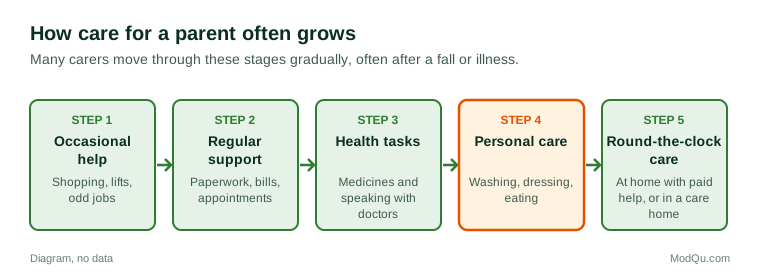
Caring for an ageing parent often starts small and grows over time. It can include:
- practical help: shopping, cleaning, cooking, laundry and gardening;
- transport to appointments and social activities;
- money and paperwork: paying bills, dealing with banks and benefits;
- health tasks: managing medicines, attending appointments, speaking with doctors;
- personal care: help with washing, dressing, eating and using the toilet;
- supervision and company, especially for parents with dementia;
- arranging and managing paid care.
Many carers do not call themselves carers. They see what they do as being a son, daughter or in-law, which can mean they do not seek support that is available.
Who provides care
In most countries, family members provide a large share of care for older people. Patterns differ by culture and policy. In many societies, daughters and daughters-in-law provide more care than sons, though this is changing. In some cultures, older parents traditionally live with an adult child; in others, they live independently with help from family nearby.
Carers often juggle care with work and their own children, and are sometimes called the sandwich generation. Some care from a distance, managing help by phone and visiting when they can.
Example
A man in his fifties lives two hours from his mother, who has early dementia. He arranges a weekly cleaner, a meal delivery service and a daily phone call from a neighbour. He visits every second weekend and speaks with her doctor by phone. He says organizing care from a distance is a second job.
Options for care
Families choose from a range of options, which differ in availability and cost between countries:
- informal family care at the parent's home;
- paid home care, from short visits to live-in carers;
- day centres for social activities and respite;
- adapting the home, with rails, ramps, alarms and stairlifts;
- moving the parent in with an adult child;
- sheltered or assisted living, with support on site;
- care homes and nursing homes for people who need help around the clock;
- migrant care workers, common in some countries for live-in care.
Decisions often follow a crisis, such as a fall or hospital stay, rather than planning.
Costs
Care costs vary hugely between countries. In some, public systems pay for much of the care; in others, families pay most of it, or rely on unpaid family care. Costs include paid care, equipment, home adaptations, travel and lost earnings.
Example (hypothetical figures)
A family pays for home care visits of one hour a day, seven days a week, at 30 dollars an hour, which is 210 dollars a week or about 910 dollars a month. Equipment and adaptations cost 2,000 dollars once. The daughter who coordinates care also cuts her working hours from five days to four, losing about 600 dollars a month in pay. Her lost income is two-thirds of the monthly cost of the paid care.
Effects on work
Caring often affects carers' jobs. Common effects include:
- reducing hours or moving to part-time work;
- taking leave, holiday or unpaid time off for appointments and emergencies;
- turning down promotions or changing jobs;
- leaving work altogether;
- stress and tiredness at work.
Some countries give legal rights to carer's leave or flexible working, and some employers offer carer policies. Many carers do not tell their employer about their caring role.
Example
An office manager asks for flexible hours after her father's stroke. Her employer agrees to a compressed week of four longer days, leaving Fridays free for his hospital appointments. She says the change let her keep her job, which she would otherwise have left.
Effects on carers' health and wellbeing
Caring can be rewarding: many carers describe closeness, a chance to give back and pride. It can also bring stress, tiredness, isolation, money worries and strain on relationships. Caring for a parent with dementia can be especially demanding. Carers often neglect their own health and appointments.
Support for carers
Support available in many countries includes:
- carer's assessments by local services, to identify support needed;
- carer's allowances or benefits in some countries;
- respite care, giving carers a break;
- carers' charities, helplines and support groups;
- information on conditions such as dementia;
- employer support, such as carer's leave.
Siblings and other relatives sharing tasks also matters. Disagreements between siblings about who does what are a common source of strain.
Talking to a parent about care
Starting the conversation about care is often hard. Parents may want to stay independent and resist help, while adult children may worry about upsetting them. Many families find it easier to talk early, before a crisis, and to focus on what the parent wants rather than on what they can no longer do. Some involve a doctor, social worker or trusted friend in the discussion.
Planning ahead
Families who plan ahead often discuss a parent's wishes about where they want to live, who will make decisions if they cannot, and how care will be paid for. Powers of attorney and advance care plans let parents set out their wishes while they are able to. Many families say they wish they had talked earlier.
What people disagree about
Care for older people raises many debates:
- how much care should be paid for by governments, families or individuals;
- whether family members should be paid for caring;
- the role of migrant care workers;
- whether older people should be supported to stay at home as long as possible;
- how to share caring fairly between siblings and between men and women.
Questions senior living operators, insurers, employers and care services want answered include who provides care, how many hours, at what cost, how it affects work and what support carers want.
Key terms
- CarerA person who provides unpaid care to a family member or friend.
- Personal careHelp with washing, dressing, eating and using the toilet.
- Respite careShort-term care that gives a carer a break.
- Sandwich generationPeople caring for both their parents and their own children.
- Home carePaid care provided in a person's home.
- Assisted livingHousing with support available on site.
- Carer's assessmentA review of a carer's needs by local services, in some countries.
- Advance care planA record of a person's wishes for future care.
Full glossary: geriatric care management terms on EditingTests.com.
Caring for ageing parents vocabulary test
How well do you know the language of this topic? Try 8 quick questions. Your score is shown straight away and is not saved.
What the caring for ageing parents survey asks
This survey is part of ModQu's Life Stages and Family survey. The caring for ageing parents part takes about five minutes and covers:
- Whether you help care for a parent aged 70 or over, and what kind of help you give.
- How many hours a week you spend on care.
- Whether paid care is used, and who pays.
- How caring has affected your work and income.
- How caring has affected your own health and wellbeing.
- What support you use and what would help most.
After that you can choose to continue with other short parts of the Life Stages and Family survey, such as ageing and senior living or weddings and celebrations, or stop.
Ready to take part?
Your answers help show what people really think and do. Results are only ever reported as totals; no one can see your individual answers.
Start the surveyQuestions about this survey
Who can take part?
Adults with a parent aged 70 or over.
Do I have to give my name?
No. You may be asked for your age group, region and similar details so results can be broken down, but not your name. ModQu never asks for passwords, card numbers or account numbers.
How are the results used?
Answers are combined into totals and percentages and published in ModQu reports. Individual answers are never shown.
Is the vocabulary test part of the survey?
No. It is optional and separate, and your score is not stored.
Do I count as a carer if I only help a little?
Yes. The survey includes any regular help, from shopping and lifts to daily personal care.
Does the survey ask about my parent's health?
It may ask about the kind of help needed. Health questions are optional.