
Surveys · Ethics and law
Surveying Children and Vulnerable Groups: Ethical Safeguards
Children, people with limited capacity to consent and others in vulnerable situations need extra protection when they take part in surveys. This article explains the ethical principles involved, how consent and assent work, how questionnaires can be adapted and how to respond when a survey reveals that someone is at risk.
Surveys of children, older people with dementia, people with intellectual disabilities, prisoners, refugees and people in crisis can provide information that is available in no other way. These groups are often the subject of policy decisions, and their own views should inform those decisions. But they may be less able to understand what research involves, to refuse, or to protect themselves from harm. Research ethics therefore require additional safeguards when surveying them (National Commission for the Protection of Human Subjects of Biomedical and Behavioral Research, 1979; Canadian Institutes of Health Research et al., 2022).
Who is vulnerable?
Vulnerability can arise from several sources: age, as with children; limited capacity to understand or decide, as with some people with dementia or intellectual disabilities; dependence on others, as with prisoners, patients or employees surveyed by their employer; and difficult circumstances, such as homelessness, recent trauma or insecure legal status. Vulnerability depends on the situation as well as the person. An adult who is well able to consent to most surveys may be vulnerable when asked about a recent bereavement.
Children
The right to be heard
The United Nations (1989) Convention on the Rights of the Child gives children the right to express their views on matters affecting them. Research with children has moved from treating them as subjects about whom adults report to treating them as participants who can speak for themselves (Alderson & Morrow, 2011; Graham et al., 2013).
Consent and assent
Children below a certain age cannot give legal consent, so researchers usually need the consent of a parent or guardian as well as the child's own agreement, called assent. A child's refusal should be respected even if a parent has consented. Older adolescents may be able to consent for themselves, depending on the law and the risk of the research.
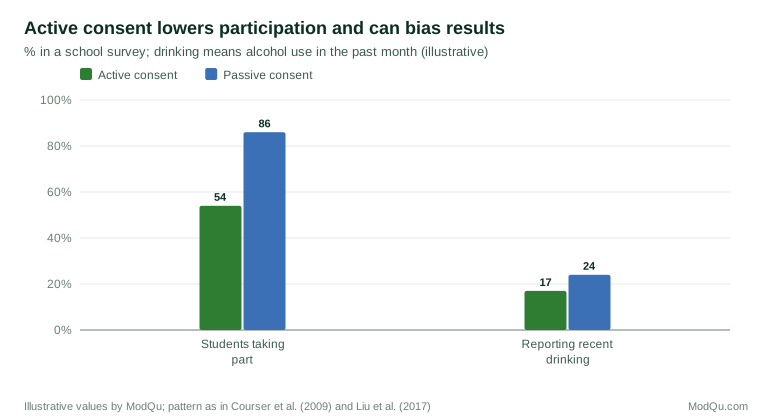
Parental consent may be active, where parents must return a signed form, or passive, where parents are informed and their child takes part unless they object. Active consent offers more protection but often greatly reduces participation, and those who take part may differ from those who do not. Studies of school surveys have found that active consent produced lower participation and samples that under-represented young people at higher risk of problems such as substance use (Esbensen et al., 1999; Courser et al., 2009). A meta-analysis found that surveys requiring active parental consent reported lower rates of risk behaviours than those using passive consent, suggesting biased samples (Liu et al., 2017). Figure 1 illustrates the pattern. Ethics committees weigh these effects against the protection active consent offers, often allowing passive consent for low-risk surveys.
Adapting questions
Children's ability to answer survey questions develops with age. Younger children have more difficulty with abstract ideas, negative wording, long recall periods and many response options, and are more likely to give answers they think adults want (Borgers et al., 2000; Scott, 1997). Questionnaires for children should use simple words, short sentences, concrete examples and fewer response categories, and should be tested with children of the target age. Visual aids and interactive methods can help younger children take part (Fargas-Malet et al., 2010).
Privacy
Young people are more likely to report sensitive behaviour when answers are private. Computer-assisted self-interviewing has been shown to increase reports of sensitive behaviour among adolescents compared with paper questionnaires (Turner et al., 1998), and the validity of self-reports depends on assurances of confidentiality and the setting in which the survey is completed (Brener et al., 2003). In schools, teachers should not be able to see answers, and in homes, parents should not be present while children answer sensitive questions.
Adults with limited capacity
Some adults cannot fully understand the information needed to consent, because of dementia, intellectual disability, mental illness or injury. Laws such as the Mental Capacity Act (2005) in England and Wales set out how capacity is assessed and when others may decide on a person's behalf. Researchers should assume capacity unless there is reason to doubt it, support people to understand through simple language and pictures, and involve a family member or carer where a person cannot consent. People with intellectual disabilities can often answer well-designed questions, but they may agree with statements regardless of content or struggle with complex response scales, so questionnaires need careful adaptation and testing (Finlay & Lyons, 2001).
Other vulnerable groups
Other groups need safeguards suited to their situation. People in institutions, such as prisoners, care home residents and hospital patients, may feel unable to refuse when a survey is introduced by staff, and their answers may be overheard or seen. Surveys in these settings should be introduced by independent researchers, with private spaces for answering and clear statements that refusal will not affect treatment or privileges. Refugees and people with insecure legal status may fear that answers will be passed to authorities, so promises of confidentiality must be credible and identifying information kept to a minimum. People who have experienced trauma, such as violence or disaster, may be distressed by questions about their experiences; questions should be asked only where necessary, with support available. Employees surveyed by their employer depend on that employer for their livelihood, so surveys should be run by an independent party and results reported only for groups large enough to protect individuals.
Safeguarding
Surveys sometimes reveal that a respondent is at risk of harm, for example through answers about abuse, self-harm or suicidal thoughts. Researchers must decide in advance how they will respond. Good practice includes telling respondents at the start what will happen if they disclose that they or someone else is at risk, providing details of support services to everyone, training interviewers to respond appropriately and having a clear procedure for referring serious cases. These duties can conflict with promises of confidentiality, so the limits of confidentiality must be explained honestly before the survey begins (Graham et al., 2013).
Other safeguards
- Minimise burden, with short questionnaires and breaks.
- Avoid unnecessary sensitive questions, and offer "prefer not to say".
- Use appropriate incentives that do not pressure people who are in need.
- Train interviewers to recognise distress and to stop the interview if needed.
- Involve members of the group in designing the survey, so that questions are relevant and respectful.
Conclusion
Surveying children and vulnerable people is important, because their views and circumstances matter to the decisions that affect them. It requires additional care: consent and assent suited to the person, questions they can understand, privacy, protection from harm and honest limits on confidentiality. With these safeguards, surveys can give voice to people who are too often spoken for.
References
Alderson, P., & Morrow, V. (2011). The ethics of research with children and young people: A practical handbook. SAGE. https://doi.org/10.4135/9781446268377
Borgers, N., de Leeuw, E., & Hox, J. (2000). Children as respondents in survey research: Cognitive development and response quality. Bulletin de Méthodologie Sociologique, 66(1), 60–75. https://doi.org/10.1177/075910630006600106
Brener, N. D., Billy, J. O. G., & Grady, W. R. (2003). Assessment of factors affecting the validity of self-reported health-risk behavior among adolescents: Evidence from the scientific literature. Journal of Adolescent Health, 33(6), 436–457. https://doi.org/10.1016/S1054-139X(03)00052-1
Canadian Institutes of Health Research, Natural Sciences and Engineering Research Council of Canada, & Social Sciences and Humanities Research Council of Canada. (2022). Tri-Council policy statement: Ethical conduct for research involving humans – TCPS 2 (2022). Government of Canada.
Courser, M. W., Shamblen, S. R., Lavrakas, P. J., Collins, D., & Ditterline, P. (2009). The impact of active consent procedures on nonresponse and nonresponse error in youth survey data: Evidence from a new experiment. Evaluation Review, 33(4), 370–395. https://doi.org/10.1177/0193841X09337228
Esbensen, F.-A., Miller, M. H., Taylor, T. J., He, N., & Freng, A. (1999). Differential attrition rates and active parental consent. Evaluation Review, 23(3), 316–335. https://doi.org/10.1177/0193841X9902300304
Fargas-Malet, M., McSherry, D., Larkin, E., & Robinson, C. (2010). Research with children: Methodological issues and innovative techniques. Journal of Early Childhood Research, 8(2), 175–192. https://doi.org/10.1177/1476718X09345412
Finlay, W. M. L., & Lyons, E. (2001). Methodological issues in interviewing and using self-report questionnaires with people with mental retardation. Psychological Assessment, 13(3), 319–335. https://doi.org/10.1037/1040-3590.13.3.319
Graham, A., Powell, M., Taylor, N., Anderson, D., & Fitzgerald, R. (2013). Ethical research involving children. UNICEF Office of Research – Innocenti.
Liu, C., Cox, R. B., Jr., Washburn, I. J., Croff, J. M., & Crethar, H. C. (2017). The effects of requiring parental consent for research on adolescents' risk behaviors: A meta-analysis. Journal of Adolescent Health, 61(1), 45–52. https://doi.org/10.1016/j.jadohealth.2017.01.015
Mental Capacity Act 2005, c. 9 (UK).
National Commission for the Protection of Human Subjects of Biomedical and Behavioral Research. (1979). The Belmont report: Ethical principles and guidelines for the protection of human subjects of research. U.S. Department of Health, Education, and Welfare.
Scott, J. (1997). Children as respondents: Methods for improving data quality. In L. Lyberg, P. Biemer, M. Collins, E. de Leeuw, C. Dippo, N. Schwarz, & D. Trewin (Eds.), Survey measurement and process quality (pp. 331–350). Wiley. https://doi.org/10.1002/9781118490013.ch14
Turner, C. F., Ku, L., Rogers, S. M., Lindberg, L. D., Pleck, J. H., & Sonenstein, F. L. (1998). Adolescent sexual behavior, drug use, and violence: Increased reporting with computer survey technology. Science, 280(5365), 867–873. https://doi.org/10.1126/science.280.5365.867
United Nations. (1989). Convention on the rights of the child. United Nations.