
Surveys · Ethics and law
Push Polls and Sugging: When Surveys Are Not Really Surveys
Some activities look like surveys but are really attempts to persuade, sell or raise money. This article explains push polls, sugging and frugging, how to tell them apart from genuine research, why professional codes forbid them and how they harm legitimate surveys.
Most people asked to take part in a survey assume that someone wants to know what they think. Some calls and questionnaires that look like surveys have a different purpose: to spread a message, to sell a product or to ask for money. These practices misuse the trust that genuine research depends on, and professional codes of conduct forbid them (American Association for Public Opinion Research, 2021; ESOMAR & International Chamber of Commerce, 2016).
Push polls
A push poll is a political campaign technique disguised as an opinion poll. Callers contact large numbers of voters and ask questions designed to spread negative, and often false or misleading, information about a candidate, such as "Would you be more or less likely to vote for Smith if you knew that Smith had been investigated for fraud?" The aim is not to measure opinion but to change it, by planting the information in voters' minds under the cover of research (Traugott & Kang, 2000; Sabato & Simpson, 1996).
Push polls can be recognised by several features, summarised in Figure 1:
- Very large numbers of calls, often thousands or tens of thousands, far more than a genuine poll needs.
- Very short calls, with only a few questions, mostly about one candidate.
- No demographic questions or other information needed to analyse results.
- Results are not reported, because the calls were never meant to produce data.
- Unclear or false sponsorship, with callers unable or unwilling to say who commissioned the "poll".
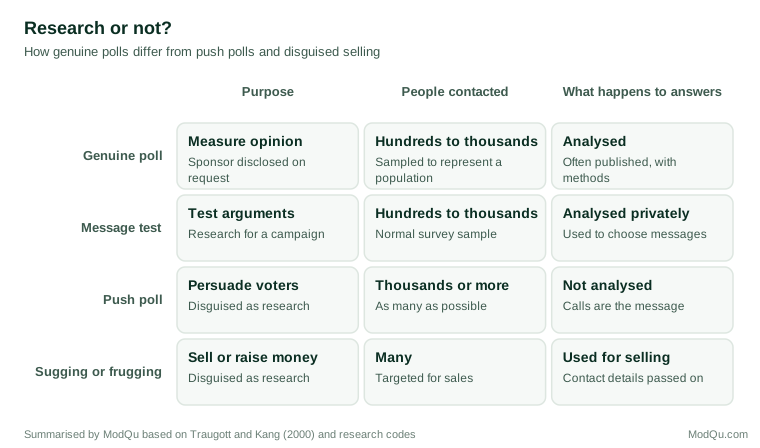
Push polls and message testing
Push polls should be distinguished from legitimate message testing. Campaigns often commission genuine surveys that ask how voters would react to arguments for and against candidates, including negative ones, in order to decide which messages to use. Such surveys use normal samples of a few hundred to a few thousand people, ask many questions including demographics, and analyse the results. The questions may resemble those of a push poll, but the purpose is research. The difference lies in intent and scale, not wording alone (Traugott & Kang, 2000).
Sugging and frugging
Sugging, short for "selling under the guise of research", uses a survey as a way to start a sales conversation or gather contact details for later selling. A caller may ask a few questions about home heating and then offer a visit from a salesperson. Frugging, "fundraising under the guise of research", uses a questionnaire to solicit donations, often with a few opinion questions followed by a request for money. Both are forbidden by research codes, which require that research be kept separate from any sales or fundraising activity (Market Research Society, 2019; ESOMAR & International Chamber of Commerce, 2016). In some countries, they may also breach data protection or direct marketing laws.
Why they matter
These practices harm more than their direct targets. Each time people are misled by a fake survey, they become more suspicious of genuine ones. Public attitudes towards surveys, including trust that surveys are what they claim to be, affect people's willingness to take part (Loosveldt & Storms, 2008). Falling response rates make genuine research more expensive and potentially less accurate, so disguised selling and push polling impose costs on everyone who relies on survey data (Groves et al., 2009).
How to tell the difference
Respondents and journalists can ask:
- Who is sponsoring the survey? Genuine researchers will say.
- How many people are being contacted, and how?
- Will results be published, and where?
- Are there questions about me, such as age and occupation, needed for analysis?
- Is anything being sold or requested?
Guidance for journalists on evaluating polls recommends similar questions before reporting any poll results (Gawiser & Witt, 2007).
What researchers can do
Genuine researchers can protect themselves and their respondents by always identifying the sponsor or research organisation, giving a contact number or website where respondents can check the survey is genuine, and never combining research with sales or fundraising. Research associations in several countries offer verification services that let members of the public confirm whether a survey is genuine.
An example
During a local election, several residents report calls asking whether they would still support a candidate "if they knew" the candidate had voted to close a hospital. Each call lasts about a minute and asks no other questions. Thousands of households receive the call, and no results are ever published. A regional polling association investigates, finds no registered research company behind the calls, and issues a statement identifying them as a push poll (illustrative example).
Conclusion
Push polls, sugging and frugging borrow the form of a survey without its purpose. They mislead the people contacted and damage trust in genuine research. Professional codes forbid them, and knowing their signs helps respondents, journalists and researchers to distinguish them from legitimate surveys.
References
American Association for Public Opinion Research. (2021). AAPOR code of professional ethics and practices. AAPOR. https://aapor.org/standards-and-ethics/
ESOMAR & International Chamber of Commerce. (2016). ICC/ESOMAR international code on market, opinion and social research and data analytics. ESOMAR. https://esomar.org/code-and-guidelines/icc-esomar-code
Gawiser, S. R., & Witt, G. E. (2007). 20 questions a journalist should ask about poll results (3rd ed.). National Council on Public Polls.
Groves, R. M., Fowler, F. J., Jr., Couper, M. P., Lepkowski, J. M., Singer, E., & Tourangeau, R. (2009). Survey methodology (2nd ed.). Wiley.
Loosveldt, G., & Storms, V. (2008). Measuring public opinions about surveys. International Journal of Public Opinion Research, 20(1), 74–89. https://doi.org/10.1093/ijpor/edn006
Market Research Society. (2019). MRS code of conduct. Market Research Society.
Sabato, L. J., & Simpson, G. R. (1996). Dirty little secrets: The persistence of corruption in American politics. Times Books.
Traugott, M. W., & Kang, M.-E. (2000). Push polls as negative persuasive strategies. In P. J. Lavrakas & M. W. Traugott (Eds.), Election polls, the news media, and democracy (pp. 281–300). Chatham House.