
Surveys · Ethics and law
Ethical Standards in Market and Social Research: ESOMAR, MRS and AAPOR Codes
Professional codes set the ethical standards for survey and market research. This article compares three of the most influential, the ICC/ESOMAR International Code, the MRS Code of Conduct and the AAPOR Code, and explains the principles they share, how they differ and how they are enforced.
Survey and market research depend on public trust. People take part because they believe their answers will be used honestly, kept confidential and not turned into a sales pitch. Professional associations protect that trust through codes of conduct, which set out what researchers owe to participants, clients, the public and each other. Three codes are especially influential: the ICC/ESOMAR International Code, the MRS Code of Conduct and the AAPOR Code of Professional Ethics and Practices.
The three codes
ESOMAR, founded in 1948 as the European Society for Opinion and Marketing Research, is now a global association. Its code, issued jointly with the International Chamber of Commerce since 1977, has been adopted or endorsed by many national associations. The current version covers market, opinion and social research and data analytics (ESOMAR & International Chamber of Commerce, 2016).
The Market Research Society (MRS) is the professional body for research in the United Kingdom. Its code applies to all members and to accredited company partners, and is supported by detailed guidance notes on topics such as research with children and online research (Market Research Society, 2019).
The American Association for Public Opinion Research (AAPOR), founded in 1947, represents survey and public opinion researchers in the United States and beyond. Its code places particular emphasis on disclosure of methods, so that others can evaluate published findings (American Association for Public Opinion Research, 2021).
Shared principles
Despite differences in emphasis, the codes share core principles, shown in Figure 1.
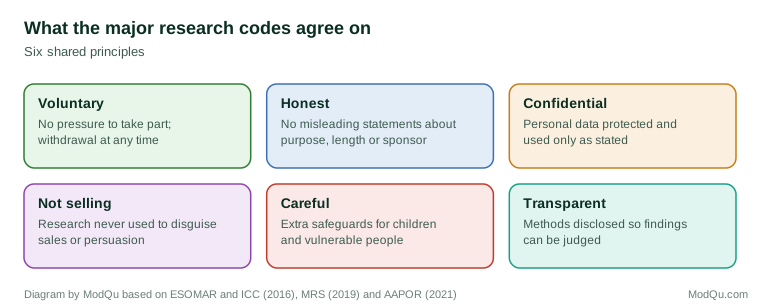
- Voluntary participation. People must not be pressured to take part and may withdraw at any time.
- Honesty. Researchers must not mislead participants about the purpose of research, its length or who is conducting it.
- Confidentiality and data protection. Personal data must be protected and used only for the purposes participants were told about, in line with the law.
- Separation of research from selling. Research must not be used as a disguise for sales, fundraising or persuasion. Activities such as "selling under the guise of research", known as sugging, are explicitly forbidden.
- Care for vulnerable people, including children, with additional consent and safeguards.
- Transparency about methods, so that findings can be judged fairly.
These principles reflect wider ethical ideas found in research ethics generally, such as respect for persons and avoidance of harm (@@National Commission for the Protection of Human Subjects of Biomedical and Behavioral Research, 1979; Kimmel, 2007).
Differences in emphasis
The codes differ in scope and focus, as summarised in Figure 2.
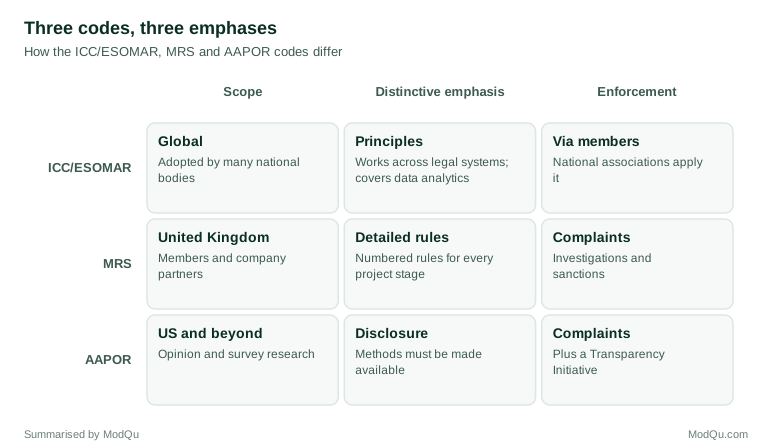
The ICC/ESOMAR code is designed to work across many countries and legal systems. It sets principles and leaves detailed rules to national associations and law. Recent versions address data analytics and the use of data not collected by researchers themselves, such as social media data.
The MRS code is more detailed and prescriptive, with numbered rules covering every stage of a project, from designing research to reporting it. MRS can investigate complaints against members and impose sanctions.
The AAPOR code focuses strongly on disclosure. Researchers who publish survey results must make available key information about how the survey was done, such as the sponsor, the population, the sampling method, the dates, the mode, the question wording and how weights were constructed. AAPOR's Transparency Initiative recognises organisations that commit to routine disclosure.
Other codes and guidelines
Many other bodies publish codes that overlap with these three. In the United States, the Insights Association sets standards for marketing research and data analytics (Insights Association, 2019). In the United Kingdom, the Social Research Association publishes ethical guidance for social researchers in government, universities and charities (Social Research Association, 2021). Research funded by governments or carried out in universities is also governed by research ethics frameworks, such as Canada's Tri-Council Policy Statement, which require review by an ethics board (Canadian Institutes of Health Research et al., 2022). A survey project may therefore be subject to several codes at once, and researchers should identify all that apply before fieldwork begins.
Codes and the law
Codes do not replace the law; they add to it. Data protection laws, such as the European Union's General Data Protection Regulation, set legal requirements for handling personal data, and the codes require members to comply with them (European Parliament & Council of the European Union, 2016). But codes go further than the law in several respects, for example by forbidding disguised selling even where it would be legal, or by requiring disclosure of methods that no law demands. Where laws differ between countries, codes provide a common minimum standard for international projects.
Applying codes to new methods
New methods raise questions the original codes did not anticipate. Online panels, data collected from social media, passive data from smartphones and the use of artificial intelligence to analyse or even simulate responses all test the principles of consent, transparency and confidentiality. Associations respond with guidance notes and updated codes. ESOMAR, for example, publishes a set of questions that buyers should ask suppliers of online samples about how panel members are recruited, how their identity and attention are checked and how they are rewarded (ESOMAR, 2021).
Standards and enforcement
Codes are supported by quality standards. The international standard ISO 20252 sets requirements for the processes used in market, opinion and social research, and many research companies are certified against it (International Organization for Standardization, 2019). Enforcement of codes relies mainly on membership: associations can investigate complaints and expel or censure members. Their reach is therefore limited to members, and organisations outside professional associations, such as some polling and feedback companies, are not bound by them.
Why codes matter
Codes protect participants, but they also protect the research industry. Practices such as disguised selling, push polling and misleading reporting damage public willingness to take part in genuine research. By setting clear standards and distinguishing professional research from these practices, codes help to maintain the survey climate on which all researchers depend (Groves et al., 2009).
Conclusion
The ICC/ESOMAR, MRS and AAPOR codes share core commitments to voluntary participation, honesty, confidentiality, separation from selling and transparency. They differ in scope, detail and emphasis, from ESOMAR's international principles to the MRS's detailed rules and AAPOR's focus on disclosure. Researchers should know the codes that apply to their work and treat them as a minimum standard rather than a checklist.
References
American Association for Public Opinion Research. (2021). AAPOR code of professional ethics and practices. AAPOR. https://aapor.org/standards-and-ethics/
Canadian Institutes of Health Research, Natural Sciences and Engineering Research Council of Canada, & Social Sciences and Humanities Research Council of Canada. (2022). Tri-Council policy statement: Ethical conduct for research involving humans – TCPS 2 (2022). Government of Canada.
ESOMAR & International Chamber of Commerce. (2016). ICC/ESOMAR international code on market, opinion and social research and data analytics. ESOMAR. https://esomar.org/code-and-guidelines/icc-esomar-code
ESOMAR. (2021). Questions to help buyers of online samples. ESOMAR.
European Parliament & Council of the European Union. (2016). Regulation (EU) 2016/679 of the European Parliament and of the Council of 27 April 2016 on the protection of natural persons with regard to the processing of personal data and on the free movement of such data (General Data Protection Regulation). Official Journal of the European Union, L 119, 1–88.
Groves, R. M., Fowler, F. J., Jr., Couper, M. P., Lepkowski, J. M., Singer, E., & Tourangeau, R. (2009). Survey methodology (2nd ed.). Wiley.
Insights Association. (2019). Code of standards and ethics for marketing research and data analytics. Insights Association.
International Organization for Standardization. (2019). Market, opinion and social research, including insights and data analytics — Vocabulary and service requirements (ISO Standard No. 20252:2019).
Kimmel, A. J. (2007). Ethical issues in behavioral research: Basic and applied perspectives (2nd ed.). Blackwell.
Market Research Society. (2019). MRS code of conduct. Market Research Society.
National Commission for the Protection of Human Subjects of Biomedical and Behavioral Research. (1979). The Belmont report: Ethical principles and guidelines for the protection of human subjects of research. U.S. Department of Health, Education, and Welfare.
Social Research Association. (2021). Research ethics guidance. Social Research Association.