
Share how your business uses legal services
Tell us whether your business has used a lawyer in the last year, what for and how you chose them. Your answers are combined with other people's and reported only as totals.
Start the legal services for businesses surveyAbout 5 minutes. No account needed. You can stop at any time.
About this page
This page describes how businesses use legal services. It is not legal advice. Laws and professional rules differ widely between countries, and businesses usually seek advice from a qualified lawyer where they operate.
When businesses need legal help
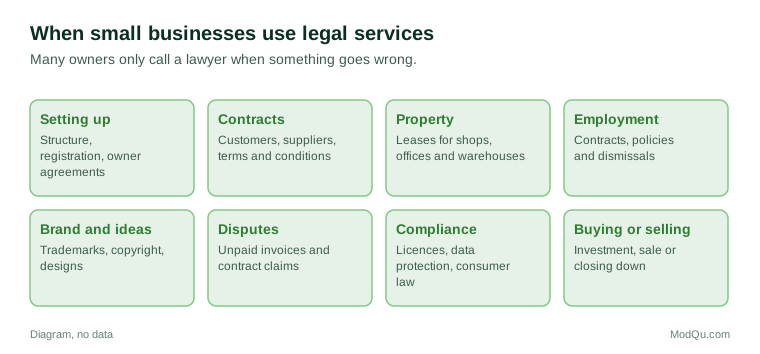
Common reasons small businesses use legal services include:
- setting up: choosing a business structure, registering a company, shareholder or partnership agreements;
- contracts: drafting or reviewing contracts with customers, suppliers and partners, and terms and conditions;
- property: leases for shops, offices and warehouses;
- employment: contracts, policies, disciplinary matters and dismissals;
- intellectual property: trademarks, copyright, designs and patents;
- disputes: unpaid invoices, contract disagreements, complaints and claims;
- regulation and compliance: licences, data protection, consumer law and sector rules;
- buying or selling a business, raising investment or closing down;
- debt recovery and insolvency.
Many businesses only contact a lawyer when something goes wrong. Lawyers often say that early advice, such as checking a lease before signing, can avoid larger costs later.
Example
A café owner signs a five-year lease without legal advice. Two years later the landlord passes on a large repair bill under a clause the owner had not noticed. A lawyer confirms the clause is valid. The owner says that a few hundred dollars of advice before signing would have saved several thousand.
Kinds of legal service
Businesses can choose from many kinds of provider:
- law firms, from sole practitioners to large firms, often specializing in business law;
- in-house lawyers, employed by larger businesses;
- online legal services, offering document templates, fixed-fee services and online consultations;
- legal document tools for standard contracts and policies;
- legal expenses insurance, which may cover some advice and dispute costs;
- advice from business associations, chambers of commerce and government business support services;
- specialists, such as trademark attorneys, notaries and, in some countries, other regulated legal professionals.
Some tasks, such as registering a company or a trademark, can be done directly with a government office without a lawyer, though many businesses still seek advice.
How businesses choose a lawyer
Owners often choose through:
- recommendations from accountants, other business owners or banks;
- previous experience;
- online searches and reviews;
- professional directories and bar or law society listings;
- business association referral services.
They weigh specialist knowledge, price, clear communication, speed, location and whether they feel the lawyer understands small businesses.
How legal services are paid for
Common fee arrangements include:
- hourly rates, often charged in small time units;
- fixed fees for defined tasks, such as a lease review or company registration;
- retainers for ongoing advice;
- subscription legal services for small businesses;
- conditional or contingency fees in some countries and types of case, linked to the outcome;
- insurance-funded advice and cases.
Many small business owners say uncertainty about cost puts them off getting advice. Fixed fees and clear estimates help them plan.
Example (hypothetical figures)
A small business needs three things in a year: a shareholder agreement, a lease review and a debt claim. A law firm quotes a fixed fee of 1,500 dollars for the agreement and 600 dollars for the lease review, and charges 250 dollars an hour for the debt claim, which takes six hours. The total is 1,500 plus 600 plus 1,500, or 3,600 dollars. The debt recovered is 9,000 dollars.
Disputes and alternatives to court
Disputes are among the most stressful legal issues for small firms. Common types include unpaid invoices, quality complaints, contract disagreements and disputes with landlords or employees. Options before or instead of court include:
- negotiation, often with a lawyer's letter;
- mediation, with a neutral mediator;
- arbitration, where an arbitrator makes a binding decision;
- small claims procedures for lower-value claims in many countries;
- ombudsman and industry schemes in some sectors.
Example
A design studio is owed 4,000 dollars by a client who stops responding. The studio sends a formal letter through its lawyer and, when that fails, files a claim through the local small claims process, which it handles itself with guidance. The client pays before the hearing.
Legal costs and how owners plan for them
Many small businesses do not budget for legal costs and treat them as an emergency expense. Some set aside a yearly amount for routine matters such as contract reviews, or buy legal expenses insurance, sometimes added to a business insurance policy. Others use business association memberships that include a legal helpline. Owners who use a lawyer regularly often say a long-term relationship helps, because the lawyer already knows the business and can give quicker advice.
Barriers to getting legal help
Owners often mention:
- cost and unclear pricing;
- not knowing whether a problem is legal or when to seek advice;
- finding a lawyer who understands small businesses;
- time taken to resolve matters;
- language and jargon.
Some governments and business groups provide free initial advice or legal clinics for small businesses.
Technology and legal services
Technology is changing how businesses get legal help. Online platforms offer contract templates, electronic signatures, company registration and fixed-price advice by video call. Some law firms use software to draft standard documents faster. Owners like the lower cost and speed, while lawyers caution that templates may not fit every situation and that errors in important contracts can be costly.
What people disagree about
Legal services raise some debates:
- whether online legal tools and templates are good enough for most small businesses;
- whether legal fees should be more transparent;
- how much routine legal work could be done by people other than lawyers;
- whether legal expenses insurance is worth buying.
Questions law firms, insurers, banks and software firms want answered include how often small businesses use lawyers, for what, how they choose, what they pay and what stops them seeking advice.
Key terms
- Business structureThe legal form of a business, such as a sole trader, partnership or company.
- Shareholder agreementA contract between a company's owners about how it is run.
- LeaseA contract to rent property for a set period.
- TrademarkA registered sign, such as a name or logo, that identifies a business's goods or services.
- Fixed feeA set price agreed in advance for a defined task.
- MediationA process where a neutral person helps the parties reach agreement.
- ArbitrationA process where an arbitrator makes a binding decision on a dispute.
- Small claimsA simpler court procedure for lower-value claims.
Full glossary: corporate law terms on EditingTests.com.
Legal services for businesses vocabulary test
How well do you know the language of this topic? Try 8 quick questions. Your score is shown straight away and is not saved.
What the legal services for businesses survey asks
This survey is part of ModQu's Business and Professional Services survey. The legal services for businesses part takes about five minutes and covers:
- Whether your business has used a lawyer or legal service in the last year.
- What it was for: setup, contracts, property, employment, disputes or other.
- How you chose the lawyer or service.
- How you paid, and whether the cost was what you expected.
- Whether you have used online legal tools or templates.
- What stops your business getting legal advice when it might need it.
After that you can choose to continue with other short parts of the Business and Professional Services survey, such as small business owners or accounting and bookkeeping, or stop.
Ready to take part?
Your answers help show what people really think and do. Results are only ever reported as totals; no one can see your individual answers.
Start the surveyQuestions about this survey
Who can take part?
Business owners.
Do I have to give my name?
No. You may be asked for your age group, region and similar details so results can be broken down, but not your name. ModQu never asks for passwords, card numbers or account numbers.
How are the results used?
Answers are combined into totals and percentages and published in ModQu reports. Individual answers are never shown.
Is the vocabulary test part of the survey?
No. It is optional and separate, and your score is not stored.
Does this page give legal advice?
No. It describes how businesses use legal services. Laws differ by country.
Will the survey ask about specific disputes?
It asks about the kind of matter, not details, and every question is optional.