
Share your experience of learning to drive
Tell us whether you have a driving licence, how you learned and how much learning cost. Your answers are combined with other people's and reported only as totals.
Start the driving licences and learning to drive surveyAbout 5 minutes. No account needed. You can stop at any time.
What this topic covers
This topic covers the process of becoming a licensed driver:
- the age at which people learn and why;
- how they learn: professional lessons, family practice, driving schools or online theory courses;
- the theory and practical tests;
- licence systems, including learner permits and graduated licences;
- the cost and time involved;
- why some people do not learn to drive;
- exchanging a licence when moving to another country.
How licence systems work
Most countries have several stages, though the details differ:
- Learner stage: a learner permit or provisional licence allows supervised practice, often after passing a theory test. Learners may need to display L plates or similar signs.
- Tests: usually a written or computer-based theory test on road rules and hazards, and a practical driving test with an examiner. Some countries also have a hazard perception test or an eyesight check.
- Graduated licensing: in many places, including Canadian provinces, Australian states, US states and New Zealand, new drivers pass through stages with restrictions on night driving, passengers or alcohol before getting a full licence.
- Probation periods: some countries apply stricter rules, such as lower penalty point limits, for the first years after passing.
The minimum age for driving a car ranges from around 16 in some places to 18 in most of Europe and many other countries.
How people learn
Learners use different combinations of methods:
- Professional driving lessons with a licensed instructor, often in a dual-control car;
- Driving schools with set courses, compulsory in some countries;
- Practice with family or friends, allowed in many countries if the supervisor meets age and licence rules;
- Intensive courses that aim to prepare learners in a week or two;
- Theory apps and online courses;
- Simulators, used by some schools;
- Learning in an automatic car, which may lead to a licence that only covers automatics in some countries.
Some countries require a minimum number of professional lessons or logged supervised hours. Others leave it to the learner.
Example
A teenager learns with a mix of weekly lessons from an instructor and practice with a parent at weekends. The parent finds supervising stressful at first, so the instructor suggests specific routes and skills to practise between lessons. The teenager passes on the second attempt after about eight months.
The tests
The theory test usually covers road signs, rules, hazards and safe behaviour. The practical test checks control of the vehicle, observation, following road rules and handling real traffic. Some include manoeuvres such as parking and turning in the road, and driving using a navigation device.
Common reasons people fail the practical test include:
- poor observation at junctions;
- not using mirrors effectively;
- incorrect positioning on the road;
- speed control;
- responding poorly to traffic lights and signs;
- nerves.
Waiting times for practical tests are long in some countries, and some learners travel to other test centres to get earlier dates.
What learning costs
The cost of learning to drive varies a great deal between countries and depends on how many lessons a person needs. Costs can include:
- lessons;
- learner permit and test fees;
- theory test preparation;
- insurance for practice in a family car;
- retests;
- the licence itself.
Example (hypothetical figures)
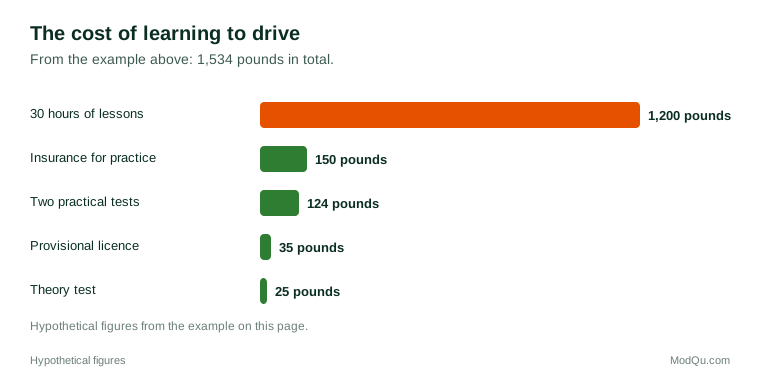
A learner pays 40 pounds an hour for 30 hours of lessons, which is 1,200 pounds. The provisional licence costs 35 pounds, the theory test 25 pounds, and two attempts at the practical test cost 62 pounds each, 124 pounds. Insurance for practice in a parent's car costs 150 pounds. The total is 1,534 pounds, of which lessons are about 78%.
Figure 1 shows the costs in that example. Costs like these can be a barrier for young people and for people on low incomes, especially where a licence is needed to get a job.
Why some people do not learn to drive
Not everyone wants or can afford a licence. Reasons people give include:
- cost of lessons, tests, insurance and a car;
- living in a city with good public transport;
- anxiety about driving;
- environmental reasons;
- health conditions or disabilities that affect driving;
- not having anyone to practise with;
- simply not needing to drive.
In several high-income countries, young people are getting licences later than previous generations did. Researchers link this to cost, more people living in cities, studying for longer and online life. In many lower-income and fast-growing countries, demand for licences is rising.
Example
A 24-year-old in a large city has never learned to drive. They use public transport and cycle. When they get a job offer that requires visiting clients outside the city, they start lessons and pass within four months. They say being older made them more confident but less patient with the cost.
Licences and moving abroad
People who move to another country often have to exchange their licence, take new tests or carry an International Driving Permit for a limited time. Rules depend on agreements between countries. Some licences can be exchanged directly; others require the holder to pass the local theory and practical tests. Newcomers sometimes find this an unexpected cost and barrier to work.
Trends and debates
Trends include online theory learning and booking, automatic-only licences becoming more common as manual cars decline, electric cars used for lessons, and digital driving licences on phones. Debates include whether the minimum age should change, whether graduated licensing should be stricter, how to reduce test waiting times, whether older drivers should be retested, and how to make learning affordable.
Questions that businesses want answered here include who has a licence, how people learned, how much it cost, how many attempts they needed and what stopped people from learning.
Key terms
- Learner permitA permit that allows supervised driving practice before a full licence.
- Provisional licenceA learner's licence, the term used in some countries.
- Theory testA test of knowledge of road rules, signs and hazards.
- Practical testA driving test with an examiner in real traffic.
- Graduated licenceA system where new drivers face restrictions that are lifted in stages.
- Dual-control carA car with extra pedals for the instructor.
- Hazard perception testA test of how quickly a learner spots developing dangers, often using video clips.
- International Driving PermitA document that translates a licence for use in other countries for a limited time.
Full glossary: career technical education terms on EditingTests.com.
Driving licences and learning to drive vocabulary test
How well do you know the language of this topic? Try 8 quick questions. Your score is shown straight away and is not saved.
What the driving licences and learning to drive survey asks
This survey is part of ModQu's Cars and Getting Around survey. The driving licences and learning to drive part takes about five minutes and covers:
- Whether you have a driving licence, and at what age you got it.
- How you learned: lessons, a driving school, family practice or a mix.
- How many attempts you needed to pass the theory and practical tests.
- How much learning to drive cost, and how long it took.
- If you do not drive, why not, and whether you plan to learn.
- Whether you have had to exchange a licence after moving to another country.
After that you can choose to continue with other short parts of the Cars and Getting Around survey, such as buying a car or electric vehicles, or stop.
Ready to take part?
Your answers help show what people really think and do. Results are only ever reported as totals; no one can see your individual answers.
Start the surveyQuestions about this survey
Who can take part?
Adults and teens aged 16 and over.
Do I have to give my name?
No. You may be asked for your age group, region and similar details so results can be broken down, but not your name. ModQu never asks for passwords, card numbers or account numbers.
How are the results used?
Answers are combined into totals and percentages and published in ModQu reports. Individual answers are never shown.
Is the vocabulary test part of the survey?
No. It is optional and separate, and your score is not stored.
Is it better to learn in a manual or automatic car?
It depends on the country and on what the learner will drive. In some countries an automatic-only licence does not cover manual cars, while in places where most cars are automatic this matters less.
How many lessons does a typical learner need?
It varies widely with the person, the country's test and how much private practice they have. Instructors usually assess progress rather than set a fixed number.