
Share your experience of buying a car
Tell us when you plan to buy your next vehicle, what kind, and how you will research and pay for it. Your answers are combined with other people's and reported only as totals.
Start the buying a car surveyAbout 5 minutes. No account needed. You can stop at any time.
What buying a car involves
Buying a car is a chain of decisions rather than a single choice. A buyer has to settle when to buy, what kind of vehicle fits their needs, whether to buy new or used, where to buy it, how to pay for it, and what to do with the vehicle they already own. Each step affects the others. A buyer who needs low monthly payments may end up with a longer loan or a lease; a buyer who wants a particular model may have to wait for one to arrive.
For most people, the purchase falls into one of a few situations:
- First car, often bought used, often with help from family, and often with a tight budget.
- Replacement, when an existing vehicle becomes unreliable, costly to repair or is written off after a collision.
- Change of need, such as a new child, a move to the suburbs or the country, a longer commute, or retirement.
- Upgrade, when the old car still works but the owner wants newer features or an electric model.
The reason shapes what follows: someone whose car has just failed has little time to research, while someone upgrading by choice can wait for the right offer.
When people decide to buy
Most people do not buy on a fixed schedule. The timing usually depends on the condition of the current vehicle, household finances and life events. Common signals that a purchase is near include rising repair bills, a large repair estimate that seems out of proportion to the car's value, a lease ending, or a family change.
Some buyers try to time the purchase to get a better price, for example near the end of a month, quarter or model year, when dealers may want to meet sales targets, or when the next model year arrives and the outgoing models are discounted.
Example
A household's ten-year-old minivan needs a transmission repair that would cost more than half of what the van is worth. They had planned to replace it in two years, but the estimate brings the decision forward. Because they have to act within weeks, they look only at vehicles that dealers in their area already have on the lot, rather than ordering the model they would have preferred.
Questions that businesses want answered here include how far ahead people plan and what finally triggers a purchase.
New or used
The choice between a new and a used vehicle is one of the biggest in the process.
A new car comes with the full manufacturer's warranty, the latest safety and technology features, a known history and, often, lower promotional interest rates. Its main drawback is depreciation: a new car loses value fastest in its first few years.
A used car costs less to buy and has already taken the steepest part of its depreciation. In exchange, the buyer takes on more uncertainty about its condition and history, may have less warranty cover, and may pay a higher interest rate on a loan.
Between the two sit certified pre-owned vehicles. These are used vehicles, usually only a few years old, that a dealer has inspected and that come with an extended warranty from the manufacturer or dealer. They cost more than similar used cars without certification.
Buyers of used vehicles commonly check:
- a vehicle history report, which can show past accidents, insurance claims, liens, odometer readings and whether the vehicle was registered in another province or state;
- whether there is a lien on the vehicle, meaning money is still owed on it;
- a pre-purchase inspection by an independent mechanic;
- the service records kept by the previous owner.
Where people research
Car buyers often spend weeks or months researching. Most begin online, then narrow their list before visiting a dealer or seller in person. Common sources include:
- manufacturer and dealer websites, with prices, options and stock;
- online listing sites and classified ads for used vehicles;
- reviews and comparison tests by journalists and reviewers;
- owner forums and videos;
- safety ratings from public and independent testing bodies, such as Transport Canada's recall database and the crash-test ratings published in the United States;
- friends, family and co-workers who own the model;
- the test drive, which many buyers still see as essential.
Dealers, private sales and buying online
Most new cars are sold through franchised dealers. Used cars are sold by franchised dealers, independent used-car dealers, and private sellers. A growing number of buyers also complete much of the purchase online, choosing a vehicle, applying for credit and arranging delivery or pickup with little time at the dealership.
Each route has trade-offs:
- Dealers handle the paperwork, licensing and taxes, may offer warranties and financing, and in most provinces are regulated by a provincial body that handles complaints and may run a compensation fund. Prices are usually higher than in a private sale.
- Private sales can offer a lower price but with fewer protections. The buyer is responsible for checking the vehicle, confirming the seller owns it, and dealing with registration and tax.
- Online sales can save time and reduce pressure, but the buyer may not be able to test drive the exact vehicle before committing, so return policies matter.
Example
A buyer finds the same used hatchback for sale privately and at a dealer. The private price is lower. The dealer's price is higher but includes a safety inspection, a 90-day warranty and the paperwork. The buyer pays for an independent inspection of the private car, learns it needs new brakes and tires, adds those costs to the private price, and finds the two offers are closer than they first looked.
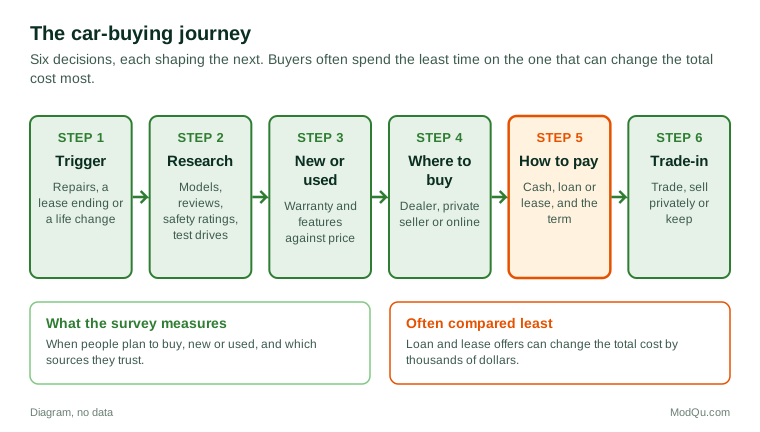
Paying for a car: cash, loans and leases
Few buyers pay the full price in cash. The main ways to pay are:
- Cash or savings, which avoids interest but uses up savings.
- A car loan, arranged through the dealer or directly with a bank or credit union. The buyer owns the car and pays it off over a set term.
- A lease, in which the buyer pays to use the car for a set period and distance, then returns it, buys it at a set price, or leases another.
Loan terms have become longer over time in many markets, which lowers the monthly payment but increases the total interest paid. A long loan can also leave the buyer owing more than the car is worth for much of the term, which is called negative equity. If they trade the car in early, the amount still owed may be rolled into the next loan.
Example (hypothetical figures)
A buyer is offered the same car with two loans. Loan A is $30,000 over 60 months at 6% interest, with a monthly payment of about $580 and total interest of about $4,800. Loan B is $30,000 over 84 months at the same rate, with a monthly payment of about $438 and total interest of about $6,800. The buyer likes the lower payment of Loan B, but it costs about $2,000 more in interest over the life of the loan.
A lease usually has lower monthly payments than a loan on the same car, but it comes with limits on distance driven and charges for excess wear at the end. People who drive a lot or keep cars for a long time often find buying cheaper; people who like a new car every few years often prefer leasing.
Trade-ins and the full cost of owning
Many buyers trade in their current vehicle. A trade-in is convenient and, in several provinces, can reduce the sales tax paid on the new purchase because tax is charged on the difference. Selling privately often brings a higher price but takes more time.
The purchase price is only part of what a car costs. Buyers who compare vehicles carefully also consider:
- insurance, which can vary widely between models;
- fuel or electricity;
- maintenance and repairs;
- licence and registration fees;
- parking;
- depreciation, which is often the largest single cost of owning a newer car.
Common problems and what people disagree about
Buyers often describe car shopping as stressful. Common complaints include pressure to add extras such as extended warranties, rust protection or paint protection; confusion about fees added to the advertised price; long waits for popular models; and disputes over trade-in values.
People disagree on several questions. Some think new cars are a poor use of money because of depreciation, while others value the warranty and lower risk. Some see leasing as a sensible way to manage costs, others as paying for something you never own.
Key terms
- DepreciationThe loss in a vehicle's value over time.
- Certified pre-ownedA used vehicle inspected by a dealer and sold with an extended warranty.
- LienA legal claim on a vehicle by a lender until a debt is paid.
- Negative equityOwing more on a vehicle loan than the vehicle is worth.
- Lease buyoutThe set price at which a person can buy a vehicle at the end of a lease.
- Trade-inA vehicle given to the dealer as part payment for another.
- Vehicle history reportA record of a vehicle's past accidents, claims, registrations and odometer readings.
- MSRPThe manufacturer's suggested retail price for a new vehicle.
Full glossary: used vehicle remarketing terms on EditingTests.com.
Buying a car vocabulary test
How well do you know the language of this topic? Try 8 quick questions. Your score is shown straight away and is not saved.
What the buying a car survey asks
This survey is part of ModQu's Cars and Getting Around survey. The buying a car part takes about five minutes and covers:
- When you plan to buy your next vehicle, and what is prompting it.
- Whether you will buy new, used or certified pre-owned, or lease.
- What type of vehicle and fuel you are considering.
- Where you will research it, and which sources you trust most.
- Where you expect to buy: a dealer, a private seller or online.
- How you expect to pay, and what matters most in the final choice.
After that you can choose to continue with other short parts of the Cars and Getting Around survey, such as electric vehicles or public transit, or stop.
Ready to take part?
Your answers help show what people really think and do. Results are only ever reported as totals; no one can see your individual answers.
Start the surveyQuestions about this survey
Who can take part?
Drivers and people planning to buy a vehicle.
Do I have to give my name?
No. You may be asked for your age group, region and similar details so results can be broken down, but not your name. ModQu never asks for passwords, card numbers or account numbers.
How are the results used?
Answers are combined into totals and percentages and published in ModQu reports. Individual answers are never shown.
Is the vocabulary test part of the survey?
No. It is optional and separate, and your score is not stored.
Do I need to be planning a purchase to take part?
No. The survey is for anyone who drives or expects to buy a vehicle. If you have no plans, you can say so.