
Share your experience of public transit
Tell us how often you ride, how you pay and what would make you use transit more. Your answers are combined with other people's and reported only as totals.
Start the public transit surveyAbout 5 minutes. No account needed. You can stop at any time.
What public transit includes
Public transit is shared passenger transport that is open to everyone, runs on set routes and usually on a timetable, and is run or funded by a public authority. In Canada, transit is usually run by a city, a regional agency or a provincial body.
The main kinds are:
- Local buses, the most common form of transit in almost every Canadian city and town.
- Express and rapid buses, which make fewer stops and sometimes run in their own lanes. When they have dedicated lanes, stations and frequent service, they are called bus rapid transit (BRT).
- Streetcars and light rail (LRT), electric trains that run on tracks, either in the street or on their own right of way.
- Subways and metros, high-capacity trains, mostly underground or elevated, found in the largest cities.
- Commuter rail, trains linking suburbs and nearby towns to a city centre, often focused on weekday rush hours.
- Ferries, where water crossings are part of the network.
- Paratransit, door-to-door or shared-ride service for people who cannot use regular transit because of a disability.
- On-demand transit, small vehicles booked by app or phone that pick riders up in areas where fixed routes do not make sense.
Who uses transit and why
Transit riders are a varied group. Some ride because it is the best option for their trip, for example to a downtown office where parking is expensive. Others ride because they have no other option: they do not drive, cannot afford a car, are too young to drive, or have a disability that prevents driving. Researchers sometimes call the first group choice riders and the second transit-dependent riders, although many people fall somewhere in between.
The trips people make on transit include:
- commuting to work or school;
- shopping and errands;
- medical appointments;
- social visits and going out in the evening;
- getting to an airport, a train station or a long-distance bus.
How much people use transit depends mainly on how well it serves the trips they need to make. A frequent, direct route that runs late into the evening attracts riders. A route that runs every 45 minutes and needs two transfers usually does not, unless people have no choice.
Example
A nurse works shifts at a hospital across the city. Day shifts are easy by subway, about 35 minutes door to door. Night shifts end after the subway closes, when the only option is an overnight bus with a long wait. They drive on night-shift weeks and take transit the rest of the time, so they buy single fares instead of a monthly pass.
Fares and how people pay
Fare systems differ between cities, but most use some mix of the following:
- Single fares, paid each trip, often with free transfers for a set time.
- Passes, which allow unlimited rides for a day, week or month.
- Fare capping, where riders pay per trip until they reach the price of a pass, after which further trips that day, week or month are free.
- Concession fares for children, students, seniors and people on low incomes.
- Zone or distance-based fares, where longer trips cost more, common on commuter rail.
The ways people pay have changed a lot. Paper tickets and exact cash still exist in many places, but most large systems now use smart cards, reloadable cards tapped on a reader. A growing number also accept open payment, in which riders tap a contactless bank card or a phone at the reader instead of buying a transit card at all. Mobile ticketing apps are common in smaller systems.
Example (hypothetical figures)
A city charges $3.50 per trip with a cap of $140 per month. A rider who makes 44 trips in a month pays for the first 40 trips, $140, and rides free after that. Without the cap, the 44 trips would have cost $154. A rider who makes 20 trips pays $70, so they do not have to decide in advance whether a pass is worth buying.
Questions that businesses and transit agencies want answered here include which payment methods riders use and prefer, how many would use open payment if it were offered, and how fare levels affect how often people ride.
Reliability, frequency and speed
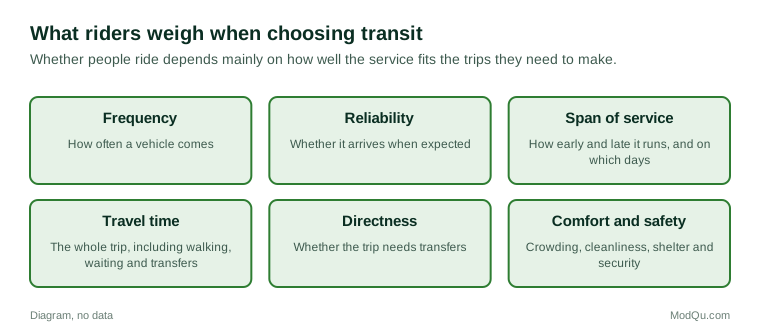
When riders are asked what matters most, the answers usually centre on whether the service is there when they need it. The key ideas are:
- Frequency: how often a vehicle comes. When service is very frequent, riders stop checking the schedule.
- Reliability: whether vehicles arrive when expected, and whether trips are cancelled.
- Span of service: how early and how late the service runs, and on which days.
- Travel time: how long the whole trip takes, including walking, waiting and transfers, compared with driving.
- Directness: whether a trip needs transfers.
Real-time arrival information, shown in apps and at stops, has changed how people use transit. Knowing a bus is eight minutes away makes the wait easier to plan, even if the service itself is no more frequent.
Safety, comfort and accessibility
Personal safety is a concern for some riders, especially late at night, at isolated stops and on crowded vehicles. Perceptions of safety affect who rides and when. Cleanliness, crowding, heating in winter, shelter at stops and the condition of stations also shape whether people are willing to use transit.
Accessibility covers more than wheelchair access. It includes working elevators at stations, low-floor buses, audible and visual stop announcements, clear signs, and accessible fare machines. When an elevator is out of service, a station can become unusable for some riders.
Example
An older rider uses a walker. Their nearest subway station has one elevator, which is often out of service. On those days they ride a bus that takes twice as long. They have registered for paratransit but find it has to be booked a day ahead, so they use it only for medical appointments.
What keeps people away
People who rarely use transit give reasons such as:
- the trip takes much longer than driving;
- service is too infrequent or does not run at the times they need;
- the nearest stop is too far from home or from where they are going;
- they need to carry things, travel with children or make several stops;
- concerns about safety, cleanliness or crowding;
- they already own a car, so each extra trip by car seems to cost little.
That last point matters. Once a household has paid for a car and its insurance, the cost of one more drive looks small compared with a transit fare, even when the full cost of owning the car is high.
Trends and what people disagree about
Ridership in many Canadian cities fell sharply during the COVID-19 pandemic and has since recovered unevenly, partly because more office workers now work from home some days. Weekday peaks are flatter in many places, while off-peak and weekend travel has recovered better in some systems. Agencies are adjusting by changing schedules, expanding open payment and trying on-demand services in low-density areas.
There are lively debates. Should cities spend on new rail lines or on more frequent buses? Should fares be lower, or even free, or should the money go to more service? How much road space should be given to buses and bike lanes rather than cars? And who should pay for transit: riders through fares, local property taxes, or provincial and federal governments?
Key terms
- HeadwayThe time between one transit vehicle and the next on the same route.
- Fare cappingA system where riders stop paying once their fares reach the price of a pass.
- Open paymentPaying a fare by tapping a contactless bank card or phone.
- TransferChanging from one route or vehicle to another during one trip.
- ParatransitDoor-to-door or shared-ride service for people who cannot use regular transit.
- Bus rapid transitBus service with dedicated lanes, stations and frequent service.
- RidershipThe number of trips taken on a transit system.
- Span of serviceThe hours and days a route runs.
Full glossary: public transit fare systems terms on EditingTests.com.
Public transit vocabulary test
How well do you know the language of this topic? Try 8 quick questions. Your score is shown straight away and is not saved.
What the public transit survey asks
This survey is part of ModQu's Cars and Getting Around survey. The public transit part takes about five minutes and covers:
- How often you use public transit, and for which kinds of trips.
- Which kinds of transit you use: bus, rapid transit, subway, train or ferry.
- How you pay your fare, and how you would prefer to pay.
- How satisfied you are with frequency, reliability, safety and comfort.
- What stops you using transit more, if anything.
- What would make you use transit more.
After that you can choose to continue with other short parts of the Cars and Getting Around survey, such as buying a car or electric vehicles, or stop.
Ready to take part?
Your answers help show what people really think and do. Results are only ever reported as totals; no one can see your individual answers.
Start the surveyQuestions about this survey
Who can take part?
Adults in urban areas.
Do I have to give my name?
No. You may be asked for your age group, region and similar details so results can be broken down, but not your name. ModQu never asks for passwords, card numbers or account numbers.
How are the results used?
Answers are combined into totals and percentages and published in ModQu reports. Individual answers are never shown.
Is the vocabulary test part of the survey?
No. It is optional and separate, and your score is not stored.
I never use transit. Can I still take part?
Yes. Answers from people who do not ride are just as useful, because they show what keeps people away.