
Share your views on cycling
Tell us how often you ride, whether you would buy an e-bike and what would make cycling safer where you live. Your answers are combined with other people's and reported only as totals.
Start the cycling and e-bikes surveyAbout 5 minutes. No account needed. You can stop at any time.
Kinds of cycling
People ride bicycles for many different reasons, and they often fall into more than one group.
- Transportation: riding to work, school, shops or appointments instead of driving or taking transit.
- Recreation: leisure rides on paths, trails and quiet roads, often with family or friends.
- Fitness and sport: road cycling, mountain biking, gravel riding, racing and indoor training.
- Work: couriers and delivery riders, and workers who use bikes on large sites.
- Touring: longer trips carrying gear, from overnight rides to cross-country journeys.
How often people ride varies by season, climate, where they live and how comfortable they feel in traffic. In much of Canada, the number of people riding drops in winter, although some cities have a dedicated group of year-round riders.
Kinds of bicycles
The bike market has many types:
- Road bikes, light, with narrow tires and drop handlebars, built for speed on pavement.
- Mountain bikes, with wide tires and suspension for trails.
- Hybrid and city bikes, with an upright position, mixed for paths and streets, often with racks and fenders.
- Gravel bikes, a mix of road and off-road features.
- Cargo bikes, with long frames or front boxes to carry children or goods.
- Folding bikes, which fold to fit on transit or in small homes.
- Adaptive bikes and tricycles, for riders who need extra stability or have a disability.
- Children's bikes, often with balance bikes as a first step.
How e-bikes work
An electric bicycle, or e-bike, has a battery and a motor that help the rider. In most e-bikes sold in North America, the motor assists only while the rider pedals, which is called pedal assist. Some also have a throttle, which can move the bike without pedalling.
The motor may be in the hub of a wheel or at the cranks, called a mid-drive motor. Riders choose a level of assistance, and the motor stops helping at a set speed.
In Canada, a long-standing definition of a power-assisted bicycle, first set in federal rules and still used by many provinces, includes working pedals, a motor of no more than 500 watts and a maximum assisted speed of 32 km/h. Provinces and cities set the rules on where e-bikes can be ridden, minimum ages and helmets, and these differ. In the United States, many states use a three-class system based on whether the bike has a throttle and its top assisted speed. Riders check the rules where they live before buying.
E-bikes have widened who rides. They make hills, headwinds, longer distances and carrying loads easier, and they let people with less fitness, older riders and people recovering from injury ride more. Cargo e-bikes are used by parents carrying children and by businesses making deliveries.
Example
A parent who lives 9 km from work and has two young children buys a cargo e-bike. On weekdays they drop the children at daycare on the way to work, then ride on. The household sells its second car. In January, when roads are icy, the parent takes the bus and a neighbour drives the children.
What cycling costs
Cycling is cheaper to run than driving, but costs can still add up.
- The bike: prices range from inexpensive used bikes to high-end road and mountain bikes. E-bikes usually cost much more than similar regular bikes, and cargo e-bikes more again.
- Gear: a helmet, lights, a lock, fenders, a rack or bags, and clothing for rain and cold.
- Maintenance: tune-ups, tires and tubes, chains and brake pads. E-bike batteries wear out over time and are costly to replace.
- Storage and security: secure parking at home or work, and sometimes paid bike lockers.
- Insurance: some people insure valuable bikes against theft.
Some governments and utilities have offered rebates for e-bikes at different times. As with car incentives, these programs change, so people check what is available.
Example (hypothetical figures)
A commuter buys an e-bike for $2,400 and spends $300 on a helmet, lights, lock and bags. They expect to spend about $200 a year on maintenance and a few dollars a year on electricity. They had been spending $120 a month on transit fares. If they ride for eight months of the year and use transit for the other four, they save $960 a year on fares, so after $200 of maintenance they are $760 a year ahead, and the $2,700 for the bike and gear is paid off in about three and a half years.
Safety and infrastructure
Safety is the main reason people give for not cycling, or for not cycling more. Many people say they would like to ride but do not feel safe sharing the road with cars and trucks.
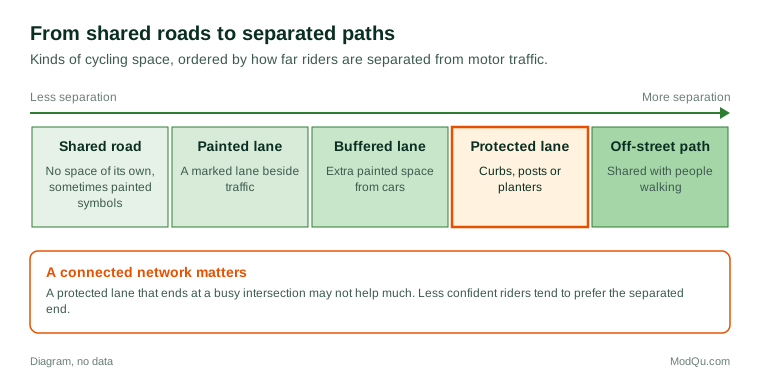
Planners often describe a range of cycling facilities:
- Shared roads with no special space, sometimes with painted symbols called sharrows;
- Painted bike lanes, marked on the road next to traffic;
- Buffered bike lanes, with extra painted space between bikes and cars;
- Protected bike lanes, also called cycle tracks, separated from traffic by curbs, posts or planters;
- Multi-use paths, shared with people walking, often in parks or along rivers;
- Traffic-calmed streets, where speed bumps and design keep car traffic slow and light.
Protected lanes and quiet streets are usually preferred by less confident riders. A connected network matters too: a protected lane that ends at a busy intersection may not help much.
Riders also mention other safety concerns: drivers opening car doors into their path, called dooring; right-turning vehicles; potholes; poor lighting; and conflicts with pedestrians on shared paths.
Example
A recreational rider would like to bike to the grocery store, 3 km away. The route has a protected lane for most of the way but then crosses a four-lane road with no signal for cyclists. They ride on weekends with their children on the park path, but they drive to the store.
Winter riding and theft
Riding in winter needs extra gear and attention: studded tires, lights for short days, fenders, warm layers, and care for the chain against salt. Whether a city clears its bike lanes of snow strongly affects how many people keep riding.
Theft is another common problem. Many cyclists have had a bike or parts stolen. Good locks, secure parking and registering the bike's serial number can help, and some police services and community groups run bike registries.
Trends and what people disagree about
Cycling grew in many places during the COVID-19 pandemic, and e-bike sales have grown since. Many Canadian cities have added protected lanes, and bike-share systems, including e-bike share, operate in larger cities.
Cycling is also the subject of strong debate. People disagree about how much road space should go to bike lanes rather than car lanes or parking, about the effect of bike lanes on local businesses, about whether helmets should be required for adults, and about where e-bikes and e-scooters should be allowed, especially on paths shared with people walking. Lithium battery fires from poorly made or damaged e-bike batteries have also led some cities and buildings to set storage and charging rules.
Key terms
- Pedal assistAn e-bike motor that helps only while the rider pedals.
- ThrottleA control that moves an e-bike without pedalling.
- Mid-drive motorAn e-bike motor placed at the cranks instead of in a wheel hub.
- Protected bike laneA bike lane separated from traffic by curbs, posts or planters.
- Multi-use pathA path shared by people cycling and walking.
- DooringA crash caused by someone opening a car door into a cyclist's path.
- Cargo bikeA bicycle built to carry children or goods.
- Bike shareA system of public bikes that people rent for short trips.
Full glossary: bicycle manufacturing terms on EditingTests.com.
Cycling and e-bikes vocabulary test
How well do you know the language of this topic? Try 8 quick questions. Your score is shown straight away and is not saved.
What the cycling and e-bikes survey asks
This survey is part of ModQu's Cars and Getting Around survey. The cycling and e-bikes part takes about five minutes and covers:
- How often you ride a bicycle, and for what kinds of trips.
- What kind of bike you ride, if any.
- Whether you own, have tried or would buy an e-bike.
- What stops you riding more.
- What would make cycling safer where you live.
- Your views on bike lanes and where e-bikes should be allowed.
After that you can choose to continue with other short parts of the Cars and Getting Around survey, such as buying a car or electric vehicles, or stop.
Ready to take part?
Your answers help show what people really think and do. Results are only ever reported as totals; no one can see your individual answers.
Start the surveyQuestions about this survey
Who can take part?
Adults.
Do I have to give my name?
No. You may be asked for your age group, region and similar details so results can be broken down, but not your name. ModQu never asks for passwords, card numbers or account numbers.
How are the results used?
Answers are combined into totals and percentages and published in ModQu reports. Individual answers are never shown.
Is the vocabulary test part of the survey?
No. It is optional and separate, and your score is not stored.
I do not ride a bike. Can I take part?
Yes. The survey asks non-riders what would encourage them, and their views on cycling in their area.