
Insights · Generating insight
Nudge Theory and Choice Architecture
What nudges and choice architecture are, the evidence on defaults, social norms and other interventions, why effects at scale are smaller than early studies suggested, and the ethical limits that separate a helpful nudge from manipulation.
Every choice is presented in some way. Options appear in an order, one of them may be pre-selected, some information is shown prominently and some is hidden. Thaler and Sunstein (2008) called the design of these features choice architecture, and argued that because there is no neutral way to present a choice, designers might as well present it in ways that help people make decisions they would endorse. They defined a nudge as any aspect of choice architecture that changes behaviour in a predictable way without forbidding options or significantly changing economic incentives.
For insight teams, nudge research is useful in two ways. It explains why small changes in how choices are presented can have large effects on customer behaviour, and it provides a method, the field experiment, for testing such changes.
Main tools of choice architecture
Defaults. The option that applies if a person does nothing is among the most powerful tools. Johnson and Goldstein (2003) compared European countries and found that those where citizens were presumed to consent to organ donation unless they opted out had far higher effective consent rates than those requiring people to opt in. Madrian and Shea (2001) studied a company that changed its retirement savings plan so that new employees were enrolled automatically unless they chose otherwise, and found that participation rose sharply and that many employees stayed with the default contribution rate and investment.
Social norms. Information about what others do can shift behaviour. Schultz et al. (2007) found that telling households how their energy use compared with their neighbours' reduced consumption among high users, but increased it among low users, an effect that was eliminated by adding a simple sign of approval for low use. Allcott (2011) analysed a large programme of home energy reports that compared each household with its neighbours and found that it reduced energy consumption by about 2% on average.
Simplification and timely reminders. Reducing the effort a choice requires, and prompting people at the right moment, can increase follow-through. Hallsworth et al. (2017) found in a large field experiment that adding social norm messages to tax reminder letters increased the share of people who paid on time.
Structure and description. Johnson et al. (2012) described a wider set of tools available to choice architects, including the number of options offered, how they are sorted and grouped, and how attributes are described, for example by translating fuel consumption into annual cost.
How large are nudge effects?
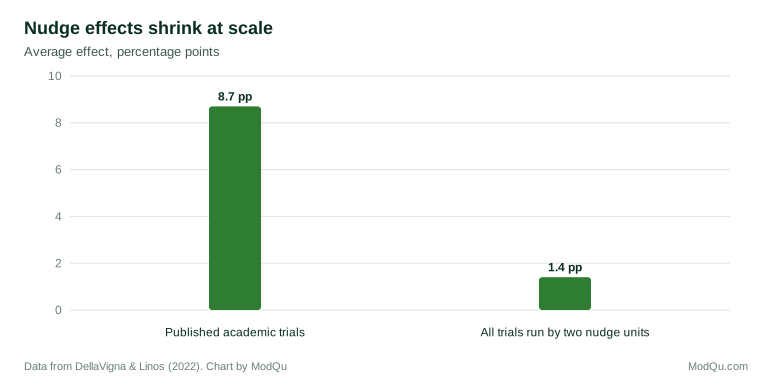
Early studies often reported large effects, but later evidence suggests that typical effects are much smaller. DellaVigna and Linos (2022) compared randomised trials published in academic journals with all the trials run by two large government nudge units. The average effect in the published academic trials was 8.7 percentage points; in the nudge units' trials it was 1.4 percentage points. Much of the difference was explained by selective publication: smaller and null results were less likely to appear in journals.
Meta-analyses reach similar conclusions. Mertens et al. (2022) pooled over 200 studies and found an overall effect of moderate size, largest for changes to decision structure such as defaults. Maier et al. (2022) re-analysed the same data and argued that, after adjusting for publication bias, the evidence for nudging as a general effect was weak, although some kinds of nudge, notably defaults, may still be effective. The practical conclusion is that nudges can work, that defaults are the most reliable, and that effects in a particular setting should be tested rather than assumed.
Ethics and dark patterns
Thaler and Sunstein (2008) described nudging as "libertarian paternalism": steering people towards choices that make them better off by their own judgement, while preserving their freedom to choose otherwise. Sunstein (2015) argued that nudges should be transparent and should serve people's own interests, and that many objections to nudging apply with greater force to choice architecture designed to serve the designer at the user's expense.
That second kind of design is common in commerce. Mathur et al. (2019) examined around 11,000 shopping websites and found dark patterns, interface designs that push users towards choices they might not otherwise make, on more than one in ten of them, including false urgency messages, hidden costs and obstacles to cancellation. Such designs use the same psychological mechanisms as nudges but against the customer's interest, and they increasingly attract regulatory attention.
A simple test separates the two. A nudge is acceptable if the organisation would be comfortable explaining it openly to customers, if it leads customers towards outcomes they would choose on reflection, and if opting out is easy.
Using choice architecture in insight work
Insight teams can use choice architecture in several ways. They can examine the existing customer journey for unintended nudges, such as defaults or orderings that work against customers or the business. They can use behavioural findings to generate hypotheses about how changes in presentation might affect choices. And because effects vary widely, they can test changes through randomised experiments before rolling them out, measuring both the intended effect and any side effects on satisfaction and trust.
For example, an insurer might find that many customers do not review their cover at renewal and stay on policies that no longer suit them. Behavioural research suggests several possible changes: a renewal letter that compares the customer's cover with what similar customers choose, a simplified one-page summary of options, or a reminder timed a few weeks before renewal. Rather than adopting all three on the strength of published studies, the insight team can test each against the current letter with randomly assigned groups of customers, measuring not only how many review their cover but also complaints, satisfaction and later cancellations. The result shows which change actually helps customers in this setting, and by how much.
Key takeaways
Choice architecture is unavoidable, and nudges, such as defaults, social norms and simplification, can change behaviour without restricting choice. Defaults are the most reliably effective. Effects at scale are much smaller than early published studies suggested, so nudges should be tested in context. Ethical use requires transparency, alignment with customers' own interests and easy opt-out; designs that exploit the same mechanisms against customers are dark patterns.
References
Allcott, H. (2011). Social norms and energy conservation. Journal of Public Economics, 95(9–10), 1082–1095. https://doi.org/10.1016/j.jpubeco.2011.03.003
DellaVigna, S., & Linos, E. (2022). RCTs to scale: Comprehensive evidence from two nudge units. Econometrica, 90(1), 81–116. https://doi.org/10.3982/ECTA18709
Hallsworth, M., List, J. A., Metcalfe, R. D., & Vlaev, I. (2017). The behavioralist as tax collector: Using natural field experiments to enhance tax compliance. Journal of Public Economics, 148, 14–31. https://doi.org/10.1016/j.jpubeco.2017.02.003
Johnson, E. J., & Goldstein, D. (2003). Do defaults save lives? Science, 302(5649), 1338–1339. https://doi.org/10.1126/science.1091721
Johnson, E. J., Shu, S. B., Dellaert, B. G. C., Fox, C., Goldstein, D. G., Häubl, G., Larrick, R. P., Payne, J. W., Peters, E., Schkade, D., Wansink, B., & Weber, E. U. (2012). Beyond nudges: Tools of a choice architecture. Marketing Letters, 23(2), 487–504. https://doi.org/10.1007/s11002-012-9186-1
Madrian, B. C., & Shea, D. F. (2001). The power of suggestion: Inertia in 401(k) participation and savings behavior. The Quarterly Journal of Economics, 116(4), 1149–1187. https://doi.org/10.1162/003355301753265543
Maier, M., Bartoš, F., Stanley, T. D., Shanks, D. R., Harris, A. J. L., & Wagenmakers, E.-J. (2022). No evidence for nudging after adjusting for publication bias. Proceedings of the National Academy of Sciences, 119(31), Article e2200300119. https://doi.org/10.1073/pnas.2200300119
Mathur, A., Acar, G., Friedman, M. J., Lucherini, E., Mayer, J., Chetty, M., & Narayanan, A. (2019). Dark patterns at scale: Findings from a crawl of 11K shopping websites. Proceedings of the ACM on Human-Computer Interaction, 3(CSCW), Article 81. https://doi.org/10.1145/3359183
Mertens, S., Herberz, M., Hahnel, U. J. J., & Brosch, T. (2022). The effectiveness of nudging: A meta-analysis of choice architecture interventions across behavioral domains. Proceedings of the National Academy of Sciences, 119(1), Article e2107346118. https://doi.org/10.1073/pnas.2107346118
Schultz, P. W., Nolan, J. M., Cialdini, R. B., Goldstein, N. J., & Griskevicius, V. (2007). The constructive, destructive, and reconstructive power of social norms. Psychological Science, 18(5), 429–434. https://doi.org/10.1111/j.1467-9280.2007.01917.x
Sunstein, C. R. (2015). The ethics of nudging. Yale Journal on Regulation, 32(2), 413–450.
Thaler, R. H., & Sunstein, C. R. (2008). Nudge: Improving decisions about health, wealth, and happiness. Yale University Press.