
Share your experience of ride-hailing and delivery apps
Tell us which apps you use, how often, how you compare prices and how safe you feel. Your answers are combined with other people's and reported only as totals.
Start the ride-hailing and delivery apps surveyAbout 5 minutes. No account needed. You can stop at any time.
What these apps do
Ride-hailing and delivery apps are platforms that connect customers with independent drivers or couriers through a smartphone app. The app takes the request, finds a nearby driver, sets the price, handles payment and collects ratings. The platform company usually does not own the vehicles; drivers and couriers use their own cars, bikes or scooters.
The main services are:
- Ride-hailing: booking a car and driver for a trip, much like a taxi but arranged through an app. Options often include a standard car, a larger vehicle, a premium car and a shared ride with other passengers going the same way.
- Restaurant delivery: ordering a meal from a restaurant and having a courier bring it.
- Grocery and convenience delivery: ordering groceries, household items, alcohol where allowed, or pharmacy items for delivery, sometimes within an hour.
- Parcel and courier tasks: sending a package across town.
Many people use the same app for several of these services, and companies offer memberships that bundle reduced delivery fees and ride discounts.
In Canada, ride-hailing is regulated by provinces and municipalities. Rules on driver licensing, background checks, vehicle inspections and insurance differ from place to place, and some smaller communities have no ride-hailing service at all.
Why people use them
The reasons people give tend to centre on convenience and time.
- No parking or driving: useful for nights out, airport trips and busy downtown areas.
- Getting home safely: many people use ride-hailing after drinking instead of driving.
- Filling gaps in transit: late at night, in areas with poor service, or for the last part of a trip.
- Saving time: delivery saves a trip to the shop or restaurant.
- Mobility needs: people who cannot drive, or have temporary injuries, use rides for errands and appointments.
- Price and payment: the price is shown before booking, and payment happens in the app.
Example
A household with two working parents orders groceries for delivery most weeks and picks up the rest on weekends. On busy weeknights they also order dinner through an app about once a week. When they add up a month of delivery and service fees, tips and menu mark-ups, they decide to keep grocery delivery but cut restaurant delivery to twice a month.
How prices, fees and tips add up
App prices are made up of several parts, and many customers are not sure how they fit together.
For a ride, the price usually depends on:
- a base fare plus charges for distance and time;
- dynamic pricing, often called surge pricing, which raises prices when demand is high or few drivers are available, for example during storms, rush hour or after a concert;
- booking and airport fees;
- a tip, which is optional and added in the app.
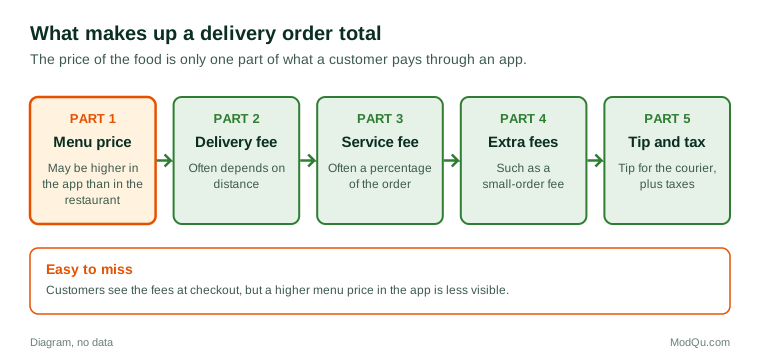
For a delivery order, the total can include:
- menu prices, which may be higher in the app than in the restaurant;
- a delivery fee, which may depend on distance;
- a service fee, often a percentage of the order;
- a small-order fee for orders under a set amount;
- the tip for the courier;
- taxes.
Example (hypothetical figures)
A meal costs $30.00 at the restaurant counter. In the app the same items are priced at $34.50, a 15% mark-up. The customer pays a $3.99 delivery fee, a service fee of 10% of the menu total ($3.45) and a $5.00 tip. Before tax, the total is $46.94, which is $16.94 more than picking the meal up in person.
Questions that businesses want answered here include how much customers think a typical order costs compared with what they pay, how they react to surge pricing, and how many compare prices across apps before booking.
Choosing between apps
In most Canadian cities there are a few competing ride-hailing apps, several delivery apps, and taxi companies with their own booking apps. People choose between them based on price, waiting time, which restaurants or shops are available, membership deals, and past experience.
Some people stick with one app out of habit or because they pay for a membership. Others keep several apps on their phone and check the price on each before booking, a practice sometimes called multi-homing. Drivers and couriers often do the same, working for more than one platform at once.
Safety
Safety is a major concern for riders, drivers and couriers. Apps have added a range of safety features over time:
- the driver's name, photo, vehicle and licence plate are shown before the ride;
- trips are tracked by GPS, and riders can share their route with a friend;
- an emergency button in the app;
- ratings in both directions;
- PIN codes to confirm the right rider and car.
Even so, people's sense of safety varies. Some feel safer in an app-booked car than in a taxi hailed on the street, because the trip is recorded. Others worry about getting into a stranger's car, especially late at night and when travelling alone. Drivers and couriers face their own risks, including road collisions, assaults and theft.
Example
A student taking a ride home after a late shift always checks that the plate matches the app, sits in the back seat and shares the trip with a roommate. When a driver once arrived in a different car from the one shown, they cancelled and reported it in the app, then booked another ride.
Drivers, couriers and how the work is organized
Most drivers and couriers on these platforms are treated as independent contractors rather than employees. They choose when to log in, and they are paid per trip or per delivery, plus tips and bonuses. They pay their own vehicle, fuel, insurance and phone costs.
Supporters say this gives workers flexibility and a way to earn extra income. Critics say pay after expenses can be low, that workers lack benefits such as paid sick leave and employment insurance, and that the apps control too much of how the work is done for it to count as independent. In Canada, several provinces have introduced or debated rules that set minimum pay for engaged time and other protections for app-based workers, and the question of employment status has been tested in courts and labour boards.
Effects on cities and other businesses
Ride-hailing and delivery apps have changed other businesses and city life:
- taxi companies have faced new competition and in many places have adopted apps of their own;
- restaurants gain customers through apps but pay commissions on each order, and some have opened delivery-only kitchens, often called ghost kitchens;
- cities have seen more cars circling and stopping at curbs, and more pressure on loading zones;
- transit agencies have partnered with apps in some areas to provide rides where buses are infrequent.
People disagree about whether these services ease or worsen traffic, whether they compete with or support public transit, and whether the convenience is worth the extra cost and the effect on workers and restaurants.
Key terms
- Ride-hailingBooking a car and driver for a trip through an app.
- Surge pricingHigher prices when demand is high or few drivers are available.
- Service feeA charge the platform adds to an order, often a percentage of the total.
- Small-order feeAn extra charge on delivery orders below a set amount.
- Independent contractorA worker who is self-employed rather than an employee.
- Multi-homingUsing more than one competing platform, as a customer or a worker.
- Ghost kitchenA kitchen that prepares food only for delivery, with no dining room.
- CommissionThe share of each order that a platform keeps from the restaurant or seller.
Full glossary: ride sharing platforms terms on EditingTests.com.
Ride-hailing and delivery apps vocabulary test
How well do you know the language of this topic? Try 8 quick questions. Your score is shown straight away and is not saved.
What the ride-hailing and delivery apps survey asks
This survey is part of ModQu's Cars and Getting Around survey. The ride-hailing and delivery apps part takes about five minutes and covers:
- Which ride-hailing and delivery apps you have used in the past year.
- How often you use them, and for what kinds of trips or orders.
- Whether you compare prices between apps before booking.
- How you feel about surge pricing, fees and tipping.
- How safe you feel using ride-hailing, and why.
- What would make you use these apps more or less.
After that you can choose to continue with other short parts of the Cars and Getting Around survey, such as buying a car or electric vehicles, or stop.
Ready to take part?
Your answers help show what people really think and do. Results are only ever reported as totals; no one can see your individual answers.
Start the surveyQuestions about this survey
Who can take part?
Adults who use ride-hail or delivery services.
Do I have to give my name?
No. You may be asked for your age group, region and similar details so results can be broken down, but not your name. ModQu never asks for passwords, card numbers or account numbers.
How are the results used?
Answers are combined into totals and percentages and published in ModQu reports. Individual answers are never shown.
Is the vocabulary test part of the survey?
No. It is optional and separate, and your score is not stored.
I only use delivery apps, not ride-hailing. Can I take part?
Yes. The survey asks about both, and you can skip the parts that do not apply to you.