
Share your experience of commuting
Tell us how you get to work, how long it takes and what would improve your commute. Your answers are combined with other people's and reported only as totals.
Start the commuting surveyAbout 5 minutes. No account needed. You can stop at any time.
What commuting means
A commute is the regular trip between home and a place of work or study. Most discussions focus on the trip to work, but students and people who travel between several work sites also commute.
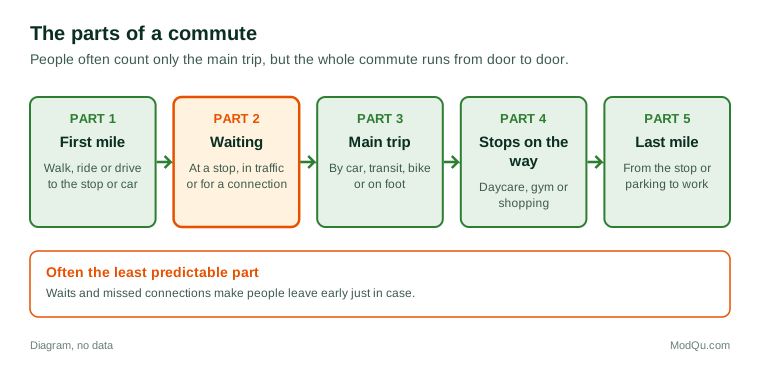
The commute has several parts that people often count differently:
- the main mode, such as driving, transit, cycling or walking;
- the first and last mile, the walk, ride or drive to and from a station or parking spot;
- waiting time, at stops, in traffic or for a connection;
- trip chaining, when people combine the commute with other stops, such as daycare drop-off, a gym or groceries.
In Canada, the census asks workers how they usually get to work and how long it takes, which gives a national picture every five years. Other surveys ask about the same questions in more detail and more often.
How people get to work
The main ways people commute are:
- Driving alone, the most common mode in most of Canada and the United States, especially outside the largest city centres.
- Carpooling, sharing a ride with co-workers, family members or neighbours.
- Public transit, including buses, subways, light rail and commuter trains. Transit shares are highest in large cities with frequent service.
- Walking, mostly for short commutes in dense neighbourhoods.
- Cycling and e-bikes, which have grown in some cities, though they vary a lot by season.
- Mixed modes, such as driving to a park-and-ride lot and taking a train, or cycling to a station.
- Working from home, which is not a commute at all, but which many people now do on some days.
The choice depends on what is available and practical. Distance, the cost and ease of parking at work, how frequent and direct transit is, the weather, family duties, and whether a person needs a vehicle during the workday all play a part.
Example
A warehouse worker on an early shift starts at 5:30 a.m., before the first bus of the day reaches the industrial park. They share a ride with two co-workers who live nearby, taking turns driving each week. When one of them changes shifts, the carpool breaks up and the worker has to drive alone, which adds fuel and parking costs.
Commute time
Commute time is one of the most widely measured parts of commuting, partly because it is easy to report and partly because it matters to people's lives. A short commute leaves more time for family, rest and other activities. A long one can take hours out of each week.
Commute time depends on:
- distance, which depends on where people live relative to where they work;
- congestion, especially at peak hours;
- mode, since transit trips with transfers often take longer than driving the same distance, while trains on their own tracks can be faster at rush hour;
- reliability, since an unpredictable commute forces people to leave early "just in case".
Researchers often point to a trade-off in where people live. Housing is often cheaper farther from job centres, so households may accept a longer commute in exchange for a larger or less expensive home.
Example (hypothetical figures)
A worker has a 50-minute commute each way, five days a week. Over 46 working weeks a year, that is 50 × 2 × 5 × 46 = 23,000 minutes, or about 383 hours, roughly the same as ten 38-hour work weeks. After moving to a hybrid schedule with three office days a week, the same commute adds up to about 230 hours a year.
Commuting costs
The cost of commuting is often underestimated, particularly by drivers, because many costs are spread out or paid in advance.
- Driving: fuel or electricity, parking, tolls, wear and maintenance, insurance, and part of the vehicle's depreciation.
- Transit: fares or passes, which may be partly paid by some employers.
- Cycling and walking: equipment, clothing and maintenance, usually much lower.
- Time: many people count time spent commuting as a cost, especially when it is unpaid and stressful.
Some employers offer help with commuting costs, such as subsidized transit passes, free or paid parking, secure bike parking, showers and carpool matching. In Canada, the tax treatment of employer-paid transit and parking has its own rules, which employers handle.
Hybrid work and the changing commute
The spread of remote and hybrid work since the COVID-19 pandemic has changed commuting for many office workers. Instead of five commutes a week, many now make two, three or four. Some have moved farther from work, accepting a longer trip on fewer days.
This has knock-on effects:
- rush hours on transit and roads have shifted, with Tuesdays to Thursdays often busier than Mondays and Fridays;
- monthly passes are worth less to part-week commuters, so some agencies have introduced fare capping and flexible passes;
- some people value their commute more as a break between home and work, while others resent it more now that they know life without it.
Many workers, including those in health care, retail, manufacturing, construction and transportation, cannot work from home, so their commutes are largely unchanged.
Stress, health and wellbeing
People's feelings about their commute vary widely. Some enjoy it, using the time to listen to audio, read on the train, or exercise by cycling or walking. Others find it the most stressful part of the day.
Common sources of commuting stress include traffic jams and unreliable service, crowded vehicles, missed connections, worries about being late, bad weather and safety concerns. Long commutes leave less time for sleep, exercise and family, and active commutes such as walking and cycling can add physical activity to the day.
Example
A teacher drives 35 minutes on a highway that often backs up. On bad days the trip takes over an hour and they arrive tense. They try leaving 20 minutes earlier and find the trip is shorter and more predictable, so they now use the extra time at school to prepare lessons before classes start.
What would improve commutes
When people are asked what would improve their commute, answers tend to fall into a few groups:
- more frequent and reliable transit, with fewer transfers;
- less traffic, or more predictable travel times;
- cheaper or more available parking, or cheaper fares;
- safe bike routes and secure bike parking;
- the option to work from home some days;
- flexible start and finish times, so people can travel outside the peak;
- living closer to work, which depends on housing costs.
People disagree about how cities should respond. Some want more road capacity, others more transit and bike lanes, others congestion pricing or tolls that charge drivers for using busy roads at peak times. There is also debate about whether employers should be able to require office attendance, given its effect on commuting time and costs.
Key terms
- CommuteThe regular trip between home and a place of work or study.
- Mode shareThe proportion of trips made by each way of travelling.
- Trip chainingCombining a commute with other stops, such as daycare or shopping.
- Park-and-rideA parking lot where commuters leave their car and take transit.
- CongestionTraffic slowed by more vehicles than a road can carry smoothly.
- First and last mileThe part of a trip between home or work and a transit stop.
- Congestion pricingCharging drivers to use busy roads or areas at peak times.
- Peak periodThe busiest times of day for travel, usually morning and late afternoon.
Full glossary: public transit fare systems terms on EditingTests.com.
Commuting vocabulary test
How well do you know the language of this topic? Try 8 quick questions. Your score is shown straight away and is not saved.
What the commuting survey asks
This survey is part of ModQu's Cars and Getting Around survey. The commuting part takes about five minutes and covers:
- How you usually get to work or study, and whether you use more than one mode.
- How long your commute takes each way, and how predictable it is.
- How many days a week you commute, and whether that has changed.
- What your commute costs, including parking, fares and fuel.
- How you feel about your commute, and how it affects your day.
- What would improve it.
After that you can choose to continue with other short parts of the Cars and Getting Around survey, such as buying a car or electric vehicles, or stop.
Ready to take part?
Your answers help show what people really think and do. Results are only ever reported as totals; no one can see your individual answers.
Start the surveyQuestions about this survey
Who can take part?
Workers.
Do I have to give my name?
No. You may be asked for your age group, region and similar details so results can be broken down, but not your name. ModQu never asks for passwords, card numbers or account numbers.
How are the results used?
Answers are combined into totals and percentages and published in ModQu reports. Individual answers are never shown.
Is the vocabulary test part of the survey?
No. It is optional and separate, and your score is not stored.
I work from home every day. Can I take part?
Yes. The survey asks how and why you work from home and what would bring you back to commuting, if anything.