
Share your experience of motorcycles and scooters
Tell us whether you own a motorcycle or scooter, what you mainly use it for and whether you would buy an electric one. Your answers are combined with other people's and reported only as totals.
Start the motorcycles and scooters surveyAbout 5 minutes. No account needed. You can stop at any time.
What this topic covers
This topic covers powered two-wheelers and similar vehicles:
- Motorcycles of all sizes, from small commuter bikes to large touring and sports bikes;
- Scooters with a step-through frame and usually automatic transmission;
- Mopeds, small low-powered scooters or motorcycles with lower speed limits;
- Electric motorcycles and scooters;
- Three-wheelers used as personal vehicles in some countries.
It does not mainly cover electric kick scooters and e-bikes, though many people compare them with small scooters.
The topic looks at ownership, uses, costs, safety, licensing and interest in electric models.
Two-wheelers around the world
The role of motorcycles and scooters differs greatly between regions:
- In much of South and Southeast Asia, two-wheelers are the most common family vehicle, used for commuting, school runs, shopping and carrying goods.
- In many African and Latin American cities, motorcycle taxis are a major form of public transport, and motorcycles are used for deliveries and small businesses.
- In southern Europe, scooters are common for city commuting because they are easy to park and move through traffic.
- In North America, northern Europe and Australia, motorcycles are more often used for leisure, touring and as a hobby, though commuting is growing in some cities.
These differences shape what people buy, how they ride and what matters to them.
Who rides and why
People give many reasons for riding:
- Cost: two-wheelers are usually cheaper to buy, fuel, insure and park than cars.
- Traffic: they can be faster in congested cities, where rules allow filtering between lanes.
- Parking: they need little space.
- Work: deliveries, motorcycle taxis and trades.
- Enjoyment: the feeling of riding, touring and the social side of riding clubs.
- Necessity: in rural areas with poor public transport, a motorcycle may be the only practical vehicle.
Example
A nurse in a large city commutes 15 kilometres to a hospital. By bus the journey takes over an hour; by scooter it takes 30 minutes, and parking at the hospital is free for two-wheelers. They ride every day except in heavy rain, when they take the bus.
Main kinds and how people choose
Buyers choose among:
- Commuter motorcycles and small scooters, usually 50 to 150 cc, focused on low running costs;
- Maxi-scooters, larger scooters with more storage and comfort;
- Standard and naked bikes, all-round motorcycles;
- Sports bikes for speed;
- Touring and adventure bikes for long trips and rough roads;
- Cruisers, with a relaxed riding position;
- Off-road and dual-sport bikes.
Factors in the choice include price, fuel economy, licence category, seat height and weight, comfort for a passenger, storage, reliability, availability of parts and servicing, and resale value.
What owning one costs
Running costs include fuel or charging, insurance, servicing, tyres, chains or belts, parking, road tax or registration, and riding gear. Riding gear such as a helmet, jacket, gloves and boots is a real cost that new riders sometimes forget.
Example (hypothetical figures)
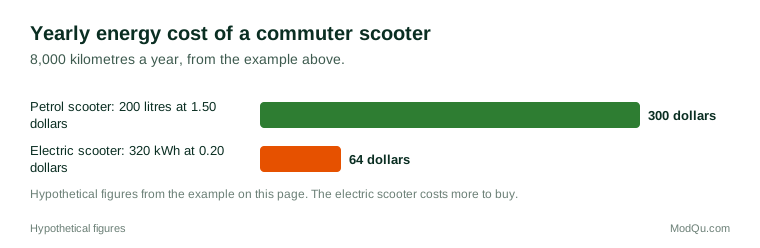
A commuter rides 8,000 kilometres a year. A petrol scooter uses 2.5 litres per 100 kilometres, so 200 litres a year; at 1.50 dollars a litre, fuel costs 300 dollars. An electric scooter uses 4 kWh per 100 kilometres, so 320 kWh; at 0.20 dollars per kWh, charging costs 64 dollars. The electric scooter saves 236 dollars a year on energy, though it costs more to buy.
Figure 1 compares the yearly energy costs in that example.
Safety
Riders are more exposed than car occupants, and motorcycle crashes are much more likely to cause serious injury or death per kilometre travelled. The World Health Organization notes that riders of motorized two- and three-wheelers make up a large share of road deaths worldwide, especially in low- and middle-income countries.
Measures that riders and road safety bodies focus on include:
- wearing a certified helmet, which is required by law in most countries;
- protective clothing;
- rider training and graduated licences;
- anti-lock brakes, now required on new motorcycles above certain sizes in several regions;
- being visible to other road users;
- road design that considers riders.
Example
A new rider passes a basic licence test but feels unsure in heavy traffic. They take an extra advanced training course run by a road safety organization, learning how to position themselves in the lane and brake in an emergency. Their insurer offers a small discount for completing the course.
Licences and rules
Licence rules vary by country. Many use categories based on engine size or power, with younger and newer riders limited to smaller bikes. Some allow car drivers to ride small scooters with little or no extra training; others require separate tests. Rules on helmets, carrying passengers, lane filtering and riding on motorways also differ.
Electric motorcycles and scooters
Electric two-wheelers are growing quickly, especially small scooters in Asian cities. Their attractions include low running costs, quiet operation, no exhaust fumes and simple maintenance. Concerns include:
- higher purchase prices for larger models;
- range, especially for longer commutes;
- charging at home for people in apartments;
- battery life and replacement cost;
- fire risk from poor-quality batteries and chargers.
Battery-swapping networks, where riders exchange a flat battery for a charged one at a station in minutes, are used in some cities and reduce charging concerns. Some governments offer subsidies or plan to restrict new petrol two-wheelers in cities.
Trends and debates
Trends include delivery work driving demand for two-wheelers, electric models and battery swapping, and more motorcycle taxis booked through apps. Debates include rider safety and road design, noise from loud exhausts, whether two-wheelers should be allowed in bus lanes or to filter through traffic, and whether to ban petrol scooters in city centres.
Questions that businesses want answered here include who owns a motorcycle or scooter, what they use it for, how much they spend and whether they would switch to electric.
Key terms
- MopedA small, low-powered scooter or motorcycle with a low maximum speed.
- ScooterA two-wheeler with a step-through frame, usually with automatic transmission.
- ccCubic centimetres, a measure of engine size.
- Lane filteringRiding between lanes of slow or stopped traffic, allowed in some places.
- Anti-lock brakesA system that stops wheels locking under hard braking.
- Graduated licenceA licence system where new riders start with restrictions that are lifted later.
- Battery swappingExchanging a flat battery for a charged one at a station.
- Riding gearProtective clothing such as a helmet, jacket, gloves and boots.
Full glossary: motorcycle manufacturing terms on EditingTests.com.
Motorcycles and scooters vocabulary test
How well do you know the language of this topic? Try 8 quick questions. Your score is shown straight away and is not saved.
What the motorcycles and scooters survey asks
This survey is part of ModQu's Cars and Getting Around survey. The motorcycles and scooters part takes about five minutes and covers:
- Whether you own a motorcycle, scooter or moped, and what kind.
- What you mainly use it for: commuting, work, errands or leisure.
- How much you spend on fuel, insurance, servicing and gear.
- What safety gear you wear and whether you have taken extra training.
- Whether you would buy an electric motorcycle or scooter, and what would stop you.
- Whether you use motorcycle taxis or delivery services that use two-wheelers.
After that you can choose to continue with other short parts of the Cars and Getting Around survey, such as buying a car or electric vehicles, or stop.
Ready to take part?
Your answers help show what people really think and do. Results are only ever reported as totals; no one can see your individual answers.
Start the surveyQuestions about this survey
Who can take part?
Adults who ride or plan to ride.
Do I have to give my name?
No. You may be asked for your age group, region and similar details so results can be broken down, but not your name. ModQu never asks for passwords, card numbers or account numbers.
How are the results used?
Answers are combined into totals and percentages and published in ModQu reports. Individual answers are never shown.
Is the vocabulary test part of the survey?
No. It is optional and separate, and your score is not stored.
Can I ride a scooter on a car licence?
In some countries, car licence holders can ride small scooters or mopeds with little or no extra training; in others a separate test is required. Rules depend on engine size and where you live.
Are electric scooters cheaper to run?
Usually, because electricity per kilometre tends to cost less than petrol and there is less maintenance. The purchase price and eventual battery replacement can offset part of the saving.