
Share your experience of driving
Tell us about your driving habits, what you think of speed limits and whether you have had a collision. Your answers are combined with other people's and reported only as totals.
Start the road safety and driving habits surveyAbout 5 minutes. No account needed. You can stop at any time.
What this topic covers
This topic looks at driving behaviour and attitudes, as described by drivers themselves. It covers:
- habits such as speeding, phone use, seat belt use, drink and drug driving and tiredness;
- how drivers judge their own skill and risk;
- attitudes to road rules, speed limits and enforcement;
- experience of collisions and near misses;
- use of driver assistance technology;
- views on road safety policies.
This page describes common patterns and debates. It does not give legal advice; road rules differ by country.
The scale of the problem
The World Health Organization estimates that around 1.2 million people die in road crashes each year, and many more are seriously injured. Road injuries are a leading cause of death for children and young adults. Most road deaths occur in low- and middle-income countries, and pedestrians, cyclists and motorcyclists make up a large share of them.
Many countries follow a "Safe System" approach, which accepts that people make mistakes and aims to design roads, vehicles, speeds and rules so that mistakes do not lead to death or serious injury.
Habits linked to risk
Road safety research highlights a number of key behaviours:
- Speeding: driving above the limit or too fast for conditions. Higher speeds increase both the chance of a crash and the severity of injuries.
- Distraction: using a phone to call, text, check maps or social media, as well as eating, adjusting controls and attending to passengers.
- Drink and drug driving: alcohol and many drugs, including some prescription medicines, impair driving.
- Not wearing seat belts or not using child restraints correctly.
- Fatigue: driving while tired, especially at night and on long journeys.
- Aggressive driving: tailgating, unsafe overtaking and road rage.
- Running red lights and not giving way to pedestrians.
Example
A sales worker drives long distances for work and often reads and answers messages at traffic lights. After a near miss with a cyclist while glancing at a map, they set their phone to driving mode, which silences messages while the car is moving, and plan routes before setting off.
How drivers see themselves
Most drivers rate their own driving as better than average, which cannot be true for everyone. This is a well-known finding in driving research. Drivers also tend to see other people's behaviour, such as phone use, as more dangerous than their own.
This matters for surveys. When asked about their own habits, people may under-report behaviour that is illegal or disapproved of, such as phone use or drink driving, a problem known as social desirability bias. Survey designers reduce it by:
- assuring respondents that answers are anonymous;
- asking about specific recent situations rather than general habits;
- using neutral wording that does not suggest a right answer;
- comparing results with other sources such as roadside observation.
Attitudes to speed limits and enforcement
Drivers' views on speed limits vary. Some think certain limits are too low, especially on motorways or open roads; others want lower limits in towns, near schools and on residential streets. In many cities, 30 km/h (or 20 mph) limits in residential areas have been introduced or debated.
Common enforcement methods include:
- police patrols;
- fixed and mobile speed cameras;
- average speed cameras that measure speed over a distance;
- red-light cameras;
- random breath testing;
- penalty points or demerit points on licences.
Example (hypothetical figures)
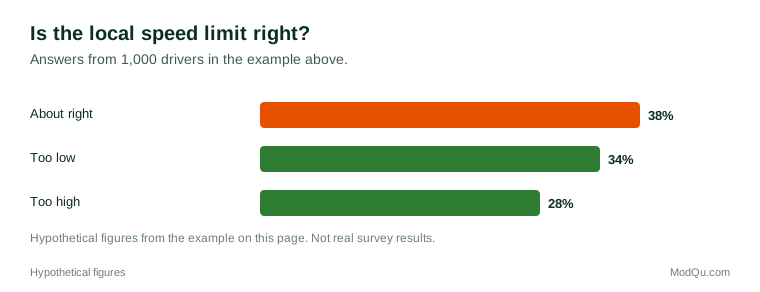
In a survey of 1,000 drivers, 380 say the local speed limit is about right, 340 say it is too low and 280 say it is too high. So 38% think it is about right, 34% too low and 28% too high. When asked whether they had driven above the limit in the past week, 610 (61%) said yes, including many who said the limit was about right.
Figure 1 shows the answers to the first question in that example. Hypothetical results like these show why surveys often compare attitudes with reported behaviour.
Collisions and near misses
Surveys often ask whether drivers have been involved in a collision in recent years, how serious it was and what caused it. Minor collisions, such as low-speed bumps in car parks, are much more common than serious crashes. Near misses are more common still and can change behaviour, although people often forget them quickly.
Example
A driver is rear-ended at a junction by someone looking at a phone. No one is hurt, but the repair and insurance process takes weeks. Afterwards, the driver leaves more space in front, checks the mirror more often when stopping and says they now notice how many drivers around them are using phones.
Vehicle technology
Modern vehicles include many driver assistance systems:
- automatic emergency braking;
- lane-keeping assistance;
- blind-spot warning;
- adaptive cruise control;
- driver fatigue and attention alerts;
- intelligent speed assistance, which warns drivers or limits speed to the posted limit, now required on new cars in the European Union.
Drivers have mixed views. Many value warnings and emergency braking; some find alerts annoying and switch them off. Researchers also study whether drivers rely on assistance too much and pay less attention.
Trends and debates
Trends include lower urban speed limits, more automated enforcement, telematics insurance that tracks driving behaviour, and growing numbers of vehicles with advanced driver assistance. Debates include whether speed cameras are about safety or revenue, how strictly phone use should be punished, whether older drivers should face more checks, how to protect pedestrians and cyclists, and how self-driving technology should be tested and regulated.
Questions that businesses want answered here include how drivers describe their habits, how they view road rules and enforcement, how they use vehicle safety features and what has changed their behaviour.
Key terms
- Safe SystemA road safety approach that designs roads, vehicles and speeds so that human mistakes do not cause death or serious injury.
- Distracted drivingDriving while attention is taken by phones, passengers, food or other tasks.
- Speed cameraA camera that records vehicles driving over the limit.
- Average speed cameraA system that measures a vehicle's average speed between two points.
- Penalty pointsPoints added to a licence for offences, which can lead to a ban.
- Random breath testingPolice stopping drivers at random to test for alcohol.
- Intelligent speed assistanceA system that warns or limits a car's speed to the posted limit.
- Social desirability biasThe tendency to give answers that seem acceptable rather than true.
Full glossary: traffic safety terms on EditingTests.com.
Road safety and driving habits vocabulary test
How well do you know the language of this topic? Try 8 quick questions. Your score is shown straight away and is not saved.
What the road safety and driving habits survey asks
This survey is part of ModQu's Cars and Getting Around survey. The road safety and driving habits part takes about five minutes and covers:
- How often you use your phone while driving, and for what.
- How often you drive above the speed limit, and in what situations.
- Whether you think local speed limits are too low, about right or too high.
- What you think of speed cameras, breath testing and other enforcement.
- Whether you have had a collision or near miss in the last five years.
- Which driver assistance features your vehicle has, and whether you use them.
After that you can choose to continue with other short parts of the Cars and Getting Around survey, such as buying a car or electric vehicles, or stop.
Ready to take part?
Your answers help show what people really think and do. Results are only ever reported as totals; no one can see your individual answers.
Start the surveyQuestions about this survey
Who can take part?
Drivers.
Do I have to give my name?
No. You may be asked for your age group, region and similar details so results can be broken down, but not your name. ModQu never asks for passwords, card numbers or account numbers.
How are the results used?
Answers are combined into totals and percentages and published in ModQu reports. Individual answers are never shown.
Is the vocabulary test part of the survey?
No. It is optional and separate, and your score is not stored.
Are hands-free phone calls safe while driving?
Hands-free calls are legal in many places, but research suggests that conversations can still distract drivers. Rules differ by country, and some limit hands-free use for new drivers.
Why do some cities lower speed limits to 30 km/h?
Lower speeds reduce the chance of a crash and the severity of injuries, especially for pedestrians and cyclists. Supporters point to safety; critics raise journey times and enforcement.