
Share your experience of buying tyres and accessories
Tell us when you last bought tyres, where you bought them and which car accessories you have bought. Your answers are combined with other people's and reported only as totals.
Start the car accessories and tyres surveyAbout 5 minutes. No account needed. You can stop at any time.
What this topic covers
This topic covers two related areas of car spending:
- Tyres: when drivers replace them, how they choose, what they pay, and where they buy and have them fitted.
- Accessories: products added to a car for safety, comfort, convenience, protection or appearance, from phone mounts and dash cameras to roof boxes and seat covers.
Together these are part of what is called the automotive aftermarket: parts, accessories and services bought after the car itself.
When drivers replace tyres
Tyres are replaced when:
- the tread wears down to the legal minimum or a safer level. Many countries set a legal minimum tread depth, such as 1.6 mm in the European Union, the United Kingdom and Australia;
- they are damaged by punctures, cuts, bulges or hitting kerbs and potholes;
- they become old, as rubber hardens and cracks over time even when tread remains;
- the season changes, for drivers who use winter tyres;
- the car fails an inspection.
Many drivers do not check their tyres regularly and only replace them when a mechanic or inspection tells them to.
Example
A driver takes their car for its yearly service. The mechanic shows them that the two front tyres are close to the legal limit and one has a small bulge from a pothole. They replace the front pair that day, choosing a mid-priced brand the garage recommends, and decide to check tyre pressure monthly from now on.
Kinds of tyre
The main kinds include:
- Summer tyres, designed for warm conditions;
- Winter tyres, with softer rubber and deeper tread for snow, ice and cold. Some countries and regions require them in winter months, such as parts of Canada and several European countries;
- All-season tyres, a compromise for moderate climates;
- Performance tyres for grip at higher speeds;
- All-terrain and off-road tyres for rough roads;
- Run-flat tyres that can be driven a limited distance after a puncture;
- Tyres for electric vehicles, designed for extra weight, torque and low noise.
How drivers choose tyres
Drivers weigh:
- Price, often the main factor;
- Brand: premium, mid-range or budget;
- Safety: grip in wet conditions and braking distance;
- Tyre labels and ratings, such as the EU tyre label, which grades fuel efficiency, wet grip and external noise;
- Reviews and test results from motoring organizations and consumer groups;
- Recommendations from mechanics and fitters;
- Long life and warranty;
- Matching tyres across an axle.
Tyre size, load and speed ratings are printed on the sidewall, and drivers need to buy the right size for their car.
Where tyres are bought and fitted
Drivers buy tyres from:
- specialist tyre and fitting centres;
- car dealers and garages;
- general retailers and warehouse stores;
- online sellers, with fitting at a partner garage or by a mobile fitter;
- local roadside tyre shops, very common in many countries.
Fitting usually includes balancing, valves and disposal of the old tyres. Some also include wheel alignment, which many drivers pay for separately.
Example (hypothetical figures)
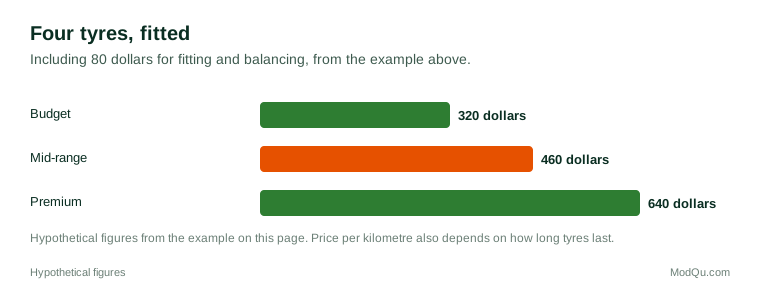
A driver needs four tyres. Budget tyres cost 60 dollars each (240 dollars), mid-range 95 dollars (380 dollars) and premium 140 dollars (560 dollars). Fitting and balancing cost 20 dollars per tyre (80 dollars). If the budget tyres last 35,000 kilometres and the premium ones 55,000 kilometres, the budget set costs about 0.91 cents per kilometre and the premium set about 1.16 cents per kilometre, including fitting.
Figure 1 compares the total prices in that example. Price per kilometre is only one factor: many drivers also consider grip and braking, especially in wet weather.
Car accessories people buy
Common accessories include:
- Phone mounts and chargers;
- Dash cameras, which record the road and can provide evidence after a collision;
- Floor mats and seat covers;
- Child car seats, required by law for young children in many countries;
- Roof racks, roof boxes and bike carriers;
- Sunshades and window tints where allowed;
- Cleaning products and air fresheners;
- Emergency kits: warning triangles, first aid kits, high-visibility vests, jump starters and tyre inflators. Some countries require certain items to be carried;
- Parking sensors and reversing cameras added to older cars;
- Electric vehicle charging cables and adapters;
- Styling items such as alloy wheels and body kits.
Example
A family buying a used car for a long road trip adds a roof box for luggage, two phone mounts, a dash camera and a first aid kit. They choose a dash camera after a relative had trouble proving who caused a minor collision. They buy most items online and fit them themselves.
Safety and maintenance
Tyres and some accessories have a direct effect on safety. Correct tyre pressure improves grip, braking, fuel economy and tyre life, yet many drivers rarely check it. Many newer cars have tyre pressure monitoring systems that warn of low pressure. Poorly fitted accessories, such as phone mounts blocking the view or overloaded roof boxes, can create risks. Child seats must be fitted correctly to protect children, and checks often find many are not.
Trends and debates
Trends include online tyre buying with mobile fitting, tyres designed for electric vehicles, longer-lasting tyres, dash cameras becoming common, and car-makers selling features through software. Debates include the safety of budget and part-worn tyres, tyre wear particles as a source of microplastic pollution, the environmental impact of tyre disposal and recycling, and whether winter tyres should be required in more places.
Questions that businesses want answered here include when drivers last bought tyres, where they bought them, how they chose and which accessories they buy.
Key terms
- Tread depthThe depth of the grooves in a tyre, which affects grip.
- SidewallThe side of the tyre, where its size and ratings are printed.
- Winter tyreA tyre made for cold, snow and ice, with softer rubber and deeper tread.
- All-season tyreA tyre designed for a range of moderate conditions.
- Wheel alignmentAdjusting wheel angles so the car drives straight and tyres wear evenly.
- BalancingAdding small weights so a wheel spins smoothly.
- Tyre labelA rating label showing a tyre's fuel efficiency, wet grip and noise.
- Dash cameraA small camera that records the road from inside a vehicle.
Full glossary: automotive aftermarket terms on EditingTests.com.
Car accessories and tyres vocabulary test
How well do you know the language of this topic? Try 8 quick questions. Your score is shown straight away and is not saved.
What the car accessories and tyres survey asks
This survey is part of ModQu's Cars and Getting Around survey. The car accessories and tyres part takes about five minutes and covers:
- When you last bought tyres, and why you replaced them.
- Where you bought them and had them fitted.
- How you chose: price, brand, labels, reviews or advice.
- Whether you use winter, summer or all-season tyres.
- Which car accessories you have bought in the last year, and where.
- How often you check your tyre pressure and tread.
After that you can choose to continue with other short parts of the Cars and Getting Around survey, such as buying a car or electric vehicles, or stop.
Ready to take part?
Your answers help show what people really think and do. Results are only ever reported as totals; no one can see your individual answers.
Start the surveyQuestions about this survey
Who can take part?
Drivers.
Do I have to give my name?
No. You may be asked for your age group, region and similar details so results can be broken down, but not your name. ModQu never asks for passwords, card numbers or account numbers.
How are the results used?
Answers are combined into totals and percentages and published in ModQu reports. Individual answers are never shown.
Is the vocabulary test part of the survey?
No. It is optional and separate, and your score is not stored.
How often should tyres be replaced?
There is no fixed interval. It depends on tread wear, damage and age. Many makers and safety groups advise inspecting tyres older than about five years and replacing tyres around ten years old, even if the tread looks fine.
Are part-worn tyres safe?
Part-worn tyres are cheaper, but their history is often unknown. Some countries regulate their sale, and safety groups advise checking them carefully for damage, tread depth and age.