
Share your experience of intercity travel
Tell us whether you have taken an intercity bus or train in the last year, how you booked and what would make you choose it over driving or flying. Your answers are combined with other people's and reported only as totals.
Start the long-distance buses and trains surveyAbout 5 minutes. No account needed. You can stop at any time.
What this topic covers
This topic covers public transport between cities and regions:
- Intercity and express coaches, including overnight services;
- Conventional intercity trains;
- High-speed rail, with speeds of 250 km/h or more on dedicated lines in many countries;
- Night trains with sleeper or couchette berths;
- Regional trains and buses for longer journeys within a region;
- International rail and coach routes that cross borders.
It looks at how often people use these services, how they book, what they pay and how they choose between bus, train, car and plane.
Services around the world
Intercity services differ widely:
- High-speed rail networks are extensive in China, Japan, Spain, France and other parts of Europe, South Korea and elsewhere, and are being built in several other countries.
- Coach networks are the main intercity transport in much of Latin America, Africa, South and Southeast Asia and Türkiye, often with several classes of seat.
- In North America and Australia, long distances and car-centred development mean intercity rail is limited in many areas, while coaches serve many routes.
- Low-cost coach networks expanded across Europe after markets were opened to competition.
The quality, speed and price of services vary greatly between and within countries.
Why people choose buses and trains
Reasons travellers give include:
- Cost: coaches are often the cheapest option; trains can be cheap when booked early;
- City centre to city centre: stations are often central, unlike many airports;
- Using the time: working, reading, sleeping or watching films;
- No driving stress or parking costs;
- Comfort: more space than on planes, especially on trains;
- Environment: rail and coach usually produce much lower emissions per passenger than flying or driving alone;
- Not having a car or licence.
Example
A student travels home from university four times a year. The coach takes five hours and costs about a third of the train fare; the train takes three hours. They take the coach in term time and the train at the end of term, when they have heavy luggage and want to arrive before dark.
Comparing journey options
Travellers compare total journey time, not only time on board. For a flight, this includes getting to the airport, security, waiting and getting into the city at the other end.
Example (hypothetical figures)
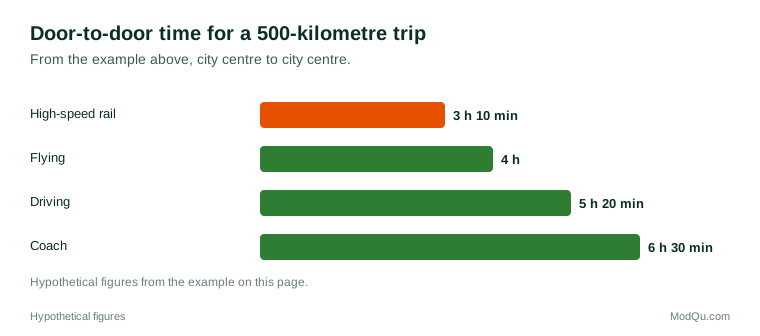
For a 500-kilometre trip between two city centres: high-speed rail takes 2 hours 30 minutes on board plus 40 minutes to and from stations, a total of 3 hours 10 minutes. Flying takes 1 hour 10 minutes in the air plus 2 hours 50 minutes for airport travel, security and waiting, a total of 4 hours. Driving takes 5 hours 20 minutes including one break. The coach takes 6 hours 30 minutes door to door.
Figure 1 compares the total journey times in that example. On many routes of this length with fast rail, rail competes well with flying on total time.
Booking and fares
People book intercity travel in several ways:
- operator websites and apps;
- ticket comparison and booking platforms;
- station ticket offices and machines;
- travel agents and bus terminal counters;
- on board, on some services.
Fares are set differently by operators:
- Dynamic or advance fares that are cheaper when booked early;
- Flexible fares that allow changes;
- Railcards and discount cards for young people, older adults, families and frequent travellers;
- Rail passes covering many journeys in a country or region;
- Classes: standard and first class on trains; seat types, sleeper buses and premium seats on coaches.
People often say rail fares are confusing because the same journey can cost very different amounts depending on time and type of ticket.
Comfort, reliability and common complaints
Things travellers value include:
- reliable departure and arrival times;
- comfortable seats and enough legroom;
- Wi-Fi and power sockets;
- clean toilets;
- food and drink;
- luggage space;
- quiet carriages;
- accessible boarding for wheelchair users and people with pushchairs.
Common complaints include delays and cancellations, crowding, poor information during disruption, high walk-up fares, few services at the times needed and poor connections between bus or rail and other transport.
Example
A family books a long train journey with a change of train halfway. The first train is delayed by 40 minutes and they miss their connection. Staff put them on the next train an hour later, and they later claim partial compensation under the operator's delay compensation scheme. They say they will allow more time between connections next time.
Rights and compensation
Many countries and regions have passenger rights for delays and cancellations. For example, the European Union has rules giving rail and bus passengers certain rights to information, assistance and compensation, and some countries have national schemes. Passengers often do not claim because they do not know about their rights or find the process complicated.
Trends and debates
Trends include new high-speed lines, the return of night trains in Europe, low-cost coach and rail competition, electric and hydrogen buses, and combined tickets across rail, bus and air. Debates include how much governments should invest in rail, whether short flights should be replaced by trains where a fast rail option exists, ticket prices compared with flying, and how to improve rural and cross-border connections.
Questions that businesses want answered here include how often people travel between cities by bus or train, how they book, what they pay and what would make them choose bus or rail over driving or flying.
Key terms
- IntercityTransport that connects cities over long distances.
- CoachA comfortable long-distance bus.
- High-speed railTrains running at 250 km/h or more on dedicated lines.
- Sleeper trainA night train with beds or berths.
- Advance fareA cheaper ticket bought ahead, usually for a specific train.
- RailcardA discount card for rail travel for certain groups.
- Rail passA ticket covering many journeys in a country or region for a period.
- Delay compensationMoney or vouchers given to passengers when services are late.
Full glossary: passenger rail terms on EditingTests.com.
Long-distance buses and trains vocabulary test
How well do you know the language of this topic? Try 8 quick questions. Your score is shown straight away and is not saved.
What the long-distance buses and trains survey asks
This survey is part of ModQu's Cars and Getting Around survey. The long-distance buses and trains part takes about five minutes and covers:
- Whether you have taken an intercity bus, coach or train in the last year, and how often.
- Which routes and types of service you used.
- How you booked, and how much you paid.
- What made you choose bus or train instead of driving or flying.
- How satisfied you were with comfort, reliability and information.
- What would make you choose bus or train more often.
After that you can choose to continue with other short parts of the Cars and Getting Around survey, such as buying a car or electric vehicles, or stop.
Ready to take part?
Your answers help show what people really think and do. Results are only ever reported as totals; no one can see your individual answers.
Start the surveyQuestions about this survey
Who can take part?
Adults who travel between cities.
Do I have to give my name?
No. You may be asked for your age group, region and similar details so results can be broken down, but not your name. ModQu never asks for passwords, card numbers or account numbers.
How are the results used?
Answers are combined into totals and percentages and published in ModQu reports. Individual answers are never shown.
Is the vocabulary test part of the survey?
No. It is optional and separate, and your score is not stored.
Is the train always better for the environment than flying?
Rail usually produces much lower emissions per passenger than flying, especially on electric lines, but the exact difference depends on the route, how full the train is and how electricity is generated.
How can I find the cheapest fare?
Booking early, travelling at quieter times, using discount cards and comparing operators often help. On some routes, splitting a journey into separate tickets can also cost less.
Can I take a bicycle on intercity trains or coaches?
Many trains carry bicycles, sometimes only with a reservation or for a fee, and folding bikes are usually allowed as luggage. Coaches vary more, so it is worth checking with the operator before booking.