
Share how you use discount stores
Tell us how often you shop at discount stores, what you buy there and whether you buy store brands. Your answers are combined with other people's and reported only as totals.
Start the discount and budget stores surveyAbout 5 minutes. No account needed. You can stop at any time.
Types of discount retailers
Discount retail takes several forms:
- Discount supermarkets with a limited range, mainly own-label products, and simple stores.
- Single-price or variety stores, where many items sell at one low price point.
- Warehouse clubs, where members buy in bulk.
- Off-price stores selling branded clothing and homeware at reduced prices, often from surplus stock.
- Outlet stores run by brands to sell past-season goods.
- Budget online retailers and marketplaces.
How they keep prices low
Discount retailers use a range of methods:
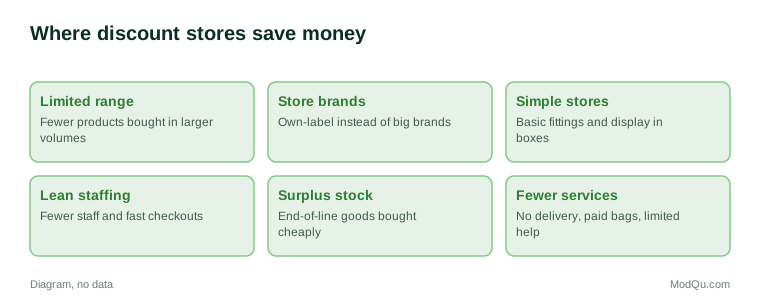
- Limited range: fewer products, so they buy each in large volumes.
- Store brands (also called own-label or private-label products).
- Simple stores: basic fittings, products displayed in shipping boxes, fewer staff.
- Efficient operations: fast checkouts, standard store layouts, lean supply chains.
- Buying surplus or end-of-line stock at low prices.
- Fewer services: limited customer service, no deliveries, or charges for bags.
The figure below shows where the savings typically come from.
Store brands versus big brands
Store-brand products are often much cheaper than branded equivalents. Some are made by the same manufacturers as branded goods. Quality varies: some store brands are rated as highly as branded products in taste and performance tests, while others are seen as lower quality. Many shoppers mix, buying store brands for staples and branded products for items they care about most.
Example (hypothetical figures)
A household compares a weekly basket of 20 items. At a mainstream supermarket buying familiar brands, the basket costs 85. At a discount supermarket buying mostly store brands, a similar basket costs 58. Over a year, the difference is about 1,400.
Who shops at discount stores
Discount stores were once associated mainly with low-income shoppers. In many countries, they now attract people across income groups. Reasons include rising living costs, improved quality and store design, and a sense that paying more for brands is not always worth it. Some shoppers say they feel pride in finding bargains.
Example
A professional couple with a good income switch their main grocery shop to a discount supermarket when prices rise. They are surprised to find they like most of the store-brand products. They still go to a larger supermarket every few weeks for items the discounter does not stock.
What shoppers trade off
Shopping at discount stores usually involves some trade-offs:
- Range: fewer choices, and some items may be missing.
- Consistency: special buys and surplus stock may not be available again.
- Service: fewer staff and limited help.
- Convenience: fewer stores in some areas, and limited online shopping.
- Experience: simpler stores and busier checkouts.
Many shoppers split their spending across several stores, buying basics at a discounter and other items elsewhere.
Special buys and impulse spending
Many discount stores have changing aisles of non-food items such as tools, clothing, garden goods and kitchen gadgets, available for a short time. These attract shoppers and encourage impulse purchases. Some shoppers say they spend more than they intended because of these items.
Bulk buying and warehouse clubs
Buying in bulk can lower the price per unit, but it requires storage space, money up front, and the ability to use items before they expire. Warehouse clubs suit larger households and small businesses more than single-person households.
Example
A single person joins a warehouse club and buys large packs of fresh fruit. Much of it spoils before it can be eaten. She switches to buying long-life items in bulk and fresh food in small amounts from a local shop.
Discount stores and local high streets
Discount chains can bring affordable shopping to areas that lacked it, but critics say they may compete with small independent shops. In some towns, discount and single-price stores have become a large share of shops on high streets and in malls.
Working conditions and supply chains
Low prices have raised questions about wages, working conditions and suppliers. Some discount retailers pay competitive wages and are praised for efficiency; others face criticism. Ethical sourcing, product safety and environmental standards are part of how some shoppers judge discount stores.
Shopping habits when prices rise
When living costs rise, many households change where and how they shop. Common changes include switching some or all grocery shopping to discount stores, buying more store brands, using loyalty schemes and coupons more, buying smaller packs or fewer treats, and shopping more often for exactly what is needed. Some changes become permanent: shoppers who try discount stores during difficult times often keep using them afterwards.
Example
During a year of high food prices, a retired couple start comparing prices across three stores using a phone app. They find they can save on most staples at a discounter and on fresh produce at a local market. When prices settle, they keep the new routine.
What people disagree about
Some see discount retailers as a positive force that keeps prices down and makes shopping fairer. Others worry about pressure on suppliers, effects on local businesses and encouraging overconsumption of cheap goods. There is also debate about whether store brands are as good as big brands.
Questions that businesses want answered include how often people shop at discount stores, what they buy there, how they rate quality, whether they buy store brands, what they miss, and how much they think they save.
Key terms
- Discount supermarketA grocery store with a limited range and low prices.
- Store brandA product sold under a retailer's own name.
- Private labelAnother term for store brand.
- Warehouse clubA membership store selling in bulk.
- Off-price storeA store selling branded goods at reduced prices.
- Special buyA non-food item available for a limited time.
- Price per unitThe cost per item, kilogram or litre, used to compare value.
- BasketA set of products used to compare prices between stores.
Full glossary: retail operations terms on EditingTests.com.
Discount and budget stores vocabulary test
How well do you know the language of this topic? Try 8 quick questions. Your score is shown straight away and is not saved.
What the discount and budget stores survey asks
This survey is part of ModQu's Shopping and Retail survey. The discount and budget stores part takes about five minutes and covers:
- How often you shop at discount or budget stores.
- What you buy there and what you buy elsewhere.
- Whether you buy store-brand products, and which.
- How you rate the quality compared with mainstream stores.
- What you miss when shopping at discount stores.
- How much you think you save, and whether you buy extra items you did not plan.
After that you can choose to continue with other short parts of the Shopping and Retail survey, such as online shopping or groceries and food shopping, or stop.
Ready to take part?
Your answers help show what people really think and do. Results are only ever reported as totals; no one can see your individual answers.
Start the surveyQuestions about this survey
Who can take part?
Adults.
Do I have to give my name?
No. You may be asked for your age group, region and similar details so results can be broken down, but not your name. ModQu never asks for passwords, card numbers or account numbers.
How are the results used?
Answers are combined into totals and percentages and published in ModQu reports. Individual answers are never shown.
Is the vocabulary test part of the survey?
No. It is optional and separate, and your score is not stored.
Are store brands made by the same companies as big brands?
Sometimes. Retailers use a range of suppliers, including some that also make branded products.
Are discount stores always cheaper?
Often for staples, but not always for every item. Comparing prices per unit helps.