
Share your life as a cricket fan
Tell us which formats you follow, how you watch matches and whether you have been to a match recently. Your answers are combined with other people's and reported only as totals.
Start the cricket fans surveyAbout 5 minutes. No account needed. You can stop at any time.
What this topic covers
Cricket is a bat-and-ball game between two teams of eleven players. One team bats, trying to score runs, while the other bowls and fields, trying to get the batters out. Then they swap. Its long history, varied formats and strong following across the Commonwealth make it one of the world's most watched sports.
This topic covers:
- which formats fans follow: Test, one-day and Twenty20;
- international cricket and domestic and franchise leagues;
- how fans watch: at the ground, on television, by streaming, on the radio or through live scores;
- what fans spend on tickets, subscriptions and merchandise;
- women's cricket and the growth of the game in new countries.
The three main formats
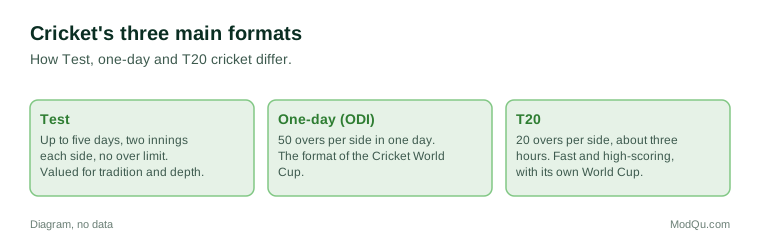
Cricket at the top level is played in three main formats:
- Test cricket: matches between national teams lasting up to five days, with each team batting twice. Many traditional fans see it as the purest and most demanding form.
- One-day internationals (ODIs): 50 overs per side, completed in a single day. The men's and women's Cricket World Cups use this format.
- Twenty20 (T20): 20 overs per side, lasting about three hours. Fast, high-scoring and popular with new audiences. There are T20 World Cups for men and women.
Shorter formats such as ten-over and hundred-ball games have also appeared. The International Cricket Council (ICC) governs the international game, with national boards running cricket in each country.
Example
A retired teacher in England has followed Test cricket on the radio for fifty years and keeps a scorebook for every home Test. His grandson, sixteen, mostly watches T20 franchise matches on his phone and follows players from several countries on social media. They agree on one thing: they both want to see an Ashes Test at the ground together.
Franchise leagues
Since the late 2000s, franchise T20 leagues have changed the sport. In these leagues, privately owned city-based teams sign players from many countries, often through auctions, and play in a short, intense season. The best-known league, in India, has become one of the most valuable sports competitions in the world by broadcast rights. Leagues now run in Australia, the Caribbean, Pakistan, South Africa, the United Arab Emirates, the United States and elsewhere.
Franchise cricket brings large salaries for players and big audiences, but critics worry that it pulls players away from Test cricket and from smaller cricket nations.
How fans watch
Fans follow cricket in several ways:
- At the ground, from a single day of a Test to a T20 night match with music and lights.
- On television, where rights to major series and leagues are usually held by pay services, with some matches free-to-air.
- By streaming on phones, which has become the main way many younger fans watch, especially in South Asia.
- On the radio, where ball-by-ball commentary has a loyal audience.
- Through live scores, apps and clips, often checked during work or school.
Because a Test match lasts five days, very few fans watch every ball. Many follow the score through the day and watch highlights in the evening.
What fans spend
Fan spending can include tickets, travel, food and drink at the ground, television and streaming subscriptions, team shirts, fantasy cricket games and memorabilia. In some countries cricket tours abroad, such as following a national team to another country, are a major expense for dedicated fans.
Example (hypothetical figures)
A fan in a large Indian city buys a streaming subscription for $18 a year that covers the franchise league and most international matches. She attends two league matches at $25 a ticket, spends $12 on food at each, and buys a team shirt for $20. Her cricket spending for the year is $112, of which the two days at the ground made up $74.
Fan culture
Cricket crowds vary by country and format. Test crowds in England are often known for their patience and picnics, while crowds in South Asia are often loud and passionate, with drums, flags and chants. Organized supporters' groups follow national teams on tour, singing and dressing up. Rivalries such as India against Pakistan, and England against Australia in the Ashes, draw enormous audiences.
Online, fans debate selection, statistics and results at great length. Cricket's detailed statistics, kept for well over a century, are a big part of how fans talk about the game.
Women's cricket
Women's cricket has grown quickly. Women's World Cups and franchise leagues now draw large crowds and television audiences, and more national boards offer professional contracts to women players. Many fans say coverage has improved but is still far behind the men's game.
Example
A family in Australia takes their two daughters, who play junior cricket, to a women's T20 match. Tickets are cheaper than for the men's game and the girls get autographs after the match. The older daughter now follows a women's franchise team on social media and asks to go to every home game.
Cricket's growth in new countries
Cricket is expanding in countries such as Afghanistan, Nepal, the Netherlands, the United Arab Emirates and the United States, often driven by South Asian diaspora communities. The sport's inclusion in future Olympic Games has been agreed for T20 cricket, which many expect to increase interest.
Playing cricket
Many cricket fans also play, from street and backyard games with a tennis ball to club cricket on weekends. In South Asia, informal tape-ball and tennis-ball cricket is played in streets, parks and car parks by millions of people. Club cricket in England, Australia, New Zealand and South Africa relies on volunteers who prepare pitches, score matches and make teas. Indoor cricket and shorter club formats have grown as fewer adults have time for a full day's play.
Clubs in several countries report that it has become harder to find players for long weekend matches, and many have added shorter evening games. Surveys that ask fans whether they play help boards understand how watching and playing support each other.
What fans disagree about
Fans disagree about whether Test cricket can survive the popularity of T20, whether franchise leagues are good for the game, how much power the largest cricket boards hold, whether ticket prices are fair, and how technology such as the Decision Review System should be used. Traditional fans and new fans often value different things: tradition and patience against pace and entertainment.
Questions that boards, leagues, broadcasters, sportswear brands and sponsors want answered include which formats fans follow, how they watch, how often they attend, how much they spend and what would bring more people to grounds.
Key terms
- Test cricketInternational matches lasting up to five days, with each team batting twice.
- ODIOne-day international, 50 overs per side.
- T20Twenty20 cricket, 20 overs per side.
- OverA set of six legal balls bowled by one bowler.
- Franchise leagueA competition of privately owned city-based teams that sign players from many countries.
- The AshesThe long-running Test series between England and Australia.
- DRSDecision Review System, which lets teams challenge umpires' decisions using technology.
- InningsOne team's turn to bat.
Full glossary: sports management terms on EditingTests.com.
Cricket fans vocabulary test
How well do you know the language of this topic? Try 8 quick questions. Your score is shown straight away and is not saved.
What the cricket fans survey asks
This survey is part of ModQu's Sports survey. The cricket fans part takes about five minutes and covers:
- Which cricket formats you follow most: Test, one-day, T20 or franchise leagues.
- Which teams or leagues you follow.
- How you watch matches: at the ground, TV, streaming, radio or live scores.
- Whether you have attended a match in the last year, and what stopped you going more.
- What you spent on cricket last year.
- Whether you follow women's cricket.
After that you can choose to continue with other short parts of the Sports survey, such as football (soccer) fans or playing team sports, or stop.
Ready to take part?
Your answers help show what people really think and do. Results are only ever reported as totals; no one can see your individual answers.
Start the surveyQuestions about this survey
Who can take part?
Adults who follow cricket.
Do I have to give my name?
No. You may be asked for your age group, region and similar details so results can be broken down, but not your name. ModQu never asks for passwords, card numbers or account numbers.
How are the results used?
Answers are combined into totals and percentages and published in ModQu reports. Individual answers are never shown.
Is the vocabulary test part of the survey?
No. It is optional and separate, and your score is not stored.