
Share your life as a football fan
Tell us which team you follow, how you watch matches and what you spent on football last year. Your answers are combined with other people's and reported only as totals.
Start the football (soccer) fans surveyAbout 5 minutes. No account needed. You can stop at any time.
What this topic covers
Football is played and watched in almost every country. It has local amateur leagues, national professional leagues, continental club competitions and international tournaments between national teams. The word "football" is used in most of the world; "soccer" is common in the United States, Canada, Australia and some other places where another sport is called football.
This topic is about fans: people who follow football teams, players or competitions. It covers:
- which teams people support and why;
- how they watch: at the stadium, on television, by streaming, on highlights or on social media;
- what they spend on tickets, subscriptions, shirts and travel;
- fan culture, from supporters' clubs to online communities;
- the issues fans argue about, such as ticket prices, ownership and the timing of matches.
How people choose a team
Most fans support a team because of family or place. Many people follow the team their parents or grandparents supported, or the team from the town where they grew up. Others choose a team because of a famous player, a memorable win when they were children, or friends at school.
Fans in many countries follow two teams: a local club and a large club from a major foreign league, which they watch on television. International fans of big clubs in Europe now number in the many millions in Asia, Africa and the Americas, and clubs tour abroad partly to reach them.
Example
A fan in a West African city grew up watching a large English club on television in a neighbourhood viewing centre because his older brother supported them. He also follows his home-town club in the national league and goes to their matches when he can. He owns shirts of both, though the foreign club's shirt cost five times as much.
Changing teams is unusual. Many fans say they would never switch, even after years of poor results. Loyalty to a team is often compared to loyalty to family, and it can last a lifetime.
How fans watch matches
Fans watch football in several ways:
- In the stadium, with a season ticket or by buying tickets for single matches.
- On free-to-air television, which still shows major international tournaments in many countries.
- On pay television and streaming services, which hold the rights to most top league matches.
- In bars, cafés and community viewing centres, which are important in places where subscriptions are expensive.
- On highlights programs and short clips on websites and social media.
- Through radio commentary and live text updates, especially when people are at work or travelling.
Watching habits are changing. Younger fans often follow football through short clips, social media and games rather than full matches. Many fans pay for more than one service, because rights to different competitions are split between broadcasters.
What fans spend
Football spending can include:
- match tickets or a season ticket;
- travel to home and away matches;
- food and drink at the ground;
- television and streaming subscriptions;
- replica shirts, scarves and other merchandise;
- football video games and fantasy football;
- membership of a club or supporters' group.
Example (hypothetical figures)
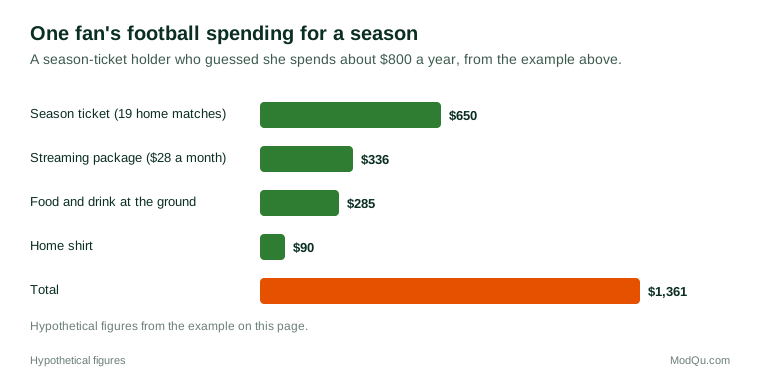
A season-ticket holder pays $650 for 19 home matches. She spends $15 a match on food and drink ($285 for the season), $90 on a new home shirt, and $28 a month on a streaming package for away matches and other leagues ($336 a year). Her total for the season is $1,361. She estimates she spends "about $800 a year" on football.
The gap between what fans think they spend and what they actually spend is common, because costs are spread through the year.
Fan culture
Football fans organize in many ways. Supporters' clubs organize travel and meet before matches. "Ultras" groups in parts of Europe, South America and North Africa create large displays, chants and banners. Fan trusts and supporters' associations represent fans to club owners and governing bodies. Online communities discuss every detail of transfers, tactics and results.
Fan culture has a darker side too. Racism, homophobia, violence and abuse of players and referees, especially online, remain problems in many countries. Governing bodies and clubs run campaigns and impose bans, and fans themselves often lead efforts against abuse.
Example
A supporters' group notices that one of their club's players receives racist messages online after a missed penalty. The group posts a statement of support, collects screenshots and sends them to the club and the platform. The club bans one season-ticket holder identified from the evidence.
Issues fans care about
Fans regularly raise the same concerns:
- Ticket prices, especially for away fans and young people.
- Kick-off times moved for television, which can make travel hard.
- Ownership: debt-funded takeovers, foreign state ownership and the risk of clubs going bankrupt.
- Competitions: proposals for new leagues or tournaments that could change the traditional structure.
- Video assistant referees, which many fans say slow the game and remove spontaneity.
- Women's football, which has grown quickly in attendance and coverage.
- Safety and policing at matches.
In some countries, fans own part or all of their clubs. In Germany, for example, the "50+1" rule generally requires club members to hold a majority of voting rights, though there are exceptions.
Amateur and grassroots football
Many fans also play. Football is the most widely played team sport in the world, from organized youth and adult leagues to informal games in streets, parks and school yards. Five-a-side and small-sided games on artificial pitches are popular with adults who no longer play full matches. Local amateur clubs often depend on volunteers, small sponsorships from local businesses and fees from players.
Fans who play often follow the game differently from those who only watch. They may pay more attention to tactics, buy more boots and equipment, and use apps that track their own games. Surveys that ask fans whether they play, and at what level, help clubs and governing bodies understand how watching and playing are linked, and whether interest in professional football leads people to take up the game themselves.
What people disagree about
Fans disagree about how much money from television and owners is good for the game, whether new tournaments and expanded competitions add value or devalue older ones, whether technology has improved refereeing, and whether supporting a foreign club makes someone a "real" fan. Long-time stadium-goers and fans who mainly watch on screens often have different priorities.
Questions that clubs, leagues, broadcasters, sportswear brands and sponsors want answered include which teams people follow, how they watch, how much they spend, what they would pay for, and what would make them watch or attend more.
Key terms
- Season ticketA ticket that covers all of a team's home matches for a season.
- Free-to-airTelevision available without a subscription.
- Broadcast rightsThe right to show matches, sold by leagues and competitions to broadcasters.
- Replica kitA copy of a team's official shirt and shorts sold to fans.
- Supporters' trustA democratic fans' organization that represents supporters to a club.
- UltrasHighly organized groups of fans known for displays and chanting.
- VARVideo assistant referee, a system that reviews key decisions using video.
- Away fansSupporters who travel to watch their team play at another team's ground.
Full glossary: sports management terms on EditingTests.com.
Football (soccer) fans vocabulary test
How well do you know the language of this topic? Try 8 quick questions. Your score is shown straight away and is not saved.
What the football (soccer) fans survey asks
This survey is part of ModQu's Sports survey. The football (soccer) fans part takes about five minutes and covers:
- Which football teams you follow, and how you came to support them.
- How you watch matches: stadium, free TV, pay TV, streaming, bars or clips online.
- How often you attend matches, and what stops you going more.
- What you spent on football last year, including tickets, subscriptions, shirts and travel.
- Which issues in football matter most to you.
- Whether you follow women's football, and how.
After that you can choose to continue with other short parts of the Sports survey, such as playing team sports or running and marathons, or stop.
Ready to take part?
Your answers help show what people really think and do. Results are only ever reported as totals; no one can see your individual answers.
Start the surveyQuestions about this survey
Who can take part?
Adults who follow football.
Do I have to give my name?
No. You may be asked for your age group, region and similar details so results can be broken down, but not your name. ModQu never asks for passwords, card numbers or account numbers.
How are the results used?
Answers are combined into totals and percentages and published in ModQu reports. Individual answers are never shown.
Is the vocabulary test part of the survey?
No. It is optional and separate, and your score is not stored.