
Share your experience as a sports parent
Tell us whether your child plays an organized sport, what it costs a year and how satisfied you are with the coaching. Your answers are combined with other people's and reported only as totals.
Start the youth sport surveyAbout 5 minutes. No account needed. You can stop at any time.
What this topic covers
Youth sport means organized sport for children and teenagers, usually run by clubs, schools, community groups or private academies. This topic is answered by parents and carers and covers:
- which sports children play and how they started;
- the costs of fees, kit, travel and tournaments;
- the time parents give to driving, watching and volunteering;
- coaching quality and the club environment;
- safety and safeguarding;
- competition, specialization and why children stop.
How children start
Children usually start organized sport between about five and ten years old. Common routes include a school friend's club, a sport a parent played, a taster session at school or a holiday camp, a nearby club, or a child's own interest after watching a sport on television. Many children try several sports before settling on one or two.
Schools play a big role in some countries, with inter-school competitions and school teams. In others, most youth sport happens through community clubs run by volunteers. In some countries, private academies offering paid coaching have grown.
Example
A seven-year-old tries a free taster session of rugby at school. She enjoys it and joins the local club's under-8 team on Sunday mornings. Her parents had never followed rugby, but within a year one of them helps run the under-8s and the other washes the team kit every other week.
What it costs
Costs vary widely by sport, level and country. Common costs include:
- registration and membership fees;
- training and match fees;
- kit, shoes and equipment, which children outgrow;
- travel to training and away matches;
- tournaments, camps and tours;
- private coaching for some families;
- fundraising and volunteering expected of parents.
Costs often rise steeply when a child moves into higher-level or representative teams, which may involve more travel, extra training and more expensive equipment.
Example (hypothetical figures)
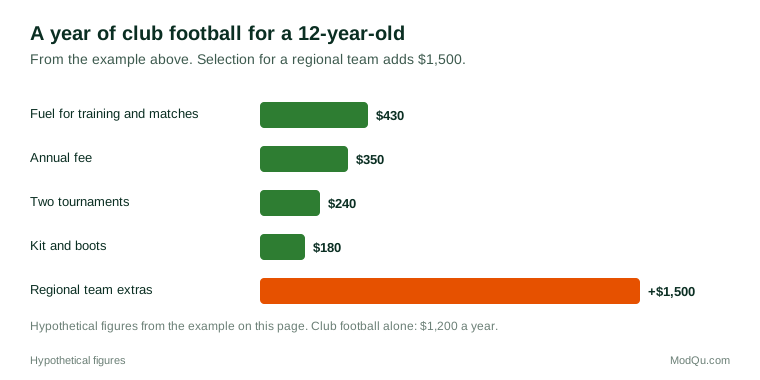
A family's 12-year-old plays club football. The annual fee is $350, kit and boots cost $180, two tournaments cost $120 each ($240), and fuel for training and matches comes to about $430 over the year. The total is $1,200, or $100 a month. When he is selected for a regional team, extra fees and travel add $1,500, more than doubling the cost.
Cost is a major reason some children do not play or stop playing. Many clubs offer reduced fees for families on low incomes, kit swaps and equipment loans, and some governments fund programs for children who would otherwise miss out.
Time
Youth sport takes a lot of parents' time: driving to training several times a week, weekend matches, tournaments that last all day, and volunteering as coaches, managers, drivers or committee members. Families with several children in different sports often find weekends fully booked. Parents who work shifts or weekends, single parents and families without cars can find it hard to keep up.
Coaching quality
Parents often say coaching is the most important factor in whether a child enjoys sport. Good youth coaching is usually described as:
- focused on fun, skill development and effort rather than only winning;
- giving all children a fair share of playing time, especially at younger ages;
- encouraging and clear;
- adapted to the child's age and stage;
- safe, with qualified and checked adults.
Many youth coaches are volunteer parents. Governing bodies in many countries offer coaching courses and require basic qualifications and background checks.
Example
A ten-year-old who loved basketball starts asking to skip practice. His parents learn that his new coach shouts at players and plays only the strongest children in close games. They move him to another club where the coach rotates players, and within a month he is keen to train again.
Safety and safeguarding
Safeguarding means protecting children from harm, including abuse, bullying and neglect. Well-run clubs have a safeguarding policy, a named welfare officer, background checks for adults working with children, rules on communication between coaches and children, and a clear way for children and parents to raise concerns. High-profile abuse cases in several sports and countries have led to stronger rules.
Physical safety includes appropriate equipment, rules adapted for age, managing heat and hydration, and care with head injuries. Many sports have introduced concussion guidelines for youth players. This page describes general practices and does not give medical advice.
Competition and specialization
Debates about youth sport often centre on two issues:
- How competitive it should be: some leagues for young children do not keep scores or league tables, to focus on development. Others think competition teaches resilience.
- Early specialization: focusing on one sport year-round from an early age. Many sports scientists and governing bodies advise sampling several sports in childhood, linking early specialization with overuse injuries and burnout, though some sports, such as gymnastics, involve early specialization by nature.
Pressure from parents, such as shouting from the sidelines, is a common concern. Many clubs ask parents to sign codes of conduct.
Why children stop
Many children stop organized sport in their early teens. Common reasons include:
- it stopped being fun;
- too much pressure or too much focus on winning;
- not getting playing time;
- other interests, school work or part-time jobs;
- cost;
- body image or self-consciousness, particularly for girls;
- conflict with coaches or teammates.
Clubs that keep teenagers often offer social and less competitive options alongside elite teams.
Disability and inclusive youth sport
Children with disabilities often have fewer chances to play organized sport. Barriers include a lack of adapted sessions, coaches without training in inclusion, inaccessible facilities, transport and cost. Some clubs run mixed sessions where children of all abilities play together; others offer adapted formats such as wheelchair basketball, frame football or visually impaired sports. Para-sport pathways can lead from local sessions to national and international competition.
Parents of children with disabilities often say that finding a welcoming club with a trained coach matters more than which sport it is. Questions on inclusion help clubs and governing bodies see where provision is missing.
What people disagree about
Parents disagree about how much to spend, how competitive youth sport should be, whether children should specialize early, whether every child should get equal playing time, and how much parents should push. They also disagree about whether school or community clubs should be the main provider, and whether governments should fund youth sport more.
Questions that clubs, governing bodies, schools, councils and sportswear brands want answered include how many children play which sports, what families spend, how parents rate coaching, what parents value most and why children stop.
Key terms
- SafeguardingProtecting children from harm, including abuse, bullying and neglect.
- Welfare officerThe person at a club responsible for children's safety and concerns.
- Representative teamA team selected from the best players across clubs or a region.
- Early specializationFocusing on one sport year-round from a young age.
- BurnoutPhysical and mental exhaustion that leads a young athlete to lose interest.
- Code of conductRules on behaviour that players, coaches and parents agree to follow.
- Playing timeThe amount of time a player spends in matches.
- Background checkA check of an adult's history before they work with children.
Full glossary: sports management terms on EditingTests.com.
Youth sport vocabulary test
How well do you know the language of this topic? Try 8 quick questions. Your score is shown straight away and is not saved.
What the youth sport survey asks
This survey is part of ModQu's Sports survey. The youth sport part takes about five minutes and covers:
- Whether your child plays an organized sport, which one and how they started.
- How much it costs your family a year, including fees, kit, travel and tournaments.
- How much time it takes you each week.
- How satisfied you are with the coaching and the club.
- How competitive you think your child's sport is, and whether that suits them.
- If your child has stopped a sport, why.
After that you can choose to continue with other short parts of the Sports survey, such as football (soccer) fans or playing team sports, or stop.
Ready to take part?
Your answers help show what people really think and do. Results are only ever reported as totals; no one can see your individual answers.
Start the surveyQuestions about this survey
Who can take part?
Parents of children who play sport.
Do I have to give my name?
No. You may be asked for your age group, region and similar details so results can be broken down, but not your name. ModQu never asks for passwords, card numbers or account numbers.
How are the results used?
Answers are combined into totals and percentages and published in ModQu reports. Individual answers are never shown.
Is the vocabulary test part of the survey?
No. It is optional and separate, and your score is not stored.