
Share how you buy sports equipment
Tell us what sports equipment you bought last year, whether it was new or used and where you bought it. Your answers are combined with other people's and reported only as totals.
Start the sports equipment surveyAbout 5 minutes. No account needed. You can stop at any time.
What this topic covers
Sports equipment covers everything people use to play sport and exercise, apart from the facilities themselves. This topic includes:
- footwear made for particular sports;
- balls, rackets, bats, sticks and clubs;
- protective gear such as helmets, pads, mouthguards and shin guards;
- bikes, skis, boards and other larger equipment;
- home fitness equipment such as weights, mats, treadmills and exercise bikes;
- wearable devices that track exercise;
- clothing designed for sport.
It covers how people choose equipment, how much they spend, new versus second-hand, and where they buy.
What people buy
Spending often follows a pattern. Many people buy a few low-cost items often, such as balls, socks and grips, and a few expensive items rarely, such as a bike, a set of golf clubs or a treadmill. Shoes are the most common regular purchase for runners, walkers and players of court and field sports.
Equipment also depends on the stage of a person's involvement. Beginners often buy cheap or borrowed gear to see if they like a sport. Keen players upgrade to better and more specialized equipment. Parents buy equipment for children that may be outgrown within a year.
Example
A teenager takes up ice hockey. In the first season her parents borrow skates and pads from the club's equipment library. When she decides to continue, they buy second-hand skates and a new helmet, because the club advises buying helmets new for safety. By her third season she wants composite sticks, which cost more than all her other gear put together.
How people choose
People weigh several factors when choosing equipment:
- Price and value for money.
- Quality and durability: how long it will last.
- Performance: whether it will help them play better, which matters more to keen players.
- Fit and comfort, especially for shoes, helmets and bikes.
- Safety standards, for helmets and protective gear.
- Brand reputation and what other players use.
- Advice from coaches, club members, shop staff and online reviews.
- Looks and fashion, especially for shoes and clothing.
Trying equipment before buying is important for many items. Some specialist shops offer fittings, such as bike fittings, shoe gait analysis or golf club fittings.
New or second-hand
Second-hand sports equipment is a large and growing market. People buy used equipment through online marketplaces, club swap sales, second-hand sports shops, charity shops and friends. Reasons include lower cost, children outgrowing gear quickly, trying a sport before committing, and reducing waste.
Some items are commonly bought used, such as bikes, golf clubs, skis and fitness machines. Others are usually bought new for safety or hygiene, such as helmets (which may have hidden damage), mouthguards and some protective gear.
Example (hypothetical figures)
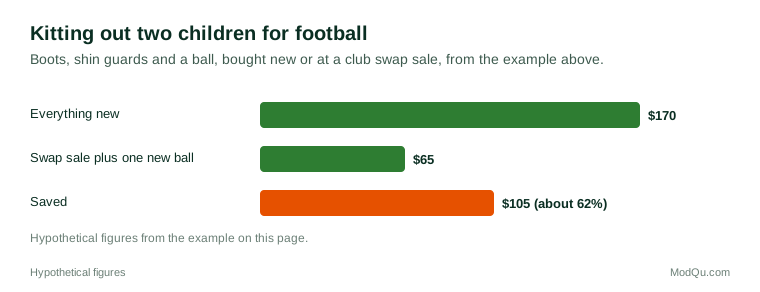
A family equips two children for a football season. New boots, shin guards and a ball would cost $85 for each child, or $170 in total. At a club swap sale they buy boots and shin guards in good condition for $20 per child and one new ball for $25, spending $65. They save $105, about 62% of the cost of buying everything new.
Where people buy
Common places to buy include:
- Large sports retailers, with a wide range at different prices.
- Specialist shops for running, cycling, golf, climbing or other sports, often with expert advice and fittings.
- General department stores and supermarkets, for basic items.
- Online retailers and brand websites, which offer wide choice and price comparison.
- Online marketplaces and resale apps, for second-hand gear.
- Club shops, which sell kit and sometimes equipment.
Many people research online and buy in a shop, or try on in a shop and buy online for a lower price, a practice that specialist shops say makes it hard to keep offering fittings and advice.
Home fitness equipment
Home fitness equipment, including weights, mats, resistance bands, exercise bikes, rowing machines and treadmills, sells in waves. Demand rose sharply during the COVID-19 pandemic when gyms closed. Many people who bought large machines then used them less once gyms reopened, and the second-hand market for home fitness equipment grew. Smart machines linked to online classes, often with monthly subscriptions, are another trend.
Example
A couple buy an exercise bike and resistance bands when their gym closes for several months. They use the bike daily at first. A year later they have returned to the gym, and the bike is used once a week. They sell it online for less than half what they paid and keep the bands.
Technology and wearables
Watches and bands that track steps, heart rate, distance and sleep are now common among people who exercise. Equipment itself has also become more technical, with lighter materials, carbon fibre in bikes and rackets, and sensors in balls and bats. Keen players often debate whether the latest technology is worth the price.
Sustainability
Sports equipment uses plastics, rubber, foam and composites that are hard to recycle. Interest is growing in repairs, rental, second-hand markets and equipment made from recycled materials. Some brands offer take-back or repair schemes. Many people say they would like to buy more sustainable equipment but are unsure how to judge claims.
Repair, rental and care
Looking after equipment makes it last longer. Common examples include restringing rackets, sharpening skates, servicing bikes, re-gripping golf clubs and repairing tears in boots and gloves. Many specialist shops offer repair services, and some clubs run workshops. Renting equipment is common for sports people do only occasionally, such as skiing, snowboarding, kayaking and climbing, and for children who outgrow gear quickly.
Some people choose rental or second-hand items to save money or reduce waste; others prefer to own new equipment that fits them exactly. Questions about repair and rental help retailers and clubs decide which services to offer.
What people disagree about
People disagree about whether expensive equipment improves performance enough for amateur players, whether second-hand safety equipment is acceptable, whether children need the latest gear, and whether governing bodies should limit technology to keep sports fair, as some have done with racing shoes and golf balls.
Questions that equipment brands, retailers, clubs and governing bodies want answered include what people bought in the last year, how much they spent, whether they bought new or used, where they bought it, and what matters most when they choose.
Key terms
- Specialist shopA shop focused on one sport, often with expert advice.
- FittingA process to match equipment, such as a bike or golf clubs, to a person's body and style.
- Equipment libraryA collection of gear a club or group lends to members.
- Swap saleAn event where people sell or exchange used equipment.
- CompositeA material made from combined layers, such as carbon fibre, used for light, strong equipment.
- Safety standardA test equipment such as a helmet must pass to be sold as protective.
- WearableA device worn on the body that tracks activity, such as a fitness watch.
- ShowroomingTrying products in a shop and then buying them online.
Full glossary: sporting goods manufacturing terms on EditingTests.com.
Sports equipment vocabulary test
How well do you know the language of this topic? Try 8 quick questions. Your score is shown straight away and is not saved.
What the sports equipment survey asks
This survey is part of ModQu's Sports survey. The sports equipment part takes about five minutes and covers:
- What sports equipment you bought in the last year, and for which sports.
- Whether you bought it new or used, and why.
- Where you bought it: large retailer, specialist shop, online or second-hand.
- Roughly how much you spent.
- What matters most when you choose equipment.
- Whether you have sold, given away or repaired equipment.
After that you can choose to continue with other short parts of the Sports survey, such as football (soccer) fans or playing team sports, or stop.
Ready to take part?
Your answers help show what people really think and do. Results are only ever reported as totals; no one can see your individual answers.
Start the surveyQuestions about this survey
Who can take part?
Adults who play sport.
Do I have to give my name?
No. You may be asked for your age group, region and similar details so results can be broken down, but not your name. ModQu never asks for passwords, card numbers or account numbers.
How are the results used?
Answers are combined into totals and percentages and published in ModQu reports. Individual answers are never shown.
Is the vocabulary test part of the survey?
No. It is optional and separate, and your score is not stored.