
Share your running habits
Tell us how often you run, whether you have entered a race and what you spend on running gear. Your answers are combined with other people's and reported only as totals.
Start the running and marathons surveyAbout 5 minutes. No account needed. You can stop at any time.
What this topic covers
Running ranges from a few minutes of jogging to ultramarathons of a hundred kilometres or more. This topic covers:
- how often people run, how far and where;
- why they run and what keeps them going;
- organized events, from free weekly park runs to big-city marathons;
- training, injuries and recovery;
- shoes, clothing, watches and other gear;
- running clubs and social running.
People run on roads and pavements, in parks, on tracks, on treadmills and on trails through forests and mountains. Trail running has grown quickly, as have weekly community events where people run a set distance together.
Why people run
People give many reasons for running:
- Fitness and health, including heart health and weight management.
- Mental health: many runners say running reduces stress and helps them think.
- Convenience: it can be done almost anywhere, at any time, alone.
- Low cost compared with gyms or many other sports.
- Goals: training for a first 5K, a personal best or a marathon.
- Social reasons: running clubs and group runs.
- Raising money for charity by running an event.
Example
A man in his forties takes up running after a health check shows high blood pressure. He follows a beginner's plan that mixes walking and running three times a week. After nine weeks he can run five kilometres without stopping and enters his first organized 5K, which he finishes in 34 minutes.
Race distances and events
Common race distances include:
- 5K and 10K (5 and 10 kilometres), the most popular entry-level road races.
- Half marathon: 21.1 kilometres.
- Marathon: 42.195 kilometres, a distance fixed in the early twentieth century.
- Ultramarathon: any distance longer than a marathon, often on trails.
- Track races, from 100 metres to 10,000 metres, and cross-country races over open ground.
Large city marathons attract tens of thousands of runners and often use ballots because demand is greater than places. Many runners raise money for charities, which may hold guaranteed entries. Smaller local races and free weekly timed runs in parks make racing accessible to beginners.
Training
Most training plans build distance slowly over weeks and mix different kinds of running:
- Easy runs at a comfortable, conversational pace.
- Long runs, usually once a week, building endurance.
- Speed work, such as intervals or tempo runs at a harder effort.
- Rest and cross-training, such as cycling or swimming, to recover.
Marathon plans commonly last 12 to 20 weeks. A common guide among coaches is not to increase weekly distance too quickly, to reduce injury risk. Runners use plans from books, apps, clubs or coaches.
Example (hypothetical figures)
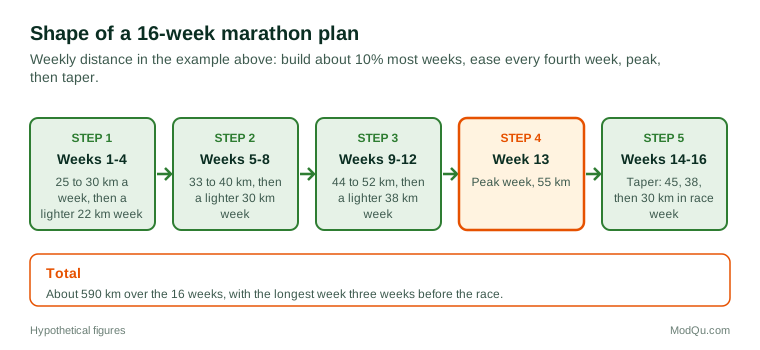
A runner training for a marathon plans 16 weeks. She starts at 25 kilometres a week and adds about 10% most weeks, with every fourth week lighter for recovery. Her peak week reaches 55 kilometres, three weeks before the race, before a taper back to 30 kilometres in race week. Over the full plan she runs about 590 kilometres.
Injuries
Running injuries are common, especially among beginners and people who increase distance quickly. Frequent problems include pain around the knee, shin splints, Achilles tendon problems, plantar fasciitis (heel pain) and stress fractures. Runners commonly try rest, strength exercises, changes in training and new shoes, and many see physiotherapists. This page describes common problems and does not give medical advice.
Shoes and gear
Shoes are the main purchase for most runners. Choices include cushioned shoes, lighter racing shoes, trail shoes with deeper grip, and minimal shoes with little cushioning. Many specialist shops offer gait analysis, watching how a person runs to suggest shoes. Recent years have brought racing shoes with carbon-fibre plates and new foams, which many runners believe make them faster and which governing bodies now regulate for elite competition.
Other gear includes:
- technical shirts, shorts and tights that move sweat away from the skin;
- sports bras;
- socks designed to reduce blisters;
- GPS watches and phone apps that track distance, pace and heart rate;
- headphones;
- reflective clothing and lights for running in the dark;
- hydration belts, vests and gels for long runs.
Runners often replace shoes after several hundred kilometres. Spending varies from almost nothing to a large sum for keen runners with watches, multiple pairs of shoes and race travel.
Example
A student runs in an old pair of trainers for a year. After a knee starts to ache, she goes to a running shop, tries several pairs and buys one cushioned pair. She also downloads a free app to track her runs and joins a free weekly park run, where she meets others who invite her to a club.
Safety and access
Many runners, especially women, report concerns about safety when running alone, in the dark or in quiet areas, including harassment from passers-by. Common responses include running in groups, sharing location with a friend, choosing well-lit routes and changing times. Access to safe places to run also varies: some neighbourhoods lack pavements, parks or clean air, and in hot climates many people run very early in the morning.
Running clubs and community runs
Running is often thought of as a solitary activity, but many runners belong to clubs or run in groups. Traditional athletics clubs offer coached sessions on tracks and roads and enter teams in races. Newer social running groups meet at cafés, shops or workplaces and focus on company rather than speed. Free, volunteer-run weekly timed runs in parks, held in many countries, have introduced large numbers of people to running, including walkers and people who had never exercised regularly.
Group running helps with motivation and safety, and many runners say they would run less without it. Clubs also offer a way to find training partners, share advice on injuries and gear, and travel to races together.
What people disagree about
Runners disagree about whether expensive shoes and technology are worth the money, whether high-tech racing shoes give an unfair advantage, whether big marathons have become too expensive to enter, whether running every day is healthy, and whether treadmill running "counts". Some see running as a solitary escape; others value it mainly as a social activity.
Questions that event organizers, sportswear and shoe brands, health bodies and clubs want answered include how often people run, what races they enter, what they spend and on what, how they choose shoes and what stops them running more.
Key terms
- 5KA race of 5 kilometres, a common first race.
- Half marathonA race of 21.1 kilometres.
- MarathonA race of 42.195 kilometres.
- UltramarathonAny race longer than a marathon.
- Personal bestA runner's fastest time over a given distance.
- TaperA planned reduction in training before a race.
- Interval trainingRepeated fast efforts separated by recovery periods.
- Gait analysisObserving how a person runs, often to help choose shoes.
Full glossary: sports medicine terms on EditingTests.com.
Running and marathons vocabulary test
How well do you know the language of this topic? Try 8 quick questions. Your score is shown straight away and is not saved.
What the running and marathons survey asks
This survey is part of ModQu's Sports survey. The running and marathons part takes about five minutes and covers:
- How often you run, how far and where.
- Why you run, and what keeps you going or stops you.
- Whether you have entered a race in the last year, and which distances.
- What you spent on running shoes, clothing, watches and race entries.
- How you choose your shoes, and where you buy them.
- Whether you feel safe running where you live.
After that you can choose to continue with other short parts of the Sports survey, such as football (soccer) fans or playing team sports, or stop.
Ready to take part?
Your answers help show what people really think and do. Results are only ever reported as totals; no one can see your individual answers.
Start the surveyQuestions about this survey
Who can take part?
Adults who run.
Do I have to give my name?
No. You may be asked for your age group, region and similar details so results can be broken down, but not your name. ModQu never asks for passwords, card numbers or account numbers.
How are the results used?
Answers are combined into totals and percentages and published in ModQu reports. Individual answers are never shown.
Is the vocabulary test part of the survey?
No. It is optional and separate, and your score is not stored.