
Share your swimming habits
Tell us how often you swim, where you swim and whether everyone in your household can swim. Your answers are combined with other people's and reported only as totals.
Start the swimming surveyAbout 5 minutes. No account needed. You can stop at any time.
What this topic covers
This topic covers swimming as an activity people do, rather than as an elite sport to watch. It includes:
- how often people swim, and why;
- where they swim: public and private pools, the sea, lakes and rivers;
- learning to swim as a child or an adult;
- water safety and drowning prevention;
- costs and access to pools;
- open-water swimming and competitive masters swimming.
Why people swim
People swim for many reasons:
- Exercise: swimming works the whole body and puts little strain on joints, so it suits people with injuries, older adults and people with some disabilities.
- Relaxation and mental health: many swimmers describe it as calming.
- Fun and family time, especially on holidays and at the beach.
- Training for triathlons or open-water events.
- Rehabilitation after injury, often guided by physiotherapists.
- Safety: being able to swim is a basic protection around water.
Example
A man in his fifties with knee problems is told by his doctor to find low-impact exercise. He buys a monthly pass at a public pool and swims before work three times a week. At first he manages ten lengths with rests. After six months he swims forty lengths without stopping and says his knee hurts less on walks.
Where people swim
- Public pools, run by councils or municipal leisure services, offering lane swimming, lessons and family sessions.
- Private pools at gyms, clubs, hotels and homes.
- School and university pools.
- The sea, often at beaches with lifeguards.
- Lakes, rivers and reservoirs, where some places are designated for swimming and others are not safe.
- Outdoor lidos and natural pools, which have become popular in some countries.
Access varies a great deal. In some countries most towns have a public pool; in others pools are rare and expensive, and people swim mainly in natural water. Many public pools have closed in recent years in some countries because of high running and heating costs.
Learning to swim
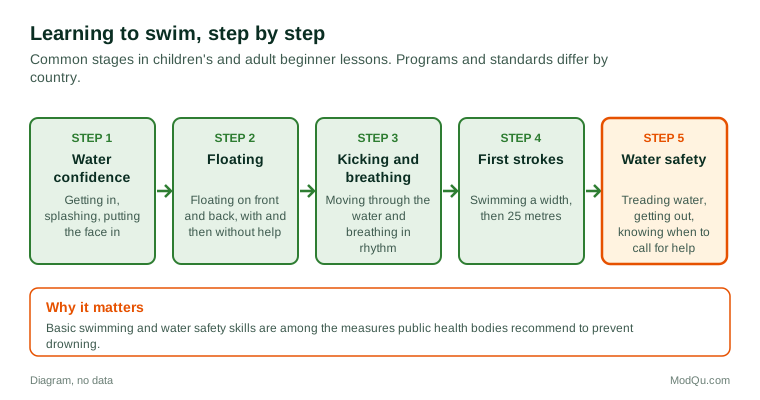
Most people who can swim learned as children, through school lessons, lessons at a pool or from family. Some countries require swimming in the school curriculum and set a standard for children to reach, such as swimming 25 metres and knowing basic water safety. Others leave it to families.
Many adults cannot swim, or cannot swim well enough to be safe in deep water. Reasons include growing up without access to pools, fear of water, cost, and cultural or religious concerns about mixed swimming or swimwear. Adult lessons and women-only sessions help some people learn later in life.
Example (hypothetical figures)
A mother signs her two children up for a ten-week course of lessons at $12 per lesson each, so $240 for the course. She has never learned to swim herself, so she joins an adult beginners' class at the same pool for $90 for ten weeks. After two courses, both children can swim 25 metres and she can swim a width unaided. Two courses for all three cost $660.
Water safety and drowning
The World Health Organization describes drowning as a major cause of death worldwide, especially among children, and most drowning deaths occur in low- and middle-income countries. Drowning often happens quickly and quietly, not with the splashing and shouting people expect. Common risk factors include lack of swimming skills, lack of barriers around water, lack of supervision of young children, alcohol use, and floods.
Prevention measures recommended by public health bodies include:
- teaching children basic swimming and water safety skills;
- supervising young children closely near any water, including baths and buckets;
- fencing pools and covering wells;
- swimming at lifeguarded beaches and inside flagged areas;
- learning about currents, cold water and how to float;
- wearing life jackets on boats.
This page describes general water safety and does not replace training or local advice.
Open-water swimming
Open-water swimming in lakes, rivers and the sea has grown in popularity, including year-round cold-water swimming in some countries. Swimmers often say they enjoy nature, the challenge and the community. Organized open-water events range from short swims to long crossings. Risks include cold water shock, currents, boats and poor water quality. Many swimmers wear brightly coloured caps and tow floats, and swim in groups.
Example
A group of friends in a coastal town start swimming in the sea every Sunday morning, including in winter. They swim for only a few minutes when the water is very cold, always together, and check tide times and water quality reports before going in. The group grows to forty people over two years.
Competitive swimming for adults
Masters swimming lets adults train and compete in age groups, often from 25 and upwards. Clubs offer coached sessions and local, national and international competitions. Triathlon, which combines swimming, cycling and running, also brings many adults back to swimming.
Costs and access
Costs include pool entry or memberships, lessons, swimwear, goggles and caps, and travel to pools. Public pools usually offer reduced prices for children, older people and people on low incomes. Common complaints include crowded lanes, limited opening hours, changing rooms in poor condition and closures for maintenance.
Swimming and health conditions
Many people turn to swimming because of a health condition. Swimming and water exercise classes, such as aqua aerobics, are often suggested for people with arthritis, back pain, obesity or during pregnancy, because the water supports body weight. Some pools run sessions for people with disabilities, with hoists, warm water and extra staff. Hydrotherapy pools, which are warmer and shallower, are used in hospitals and clinics for rehabilitation.
People with some conditions, such as epilepsy or heart conditions, may be advised to take extra care or swim with others present. This page describes general patterns and does not give medical advice; anyone with a health condition should follow advice from their own health care provider.
What people disagree about
People disagree about whether governments should fund public pools that cost a lot to run, whether swimming lessons should be compulsory and free in schools, whether women-only or family sessions are fair to other users, how to manage crowded public lanes, and whether rivers and coasts are clean enough for swimming. Water quality in natural swimming places has become a strong public concern in several countries.
Questions that councils, leisure operators, swimming bodies, schools and swimwear brands want answered include how often people swim, where, whether household members can swim, what stops people learning, and what pools could improve.
Key terms
- LengthOne trip from one end of a pool to the other.
- Lane swimmingSessions where the pool is divided into lanes by speed.
- Open waterNatural water such as lakes, rivers and the sea.
- LidoAn outdoor public swimming pool.
- Masters swimmingOrganized training and competition for adults by age group.
- Cold water shockA sudden reaction to cold water that affects breathing and heart rate.
- LifeguardA trained person who supervises swimmers and responds to emergencies.
- Tow floatA brightly coloured float an open-water swimmer pulls behind them to be seen.
Full glossary: fitness terms on EditingTests.com.
Swimming vocabulary test
How well do you know the language of this topic? Try 8 quick questions. Your score is shown straight away and is not saved.
What the swimming survey asks
This survey is part of ModQu's Sports survey. The swimming part takes about five minutes and covers:
- How often you swim, and why.
- Where you swim: public pool, private pool, sea, lake, river or other.
- Whether everyone in your household can swim, and how they learned.
- Whether you or your children have taken lessons, and what they cost.
- What stops you swimming more, such as cost, distance, crowding or opening hours.
- How safe and clean you think natural swimming places are near you.
After that you can choose to continue with other short parts of the Sports survey, such as football (soccer) fans or playing team sports, or stop.
Ready to take part?
Your answers help show what people really think and do. Results are only ever reported as totals; no one can see your individual answers.
Start the surveyQuestions about this survey
Who can take part?
Adults.
Do I have to give my name?
No. You may be asked for your age group, region and similar details so results can be broken down, but not your name. ModQu never asks for passwords, card numbers or account numbers.
How are the results used?
Answers are combined into totals and percentages and published in ModQu reports. Individual answers are never shown.
Is the vocabulary test part of the survey?
No. It is optional and separate, and your score is not stored.