
Share how you play racket sports
Tell us whether you play a racket sport, where you play and how much you spend on it a year. Your answers are combined with other people's and reported only as totals.
Start the tennis and racket sports surveyAbout 5 minutes. No account needed. You can stop at any time.
What this topic covers
Racket sports are games in which players hit a ball or shuttlecock with a racket or paddle. This topic covers playing, rather than watching, and includes:
- which racket sports people play and how often;
- where they play: public courts, private clubs, sports centres, schools or at home;
- costs: court hire, membership, coaching, rackets, shoes and balls;
- finding partners and joining leagues;
- why some sports are growing and others are not.
The main racket sports
- Tennis: played on a large court with a net, singles or doubles, on hard, clay or grass surfaces. Played worldwide, with four major professional tournaments followed by a global audience.
- Badminton: played with a shuttlecock over a high net, very popular in Asia, especially in Indonesia, Malaysia, China, India and Denmark in Europe, and one of the most played sports in the world by number of participants.
- Table tennis: played on a table with small paddles, popular in China and across Asia and Europe, and common in schools, workplaces and homes.
- Squash: played indoors in a walled court, fast and physically demanding.
- Padel: played in doubles on a small enclosed court with walls, using solid paddles. It began in Mexico and became very popular in Spain and Latin America, and is now spreading quickly across Europe and beyond.
- Pickleball: played with paddles and a plastic ball with holes on a small court, very popular in North America and growing elsewhere, especially among older adults.
Why people play
People play racket sports for exercise, competition and social contact. Doubles games are especially social. Racket sports can be played across a wide age range: many people take up tennis or badminton in childhood and keep playing into old age, and pickleball and padel are known for being easy for beginners.
Example
A retired couple who had never played a racket sport try pickleball at a community centre. The court is small, the ball is slow and they can rally after the first session. Within six months they play three mornings a week and have joined a group of twenty regular players, most of them over sixty.
Where people play
Places to play vary by sport and country:
- Public courts in parks, often free or low-cost, but sometimes in poor condition or crowded.
- Private clubs, which may charge joining fees and annual membership and offer coaching, leagues and social events.
- Sports and leisure centres, which rent courts by the hour.
- Commercial padel and pickleball centres, which have opened in many cities.
- Schools and universities.
- Home, mainly for table tennis or badminton in a garden.
Many people book courts through apps and use online groups to find partners at their level.
What it costs
Racket sports can be cheap or expensive. Costs include:
- court hire or club membership;
- coaching, individually or in groups;
- a racket or paddle, strings and grips;
- balls or shuttlecocks, which wear out;
- court shoes suited to the surface;
- league or tournament entry fees.
Example (hypothetical figures)
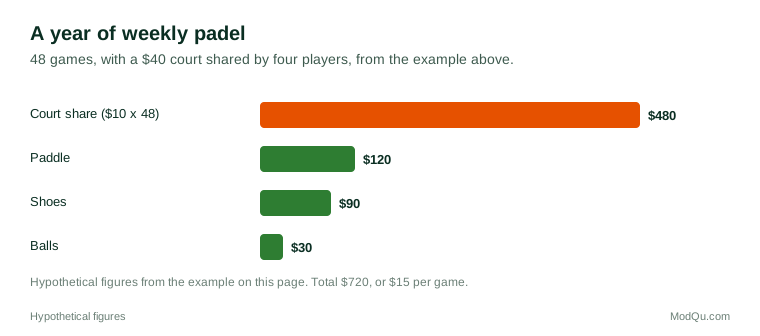
A player books a padel court once a week for 48 weeks. The court costs $40 an hour, shared by four players, so $10 each per game ($480 a year). She also buys a paddle for $120, shoes for $90 and balls for $30 over the year. Her total is $720, or $15 per game.
Because padel and pickleball are played in doubles on small courts, the cost per person for court hire is often lower than for a tennis court of the same price. Tennis club memberships, by contrast, can be expensive in some countries, which has led to concerns that tennis is a sport for wealthier families.
Coaching and improving
Many players take lessons, especially in tennis and squash, where technique is harder to learn alone. Group lessons and clinics are cheaper than private coaching. Ranking systems and apps that rate players' levels help people find balanced games and leagues.
The growth of padel and pickleball
Padel and pickleball have grown quickly in recent years. Reasons people give include:
- they are easy for beginners to learn;
- the smaller courts make them social, with players close together;
- doubles play means lower costs per person;
- they suit a wide range of ages and fitness levels;
- new commercial centres and converted tennis courts have made them easier to find.
Their growth has caused some tension. Some tennis clubs and councils have converted tennis courts for the new sports, upsetting tennis players. Pickleball can be noisy, and some neighbours of courts have complained about the sound.
Example
A town council has four public tennis courts that are often empty on weekdays. It converts one into three pickleball courts. Within a year the pickleball courts are booked every morning, while tennis players complain that weekend tennis is now harder to book. The council adds online booking and splits peak hours between the two sports.
Who plays and barriers
Barriers that people report include the cost of clubs and coaching, lack of nearby courts, difficulty finding partners at the same level, indoor court shortages in cold or rainy climates, and feeling unwelcome at traditional clubs. Badminton and table tennis are often more accessible, as they need little space and cheap equipment.
Watching racket sports
Many players also watch their sport. Professional tennis is followed around the world, especially the four major tournaments, and badminton and table tennis draw large audiences in Asia, particularly at the Olympics and world championships. Padel now has a professional tour with a growing following, and pickleball has professional events and leagues in North America.
People who play are often keener viewers, and watching top players can inspire people to take up a sport or return to it. Clubs and governing bodies often see more people asking about lessons after a major tournament, especially when a player from their own country does well. Questions about watching as well as playing help show how the two are linked.
What people disagree about
Players disagree about whether public tennis courts should be converted to padel or pickleball, whether private clubs should be more open, whether pickleball is a "real" sport, and whether courts should be free or charge fees to pay for maintenance. Fans of each sport often feel strongly that theirs is the best.
Questions that clubs, governing bodies, councils, equipment brands and facility operators want answered include who plays which racket sports, how often, where, what they spend, and what would make them play more.
Key terms
- SinglesA game with one player on each side.
- DoublesA game with two players on each side.
- PadelA doubles racket sport played on an enclosed court with walls, using solid paddles.
- PickleballA paddle sport played with a plastic ball with holes on a small court.
- ShuttlecockThe feathered or plastic projectile used in badminton.
- Court hirePaying to use a court for a set time.
- RallyAn exchange of shots before a point is won.
- Grand SlamOne of the four major professional tennis tournaments.
Full glossary: sports management terms on EditingTests.com.
Tennis and racket sports vocabulary test
How well do you know the language of this topic? Try 8 quick questions. Your score is shown straight away and is not saved.
What the tennis and racket sports survey asks
This survey is part of ModQu's Sports survey. The tennis and racket sports part takes about five minutes and covers:
- Whether you play a racket sport, which one and how often.
- Where you play: public courts, a club, a sports centre, school or at home.
- How much you spend a year on court hire, membership, coaching and equipment.
- How you find partners and book courts.
- Whether you have tried padel or pickleball.
- What stops you playing more.
After that you can choose to continue with other short parts of the Sports survey, such as football (soccer) fans or playing team sports, or stop.
Ready to take part?
Your answers help show what people really think and do. Results are only ever reported as totals; no one can see your individual answers.
Start the surveyQuestions about this survey
Who can take part?
Adults.
Do I have to give my name?
No. You may be asked for your age group, region and similar details so results can be broken down, but not your name. ModQu never asks for passwords, card numbers or account numbers.
How are the results used?
Answers are combined into totals and percentages and published in ModQu reports. Individual answers are never shown.
Is the vocabulary test part of the survey?
No. It is optional and separate, and your score is not stored.