
Share your experience of martial arts
Tell us whether you practise a martial art, whether you watch combat sports and how much you spend on classes. Your answers are combined with other people's and reported only as totals.
Start the martial arts and combat sports surveyAbout 5 minutes. No account needed. You can stop at any time.
What this topic covers
Martial arts are systems of combat and self-defence, many with long traditions, practised for fitness, self-discipline, competition and personal development. Combat sports are competitive contests in which two people fight under rules, with points, knockouts or submissions deciding the winner. The two overlap: judo, karate and taekwondo are traditional martial arts and Olympic sports.
This topic covers both practising and watching:
- which disciplines people practise and why;
- how clubs, classes, belts and gradings work;
- what it costs;
- watching boxing, mixed martial arts (MMA), wrestling and other combat sports;
- safety, injury and the debates around combat sport.
Main kinds of martial arts and combat sports
Common disciplines include:
- Striking arts: boxing, kickboxing, Muay Thai, karate and taekwondo, which use punches, kicks, knees or elbows.
- Grappling arts: judo, wrestling and Brazilian jiu-jitsu, which focus on throws, holds and submissions.
- Mixed martial arts (MMA): a combat sport combining striking and grappling.
- Weapons and traditional arts: kendo, fencing, eskrima and many forms of kung fu.
- Self-defence systems focused on practical situations rather than sport.
- Movement and wellness forms, such as tai chi, practised mainly for balance and health.
Many arts are strongly linked to the countries where they developed, for example judo and karate in Japan, taekwondo in Korea, Muay Thai in Thailand, capoeira in Brazil and wrestling traditions in Iran, Türkiye, Mongolia and many other countries.
Why people practise
People train in martial arts for many reasons:
- Fitness: strength, flexibility and conditioning.
- Self-defence and confidence, especially for people who have felt unsafe.
- Discipline and focus, a common reason parents enrol children.
- Competition, from local tournaments to international events.
- Community: many clubs become close social groups.
- Culture and tradition, including philosophy and etiquette.
- Stress relief: many adults say hitting pads or rolling on mats clears the mind.
Example
A woman in her thirties starts Brazilian jiu-jitsu after a frightening experience walking home. At first she is the only woman in her class and finds the close contact uncomfortable. After a year she trains three times a week, has made close friends at the club, and says the confidence she has gained matters more than the techniques.
Clubs, belts and gradings
Many martial arts use coloured belts or grades to show progress. A student moves up by passing a grading, a test of techniques, forms or sparring, sometimes for a fee. In karate, judo and taekwondo the black belt is often reached after several years of regular training, with further "dan" levels beyond it. Brazilian jiu-jitsu uses fewer belts and often takes a decade or more to reach black belt. Boxing and MMA usually have no belts for students; progress is shown in sparring and competition.
Clubs range from volunteer-run community clubs in school halls to full-time commercial gyms with many classes a day.
What it costs
Typical costs include:
- monthly membership or per-class fees;
- a uniform (gi or dobok) or gloves, wraps, shin guards and mouthguards;
- grading fees;
- licence or insurance fees from a governing body;
- competition entry fees and travel.
Example (hypothetical figures)
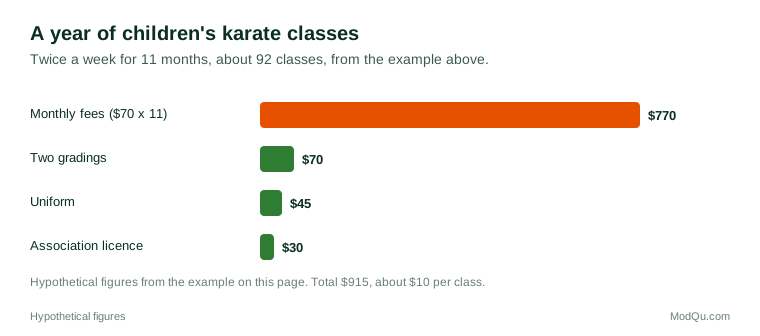
A parent pays $70 a month for a child's karate classes, twice a week, for 11 months of the year ($770). A uniform costs $45, two gradings cost $35 each ($70), and the annual association licence is $30. The year's total is $915, or about $10 per class over 92 classes.
Watching combat sports
Boxing has been one of the most watched sports for over a century, with major fights drawing large global audiences. MMA has grown quickly since the 1990s into a major professional sport. Other popular combat sports to watch include kickboxing, Muay Thai, sumo in Japan, and professional wrestling, which is a scripted performance rather than a real contest but has a large and loyal audience.
Fans watch through:
- pay-per-view purchases for major fights;
- subscription streaming services and sports channels;
- live events in arenas and smaller local venues;
- highlights and clips on social media.
Pay-per-view prices for the biggest fights can be high, and many fans watch together at friends' homes or in bars to share the cost.
Safety and injury
Combat sports involve a risk of injury. Concerns centre on repeated blows to the head, which research has linked to long-term brain injury in some fighters, as well as cuts, fractures and joint injuries. Sports bodies use rules, medical checks, weight classes, gloves, headguards in some amateur competitions and referees who can stop fights. Many clubs separate light technical sparring from full-contact fighting, and many people who train never compete. This page describes the issues and does not give medical advice.
Example
A teenage boxer enters his first amateur competition after two years of training. Before the bout he has a medical check, wears a headguard and larger gloves, and fights three short rounds. His coach stops sparring sessions for a week after the bout so he can recover.
Children and martial arts
Martial arts are among the most popular activities for children in many countries. Parents often value the discipline, respect and confidence taught in classes. Questions parents ask include whether the instructor is qualified and checked to work with children, whether sparring is safe for the age group, and how much pressure there is to buy gradings and extra classes.
Choosing a club
People choosing a martial arts club often compare several things: the instructor's experience and qualifications, the style taught and whether it suits their goals, the atmosphere and how beginners are treated, the class times and location, the cost and contract terms, and whether there are classes for women, children or older beginners. Many clubs offer a free trial class.
Some gyms ask members to sign long contracts or pay for several gradings in advance, which some people later regret. Others charge simple monthly fees with no contract. People who have trained at several clubs often say the instructor and the training partners matter more than the style itself.
What people disagree about
People disagree about whether full-contact combat sports should be allowed, whether children should spar or compete, whether MMA is a sport or entertainment, how traditional arts should balance tradition and practical effectiveness, and whether belts are earned or sold. Fans also argue about which fighters are the best and how judges score fights.
Questions that clubs, governing bodies, broadcasters, equipment brands and promoters want answered include who practises which arts, how often and why, what they spend on classes and equipment, and how and how often people watch combat sports.
Key terms
- Martial artA system of combat and self-defence, often with a long tradition.
- Combat sportA competitive contest in which two people fight under rules.
- MMAMixed martial arts, combining striking and grappling.
- GradingA test to move up a belt or grade.
- SparringPractice fighting with a partner, usually at controlled intensity.
- GrapplingFighting with holds, throws and submissions rather than strikes.
- Weight classA division that matches competitors of similar body weight.
- Pay-per-viewPaying a one-off fee to watch a single event.
Full glossary: sports management terms on EditingTests.com.
Martial arts and combat sports vocabulary test
How well do you know the language of this topic? Try 8 quick questions. Your score is shown straight away and is not saved.
What the martial arts and combat sports survey asks
This survey is part of ModQu's Sports survey. The martial arts and combat sports part takes about five minutes and covers:
- Whether you practise a martial art or combat sport, which one and how often.
- Why you started, and what keeps you training or made you stop.
- How much you spend on classes, equipment, gradings and competitions.
- Whether you watch combat sports, which ones and how.
- Whether you have paid for a pay-per-view event.
- If you have children who train, what matters most to you about their club.
After that you can choose to continue with other short parts of the Sports survey, such as football (soccer) fans or playing team sports, or stop.
Ready to take part?
Your answers help show what people really think and do. Results are only ever reported as totals; no one can see your individual answers.
Start the surveyQuestions about this survey
Who can take part?
Adults.
Do I have to give my name?
No. You may be asked for your age group, region and similar details so results can be broken down, but not your name. ModQu never asks for passwords, card numbers or account numbers.
How are the results used?
Answers are combined into totals and percentages and published in ModQu reports. Individual answers are never shown.
Is the vocabulary test part of the survey?
No. It is optional and separate, and your score is not stored.