
Share how you watch sport
Tell us how you watch live sport, how many sport subscriptions you pay for and which sports you watch most. Your answers are combined with other people's and reported only as totals.
Start the watching sport on tv and streaming surveyAbout 5 minutes. No account needed. You can stop at any time.
What this topic covers
This topic is about how people watch sport on screens rather than in person. It covers:
- the main ways to watch: free-to-air television, pay television, streaming services, and clips and highlights online;
- how many services fans pay for, and what they cost;
- why the rights to different sports and competitions are split between broadcasters;
- where people watch: at home, on phones, in bars, at friends' homes;
- unofficial streams and why some fans use them;
- how younger viewers' habits differ.
How sport reaches screens
Sports leagues, federations and event organizers own the rights to show their competitions. They sell these broadcast rights to television channels and streaming services, usually by country or region and for several seasons at a time. Rights to the biggest leagues and events are among the most valuable content in media, and the money from them is a major income for professional sport.
Rights are often split. One service might show some matches of a league and another the rest. A national team's home games might be on one channel and away games on another. Different competitions, such as a domestic league, a continental club competition and a cup, may each be on a different service.
In many countries, governments protect certain events, such as major national team matches or the Olympics, so they must be shown on free-to-air television. These "listed events" rules exist in the United Kingdom, Australia, several European Union countries and elsewhere.
Ways to watch
Fans use several kinds of service:
- Free-to-air television, paid for by advertising or a licence fee, which shows some major events.
- Pay television packages through cable, satellite or internet TV providers, with sports channels as an add-on.
- Sport streaming services, which offer live sport on phones, computers and smart TVs, often monthly with no long contract.
- League and club direct services, where a league sells its own streaming product.
- General streaming platforms that have added some live sport rights.
- Social media and video sites, which carry highlights, clips and sometimes full live events.
Example
A family in Europe watches the national team's matches on a free public channel, the father pays for a sports streaming service to watch his club's league matches, the mother uses a different app for tennis, and their teenage son mostly watches clips of goals and player highlights on social media. Between them they pay for three services.
How many subscriptions and what they cost
Because rights are split, keen fans may need several subscriptions to follow everything they want. Many fans subscribe only during the season of their main sport and cancel in the off-season, which is easy with monthly streaming services.
Example (hypothetical figures)
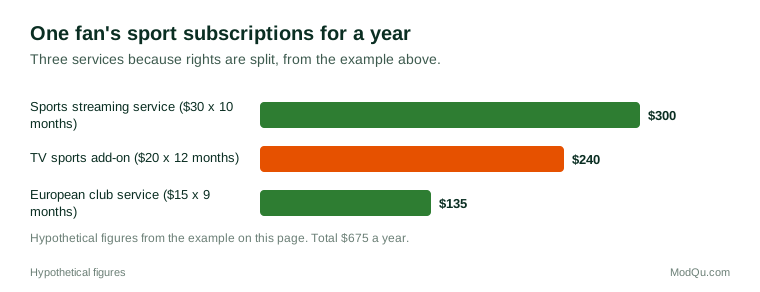
A fan pays for three services: a sports streaming service at $30 a month for ten months ($300), a second service for European club competitions at $15 a month for nine months ($135), and a sports add-on to a TV package at $20 a month all year ($240). Total spending is $675 a year. Without the add-on, which he rarely uses, he would save $240, more than a third of the total.
Fans often say the total cost of watching sport has risen sharply, and complain about paying for several services to follow one team. Others welcome the flexibility of monthly streaming compared with long pay-TV contracts.
Where people watch
Live sport is often watched together. People gather at friends' homes, in bars, pubs and cafés, at public screens during big tournaments and in community viewing centres where home subscriptions are too expensive. Watching on phones has grown quickly, especially in countries where many people's main internet access is mobile.
Many fans use a "second screen" while watching: checking statistics, following social media reaction or messaging friends during the match.
Unofficial streams
Some fans watch sport through unofficial, unlicensed streams. Reasons they give include the cost of several subscriptions, matches not being available in their country, and blackout rules that stop local broadcasts. Rights holders and governments in many countries treat this as piracy and act against illegal streams. Unofficial streams also carry risks of malware and scams. This page describes the issue and does not encourage it.
Changing habits
Viewing habits are changing in several ways:
- Younger fans often watch highlights, clips and social media content more than full matches.
- More people watch on phones and tablets.
- Streaming has replaced pay TV for many households.
- Leagues are experimenting with alternative broadcasts, such as commentary from players or creators, and with multi-game "whip-around" shows.
- Betting, fantasy sports and live statistics are increasingly built into broadcasts.
Example
A 19-year-old says she "follows" four sports closely but has not watched a full match in months. She watches five-minute highlight packages the next morning, follows players on social media and checks scores in an app. She only watches live for finals, usually at a friend's house.
Quality, delay and access
Viewers often compare services on more than price. Picture quality, delays and reliability matter, especially for live sport. Streams can run several seconds or more behind live television, so viewers may hear neighbours cheer or get a score alert before they see a goal. Busy events can also strain streaming services. Commentary language, the choice of camera angles and the ability to pause or rewind are other features fans mention.
Access is a concern for some groups. Older viewers may find apps and smart TVs harder to use than traditional channels, and households with slow internet may not be able to stream at all. In rural areas and some lower-income countries, free television and radio remain the main ways to follow live sport.
What people disagree about
People disagree about whether major events should stay on free television, whether the price of watching sport is fair, whether splitting rights between many services harms fans, whether streaming quality and delays are acceptable, and whether highlights-only viewing is good or bad for sport. Leagues and broadcasters need rights income, while fans want simpler and cheaper access.
Questions that leagues, clubs, broadcasters, streaming services and sponsors want answered include how people watch live sport, how many subscriptions they pay for, what they would pay, which sports they watch most and what would make them cancel or subscribe.
Key terms
- Broadcast rightsThe right to show a competition, sold by its owner to broadcasters.
- Free-to-airTelevision available without a subscription.
- Pay-per-viewA one-off payment to watch a single event.
- BlackoutA rule that stops a game being shown in a particular area.
- Listed eventsEvents a government requires to be shown on free television.
- Streaming serviceA service that delivers video over the internet, live or on demand.
- Second screenA phone or tablet used alongside the main screen while watching.
- HighlightsEdited clips of the key moments of a match.
Full glossary: media streaming platforms terms on EditingTests.com.
Watching sport on TV and streaming vocabulary test
How well do you know the language of this topic? Try 8 quick questions. Your score is shown straight away and is not saved.
What the watching sport on tv and streaming survey asks
This survey is part of ModQu's Sports survey. The watching sport on tv and streaming part takes about five minutes and covers:
- How you watch live sport: free TV, pay TV, streaming, social media, bars or friends' homes.
- How many sport subscriptions you pay for, and roughly what they cost.
- Which sports and competitions you watch most.
- Whether you cancel subscriptions in the off-season.
- Whether you watch full matches or mainly highlights.
- What would make you add or cancel a service.
After that you can choose to continue with other short parts of the Sports survey, such as football (soccer) fans or playing team sports, or stop.
Ready to take part?
Your answers help show what people really think and do. Results are only ever reported as totals; no one can see your individual answers.
Start the surveyQuestions about this survey
Who can take part?
Adults who watch sport.
Do I have to give my name?
No. You may be asked for your age group, region and similar details so results can be broken down, but not your name. ModQu never asks for passwords, card numbers or account numbers.
How are the results used?
Answers are combined into totals and percentages and published in ModQu reports. Individual answers are never shown.
Is the vocabulary test part of the survey?
No. It is optional and separate, and your score is not stored.