
Share your experience of buying a phone
Tell us how old your phone is, why you last replaced it and what you would buy next. Your answers are combined with other people's and reported only as totals.
Start the smartphone brands and upgrades surveyAbout 5 minutes. No account needed. You can stop at any time.
What this topic covers
A smartphone is a mobile phone that works as a small computer, with apps, internet access, a camera and a touch screen. In many parts of the world it is the main or only way people go online. This topic covers:
- the brands and operating systems people choose;
- what features matter most;
- how long people keep a phone and why they replace it;
- whether they buy new, refurbished or second-hand;
- how they pay, including outright purchase, instalment plans and phone contracts;
- what happens to the old phone.
The choice of phone is closely linked to the choice of mobile plan, which is covered in a separate topic, but the two are often bought together.
Operating systems and brands
Almost all smartphones run one of two operating systems, each with its own app store and way of working. One is made by a single company for its own phones; the other is used by many different manufacturers. Once people have used one system for several years, with paid apps, photos and settings stored in it, they tend to stay with it.
Within the system used by many manufacturers, people choose between brands that range from premium flagship phones to very low-cost models. Brands that are well known in one region may be much less common in another, and some manufacturers sell mainly in Asia, Africa or Latin America.
The reasons people give for choosing a brand include:
- trust in its quality and how long its phones last;
- familiarity and not wanting to learn a new system;
- the camera, screen or battery life of a particular model;
- price and value for money;
- how long the maker promises software and security updates;
- what friends and family use, especially for messaging features that work best between phones of the same kind.
Features people compare
People comparing phones usually look at:
- Price and whether it fits their budget.
- Camera quality, often the feature people mention first after price.
- Battery life and how fast the phone charges.
- Storage, because photos, videos and apps fill phones quickly.
- Screen size and quality.
- Durability: water resistance, how well the screen survives drops, and repairability.
- Software support: how many years of updates the phone will receive.
- Dual SIM support, important in places where people use separate SIM cards for work and personal use, or for different networks.
How long people keep a phone
People keep phones for very different lengths of time. Some upgrade every year or two, often on a contract that offers a new phone at the end. Others use a phone for four, five or more years, until it breaks or stops receiving updates. Over time many people have been keeping phones longer, as improvements between models have become smaller and prices of top models have risen.
Common reasons for replacing a phone are:
- the battery no longer lasts a day;
- the phone has become slow or runs out of storage;
- the screen is cracked or the phone has been damaged, lost or stolen;
- it no longer receives security updates or runs needed apps;
- a contract has ended and a new phone is offered;
- the person wants a better camera or a newer model.
Example
A delivery rider's phone is three years old. It still works, but the battery runs out by mid-afternoon and the navigation app is slow. They compare a new mid-range phone with replacing the battery at a repair shop. The battery replacement costs much less, and the phone still receives updates for another year, so they repair it and plan to buy a new phone next year.
New, refurbished or second-hand
People can buy phones in several ways:
- New from the manufacturer, a mobile network or a retailer.
- Refurbished: a used phone that has been tested, repaired if needed, cleaned and resold, usually with a warranty. Refurbished phones are often graded by their cosmetic condition.
- Second-hand: bought directly from another person, through a marketplace or a local shop, usually with no warranty.
- Hand-me-downs from family members, especially for children and older relatives.
Buyers of refurbished and used phones worry about battery health, hidden faults, phones that are locked to a network or still linked to someone else's account, and phones reported as stolen. In some countries, phones reported stolen are blocked from networks using their unique IMEI number.
Example (hypothetical figures)
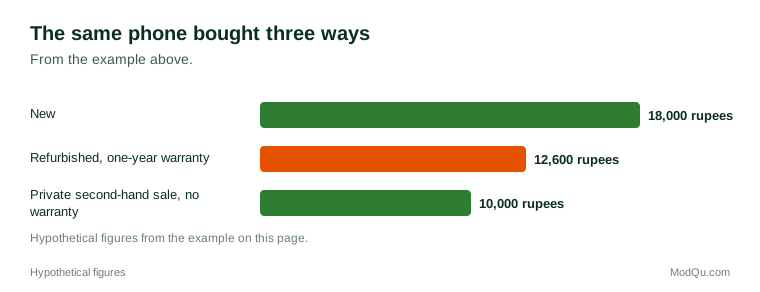
A buyer compares three ways to get the same model. New, it costs 18,000 rupees. A refurbished one with a one-year warranty costs 12,600 rupees, which is 30% less. A private second-hand sale is offered at 10,000 rupees with no warranty. They choose the refurbished phone, paying 2,600 rupees more than the private sale for the warranty and a new battery.
Figure 1 shows the three prices from the example.
How people pay for a phone
Phones can be paid for in several ways, and this varies a lot between countries:
- Outright purchase, paying the full price at once.
- Instalment plans from a retailer or the manufacturer, paying monthly over one to three years, sometimes with interest.
- Contracts with a mobile network that include the phone and a service plan for a fixed term.
- Prepaid, where the phone is bought separately and service is paid in advance. In many countries most people use prepaid plans.
- Trade-in, where an old phone is exchanged for credit towards a new one.
Spreading the cost can make expensive phones seem more affordable, but the total paid over the term can be higher than the outright price, especially if interest or a more expensive plan is included.
What happens to old phones
When people get a new phone, the old one may be:
- kept in a drawer as a spare, which is very common;
- given to a family member;
- sold, traded in or returned to a network;
- recycled at a collection point or shop;
- thrown away with household rubbish, which is discouraged because phones contain batteries and valuable metals.
People who keep old phones often say they are worried about personal data left on them, or are not sure how to wipe them safely.
Example
A couple find four old phones in a kitchen drawer. They factory-reset two that still work and give them to a local charity that passes phones to people who need them. The other two do not switch on, so they take them to a recycling point at an electronics shop.
Trends and debates
Several trends and debates shape this topic:
- Longer lives: people keeping phones for longer, and makers promising more years of updates.
- Right to repair: rules in some places, including the European Union, that aim to make batteries and parts easier to replace.
- Rising prices of top models, and growing interest in mid-range and refurbished phones.
- Foldable phones and other new designs, which some buyers find exciting and others see as fragile or expensive.
- Environmental impact: mining for materials, manufacturing and electronic waste.
Questions that businesses want answered here include how long people keep their phones, what triggers an upgrade, how open they are to refurbished phones, and how much they are willing to pay.
Key terms
- Operating systemThe main software that runs a phone and its apps.
- FlagshipA manufacturer's top, most expensive model.
- RefurbishedA used device that has been tested, repaired if needed and resold, usually with a warranty.
- Unlocked phoneA phone that can be used with any compatible mobile network.
- IMEIA unique number that identifies each mobile phone.
- Software updateA new version of a phone's software, often fixing security problems.
- Trade-inGiving an old device in exchange for credit towards a new one.
- Factory resetReturning a phone to its original settings and erasing personal data.
Full glossary: consumer electronics manufacturing terms on EditingTests.com.
Smartphone brands and upgrades vocabulary test
How well do you know the language of this topic? Try 8 quick questions. Your score is shown straight away and is not saved.
What the smartphone brands and upgrades survey asks
This survey is part of ModQu's Technology at Home survey. The smartphone brands and upgrades part takes about five minutes and covers:
- How old your current phone is, and which kind of phone it is.
- Why you last replaced your phone, and what you did with the old one.
- Which features mattered most when you chose your phone.
- Whether you bought it new, refurbished or second-hand, and whether you would buy refurbished.
- How you paid: outright, in instalments, on a contract or with a trade-in.
- When you expect to replace your phone, and what you would look for next time.
After that you can choose to continue with other short parts of the Technology at Home survey, such as smartphones and mobile apps or internet and mobile plans, or stop.
Ready to take part?
Your answers help show what people really think and do. Results are only ever reported as totals; no one can see your individual answers.
Start the surveyQuestions about this survey
Who can take part?
Adults who own a smartphone.
Do I have to give my name?
No. You may be asked for your age group, region and similar details so results can be broken down, but not your name. ModQu never asks for passwords, card numbers or account numbers.
How are the results used?
Answers are combined into totals and percentages and published in ModQu reports. Individual answers are never shown.
Is the vocabulary test part of the survey?
No. It is optional and separate, and your score is not stored.