
Share your experience of internet and mobile plans
Tell us which plans you have, what you pay and whether you would switch. Your answers are combined with other people's and reported only as totals.
Start the internet and mobile plans surveyAbout 5 minutes. No account needed. You can stop at any time.
What this topic covers
This topic covers the two connections most households pay for each month:
- Home internet, delivered by fibre, cable, DSL over phone lines, fixed wireless, or satellite.
- Mobile plans, which give a phone (or tablet or watch) calls, texts and mobile data.
It also covers the companies that sell them, the way plans are priced and bundled, customer service, and what people do when they are unhappy. In Canada, these services are regulated at the federal level by the Canadian Radio-television and Telecommunications Commission (CRTC). In the United States the Federal Communications Commission (FCC) has a similar role.
Kinds of home internet
The technology at an address often decides what is possible before any choice is made:
- Fibre carries data on light through glass cables and usually gives the fastest and most even speeds, including fast upload.
- Cable uses the same coaxial lines as cable television and offers fast download speeds, with slower upload.
- DSL runs over copper telephone lines; speed drops the farther the home is from the equipment.
- Fixed wireless sends a signal from a tower to an antenna on the home and is common in rural areas.
- Satellite reaches almost anywhere, including remote communities, and newer low-orbit services have cut the delay that older satellite service had.
People in cities often have a choice of two or more networks. People in rural and northern areas may have one option or none at a good speed, which is why rural access is a long-running public policy topic in Canada.
How people choose a plan
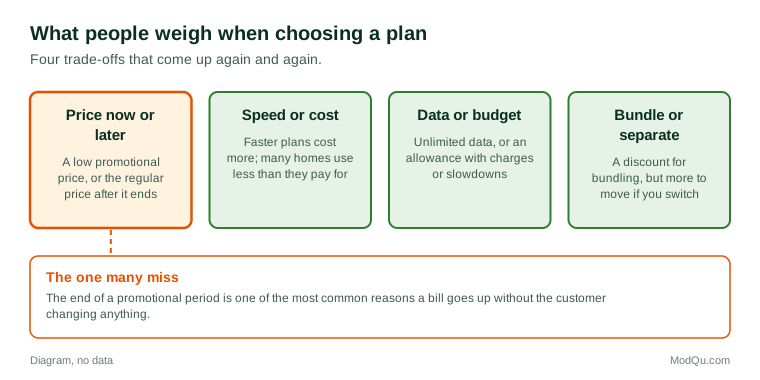
When people compare plans they weigh a few things:
- Price, and how much it will rise after a promotional period ends.
- Speed, usually advertised as the maximum download speed in megabits per second (Mbps).
- Data: home internet is often unlimited, while mobile plans may set a data allowance or slow speeds after a limit.
- Coverage and reliability, especially for mobile service outside cities.
- Contract terms, including whether there is a fixed term and what it costs to leave early.
- Bundles with television, home phone, mobile or home security.
Many households pay for more speed than they use. A household of two that streams video and works from home may be well served by a mid-tier plan, while a large household with several people gaming, streaming and uploading video at once may notice the difference with a faster one.
Example
A family moves to a new subdivision where both a fibre provider and a cable provider are available. The cable provider offers a lower price for the first year. The fibre provider costs a little more but has faster upload speeds, which matter because one parent sends large design files for work. They choose fibre and set a reminder to review the price in a year.
Mobile plans and the phone
Mobile plans are sold in several ways:
- Postpaid plans, billed each month after use, often with a phone on an instalment plan.
- Prepaid plans, paid in advance, which suit people who want a set cost or who have no credit history.
- Bring your own device plans for people who own an unlocked phone.
- Family or shared plans that combine several lines for a discount.
Phone financing has become common. The monthly bill may include an instalment for the phone, which makes the plan look more expensive than it is, or a discount that ends when the phone is paid off. People are often unsure how much of their bill is the phone and how much is the service.
Example (hypothetical figures)
A customer pays $95 a month: $55 for the plan and $40 for the phone, spread over 24 months. After the phone is paid off, they keep paying $95 for three more months before noticing. The three extra months cost them $120 for a phone they already owned, until they call and have the bill corrected to $55.
The example is made up, but the pattern of not checking a bill closely is a common subject in research on telecommunications.
Bills, price rises and promotions
Common reasons bills go up include:
- a promotional price ending, often after 12 or 24 months;
- extra charges for going over a data allowance or roaming in another country;
- equipment rental for a modem or router;
- added services, such as streaming add-ons;
- general price increases announced by the provider.
Many people find a better price by calling their provider and asking, sometimes by saying they are thinking of leaving. This works for some customers and not others, and some people find the process stressful.
Switching providers
Switching is easier than it used to be. In Canada, mobile customers can keep their phone number when they move to another carrier, and the CRTC's Wireless Code sets rules on contracts, cancellation and unlocking. Even so, many people stay with their provider for years.
Reasons people give for switching include:
- a lower price elsewhere;
- poor speeds, dropped connections or outages;
- bad customer service or a billing dispute;
- a move to an address served by a different network.
Reasons people give for staying include the effort of the change, fear of losing service during installation, bundles that would all need to move together, and a belief that all providers are about the same.
Example
A renter shares an apartment with two roommates who work from home. After a week of evening slowdowns, they test the speed at different times and find it drops sharply after 7 p.m. They switch to another provider on the same street. The installation takes five days, so they use phone hotspots in the meantime.
Complaints and help
When a problem cannot be solved with the provider, customers in Canada can go to the Commission for Complaints for Telecom-television Services (CCTS), an independent organization that handles complaints about telephone, internet and television services. People often do not know this option exists. Questions businesses and public bodies want answered include how many people have had a problem in the last year, whether it was resolved, and how many knew where to complain.
What people disagree about
Opinion is divided on several points: whether prices in Canada are fair compared with other countries, whether the government should do more to bring in competition, whether unlimited data is worth paying for, and how quickly rural areas should get faster service. Surveys repeated over time help show how these views change as prices and technology change.
Key terms
- MbpsMegabits per second, a measure of internet speed.
- Upload speedHow fast data travels from your device to the internet.
- Data allowanceThe amount of mobile data included in a plan each month.
- RoamingUsing your mobile plan on another carrier's network, often abroad.
- Promotional priceA lower price for a set period before the regular price applies.
- BundleTwo or more services, such as internet and TV, sold together.
- Prepaid planA mobile plan paid for in advance.
- Number portingKeeping your phone number when you change carriers.
Full glossary: internet service providers terms on EditingTests.com.
Internet and mobile plans vocabulary test
How well do you know the language of this topic? Try 8 quick questions. Your score is shown straight away and is not saved.
What the internet and mobile plans survey asks
This survey is part of ModQu's Technology at Home survey. The internet and mobile plans part takes about five minutes and covers:
- Which home internet and mobile providers you use, and how long you have had them.
- What you pay each month, and how satisfied you are with the price.
- How satisfied you are with speed, coverage and reliability.
- Whether you bundle services, and why.
- Whether you have switched provider in the last two years, or thought about it.
- Any problems or complaints you have had, and how they were handled.
After that you can choose to continue with other short parts of the Technology at Home survey, such as smartphones and mobile apps or smart home devices, or stop.
Ready to take part?
Your answers help show what people really think and do. Results are only ever reported as totals; no one can see your individual answers.
Start the surveyQuestions about this survey
Who can take part?
Adults who pay for internet or mobile service.
Do I have to give my name?
No. You may be asked for your age group, region and similar details so results can be broken down, but not your name. ModQu never asks for passwords, card numbers or account numbers.
How are the results used?
Answers are combined into totals and percentages and published in ModQu reports. Individual answers are never shown.
Is the vocabulary test part of the survey?
No. It is optional and separate, and your score is not stored.